3 months ago
23
3 months ago
23
A decade ago the Herald examined what Sydney would look like and how it would function in 2026. Here is what did get done - and what needs to be done next.
See all 3 stories.A decade ago, public scepticism about Sydney realising plans for major new public transport ran deep after years of failed promises by previous NSW Labor governments. If it did eventuate, the biggest wave of transport construction the city had seen for generations was expected to have run its course by 2026.
As 2026 begins, the ensuing boom in transport mega-projects might be near its peak but has at least another five to seven years to run. The sheer scale of projects Sydneysiders have become accustomed to over the past decade often astounds visitors from Australia’s other capital cities.
Illustrating the size of the build in Sydney, driverless trains are now running along more than 51 kilometres of the 113 kilometres of planned metro lines, while more than two-thirds of 74 kilometres of new motorways – much of which are underground and tolled – are open to traffic.
The cost to construct them is equally staggering. Sydney’s three autonomous metro rail lines are now forecast to cost up to $72 billion by the time the last is opened in 2032. The bill to build motorways such as WestConnex and upgrades to those they connect to is about $40 billion.
Aside from the capital cost, the expanding rail network is compounding the pressure on the public purse each year. Fares for public transport cover less than one-fifth of operating costs.
Despite hurdles, Sydney has undoubtedly exceeded expectations of a decade ago, revealed in a 2016 Herald series titled Sydney 2026: How we will live and how our city will work in 10 years.
“It’s an amazing transformation,” University of Technology transport researcher Mathew Hounsell said. “When plans for this were first released, I assumed it would not get done. I’m amazed at its success and that we’re still going.”
Overshadowed by the larger metro projects, a $3.1 billion light rail line between Circular Quay and Randwick and Kensington in the south-east has transformed a CBD main street once dominated by buses and cars, and proved popular for commuters. Less so the $2.9 billion first stage of a light rail which runs through the heart of Parramatta, while a 10-kilometre extension of it to Olympic Park remains an unfulfilled election promise of the Minns government.
Loading
Yet, the biggest transformation in decades for Sydney’s rail was realised almost 18 months ago when a driverless metro train line under the harbour and the CBD opened, reshaping the way commuters traverse the city.
However, the cost of the city and southwest sections of what is now known as the M1 line is now forecast to be as much as $23 billion, double the price tag a decade ago. And the south-west section between Sydenham and Bankstown was originally meant to open in 2024 but is now set to be as late as September due to challenges converting heavy rail to metro train standards.
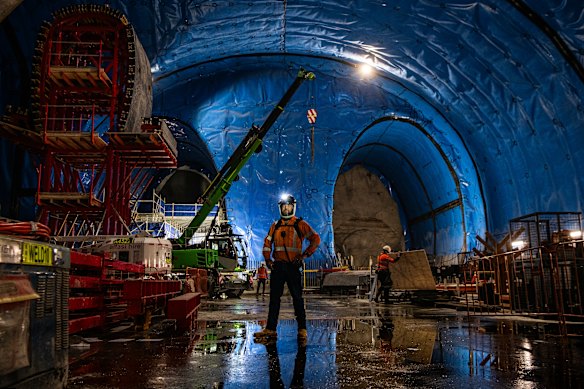
A giant cavern for the Metro West train station beneath Hunter Street in the Sydney CBD.Credit: Steven Siewert
While work on the M1 line was well advanced a decade ago, plans for another metro rail project along Sydney’s east-west spine were in their infancy. In 2016, the then-Baird government unveiled preliminary plans for a metro line between the central city and Parramatta, which it hoped would open in the second half of the 2020s. Under revised timelines, Metro West is now scheduled to open in 2032 at a cost of up to $29 billion.
Loading
Hounsell gives much of the credit for what has emerged to the ambition of former Coalition transport minister and premier Gladys Berejiklian.
“Gladys Berejiklian was ambitious. London did the Elizabeth line, which was phenomenal. But we have done more, and we are still going,” he said.
“When the [metro line between Sydenham and Bankstown] opens, it will shift how we will see the inner south-west. You will find people look differently at Bankstown as a major centre. Metro West will also change the way we see Parramatta.”
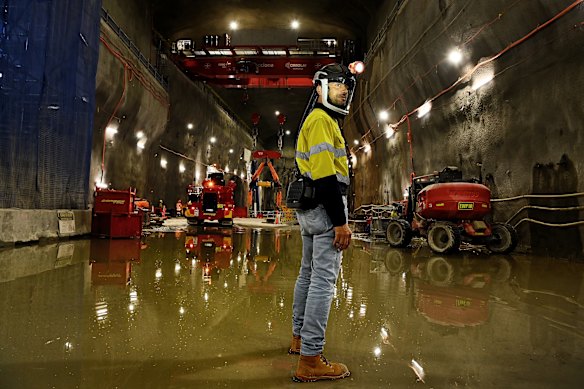
Acciona plant manager Leonardo Pia in one of two chambers beneath Birchgrove where giant boring machines will start digging the final part of the Western Harbour Tunnel.Credit: Kate Geraghty
Sydney also faces at least another three years of construction on committed motorway projects. The $7.4 billion Western Harbour Tunnel will allow drivers to bypass the CBD when it opens in late 2028, linking the WestConnex motorway under the inner west to the Warringah Freeway in the north.
Loading
In Sydney’s south, the opening of a four-kilometre underground motorway known as the M6 has been delayed by at least three years to the end of 2028 after two sinkholes forced a halt to construction on unfinished tunnels at Rockdale. It has left the government locked in negotiations since 2024 over an engineering solution and liability for delays and altered construction.
Within months, attention will quickly turn to Sydney’s outer western fringe. The opening of Sydney’s second international airport is set to become a reality late this year, four decades after the Hawke Labor government announced Badgerys Creek as the site and started land acquisitions.
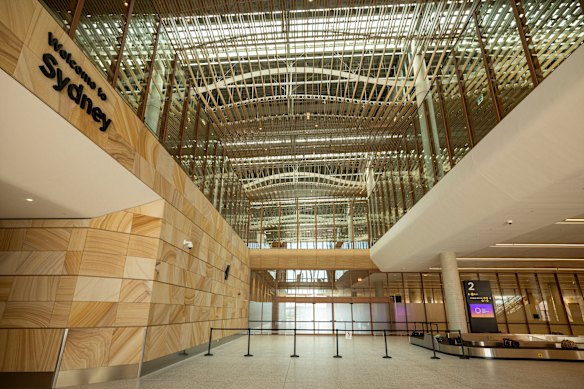
The baggage hall inside the new airport.Credit: Sitthixay Ditthavong
Before the first passenger planes are due to take off, the new M12 motorway connection to the curfew-free airport is expected to open in March. However, a 23-kilometre metro rail line to the airport is now due to open a year late in December 2027 and at least $1 billion over budget.
While the past decade has beaten expectations, the next 10 years are likely to disappoint those eager to see another bout of transport mega-projects.
Martin Locke, an adjunct professor at Sydney University’s Institute of Transport and Logistics Studies, said there was a lack of transparency regarding the next generation of major transport projects, such as the second stage of the Parramatta light rail line.
Loading
“What is being delivered is basically everything that was scheduled by the previous government. What is being added to the pipeline?” he asked. “We have entered a period where we are treading water.”
Amid ballooning costs, the NSW Labor government has indicated a pause will be put on future extensions or construction of new metro lines. Premier Chris Minns has repeatedly made clear that he will prioritise the heavy rail passenger network over committing to extra metro projects. “We believe that the transport system has been robbing Peter to pay Paul. Metros have been fantastic for Sydney but spending on the metros can’t come at the expense of the heavy rail network,” he said recently.
That is despite a government-commissioned review into Sydney Metro in late 2023 recommending the state prepare an “actionable road map” for investing up to $4 billion annually over 25 years in expanding the driverless train network.
Likewise, the Minns government has shown little appetite for injecting money into the Commonwealth’s ambitious plans for high-speed rail between Sydney and Newcastle, as part of the first stage of an east coast line.
The past decade could well be the high-water mark in Sydney’s transport revolution, although the advent of artificial intelligence makes predictions of the future for any sector a fraught exercise.