3 months ago
4
3 months ago
4
By Evelyn Tran
November 25, 2025 — 7.30pm
Think back to when you were in high school. Do you remember scanning a key card through a turnstile to mark yourself present for the day? Or hiking up 10 flights of stairs to get to class?
For students like me, that is just a normal school day.
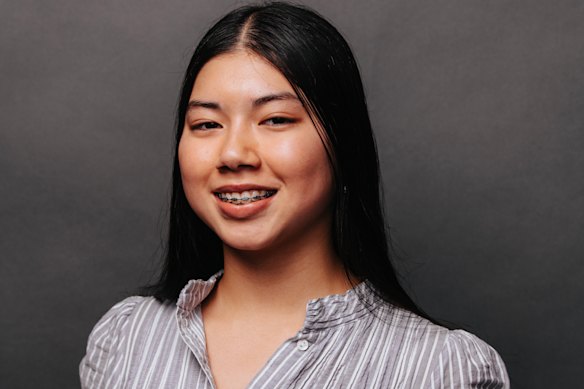
Arthur Phillip High School, Parramatta student Evelyn Tran is in year 10.Credit: James Brickwood
When I first walked in to Arthur Phillip High School in the Parramatta CBD as a 12-year-old, the building felt overwhelming. The height, the layout and the flow of people between levels were all things I had to get used to.
All of this may sound unusual for a high school – after all, those experiences are more like entering a modern office building.
Arthur Phillip is NSW’s first high-rise public high school, so that makes our schooling experience a little different to others’.
We start our day by taking the train, bus or light rail to Parramatta station then walking for about seven minutes. When we get to the gates, though, things work a little differently.
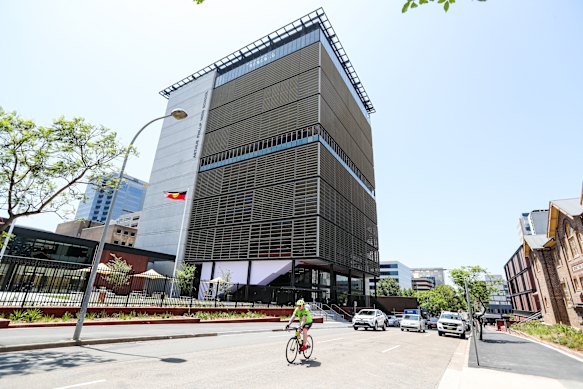
The high-rise Arthur Phillip High School in Parramatta.Credit: SMH
Instead of a traditional roll call, we use our key cards to mark our attendance for the day. If you forget your card, are running late or not at school, parents are notified by SMS. Once we’re through the gates, the real climb begins.
And we are literally talking about stairs, lots of stairs. We take up to 10 flights just to get to class every morning. But the number of flights depends on which year group you are in, and each “level” is the year group’s home base, where all classes are held. My year, year 10, is on level six, which means scaling 10 flights of stairs.
This is our equivalent of our parents’ “back in my day, we used to have to trek through the jungle just to get to school”. It was exhausting at first, but you get used to it.
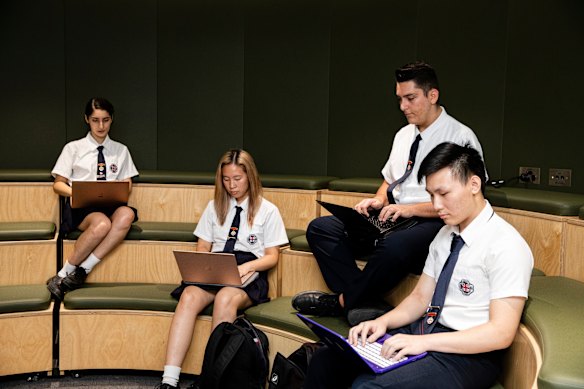
Students at work in one of Arthur Phillip’s iHubs.Credit: Dominic Lorrimer
A lot of people wonder, shouldn’t a high-rise school have lifts. The building does have lifts, but they are reserved for teachers and senior students on higher levels.
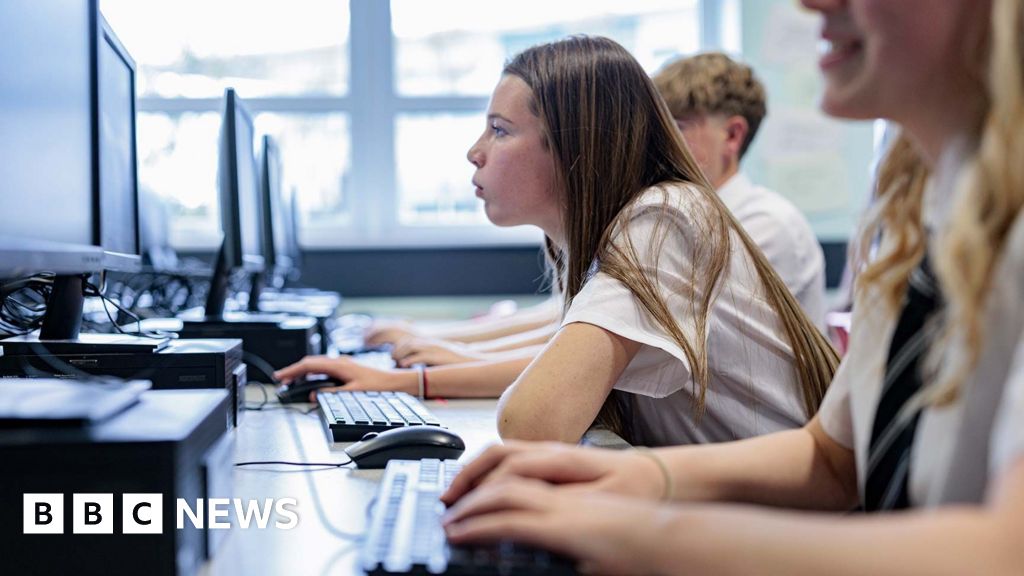
At 8.45am we head to our first class. Each student is expected to have a laptop or iPad, an exercise book and basic stationery. But, sometimes, not all classes require notebooks and pens as the majority of our classwork is completed online. Even our textbooks are online.
In a way, it feels like Arthur Phillip is preparing us for the corporate world where laptops are at the centre of the work.
Another difference we have from traditional schools is that each home base has an open learning area that spans the majority of the floor. Here, three to four classrooms are situated, mine included. It can get a bit loud with different classes working side by side, but you adapt to it.
We also have surrounding closed classrooms on one side of the home base which have full glass walls, allowing you to see in and out.
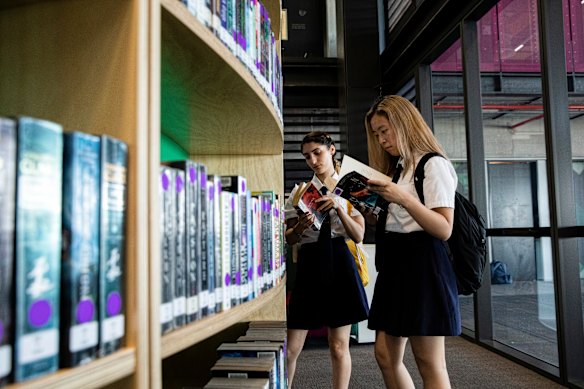
Students choose books from their stage-appropriate library. Credit: Dominic Lorrimer
Because of these design features, it is very rare for junior classes to move classrooms each period. So instead, the teachers move around the levels every period – not a bad set-up for us, honestly.
Traditional schools have a communal library for all students and teachers but, in our case, the school’s design doesn’t grant us that luxury. Instead, each home base has an iHub, which is a sound-proof cylindrical-shaped room with tiered seats. It’s typically used to watch documentaries or present speeches. It’s one of the quieter spots, which I appreciate.
Each iHub has built-in surrounding shelves that house books specifically chosen for the year group on that level, based on genre, content and maturity. So, you wouldn’t be able to find The Merchant of Venice in the year 7 library.
Loading
One of my favourite features about our school’s schedule is the 20- to 30-minute recesses in between each 75-minute period, allowing us to reset our minds and release some energy before each class.
My favourite time of the day is home time. The best part is the location of our school, near Parramatta Westfield. It is common for us to grab a quick snack or drink from the food court before we head home.
All these routines don’t just shape our day, they’ve shaped me as a student, too.
Climbing numerous flights of stairs, relying on a laptop for almost all of my work and navigating busy shared spaces was the opposite of what I was used to in primary school. Eventually, they just became part of my regular day.
Loading
The school’s design has shaped the way I learn. Open areas and constant movement mean you don’t always get a quiet classroom, so you end up figuring out how to focus in different environments.
Life at Arthur Phillip comes with its own rhythm. It is different from a typical high school, sometimes challenging, but these routines and spaces are what make being a student here a unique and rewarding experience.
Evelyn Tran is a Herald work experience student from Arthur Phillip High School.
Most Viewed in National
Loading