3 months ago
23
3 months ago
23
Life in the ’Burbs is a series that highlights the good, bad and beautiful of Brisbane suburbs. Writers from around the city are penning love letters (mostly) to their suburbs every week.
More than a decade ago, when my husband and I were searching for our first home, we landed on Annerley – the perpetual “up-and-comer” of Brisbane’s southside.
Neighbouring suburbs Tarragindi, Greenslopes and Fairfield had already been swept up in the property boom, but Annerley still had grit, and the lingering sense someone might rob you in broad daylight.
Just recently, our neighbour had their home scoped out at 9 in the morning. Security footage showed a would-be burglar checking the place out with a crowbar casually in hand. It was a reminder that the edges around here can still fray. Yet most of the “characters” wandering the streets are more eccentric than threatening.
But then, who gets to belong in a suburb in flux? How does a community reinvent itself without sanding off the stories that give it texture?
When we first arrived, Annerley felt diverse, dynamic and unapologetically rough around the edges. Students, pensioners, artists, shift workers, families, people doing it tough, newcomers seeking affordability, and long-timers who had weathered every wave of change all lived within those streets on either side of its Ipswich Road spine.
The suburb’s architectural landscape mirrored this mix: social housing blocks tucked beside modern apartments; heritage Queenslanders beside small-unit complexes; as well as the mid-century cool of Annerley Arcade and the library.
Sometimes the chaos – the 3am arguments drifting down the street, or the stranger who followed me through Woolworths only to disappear the moment I alerted staff – felt like reminders of the city’s harder edges, but they, too, belonged to the strange, uneven fabric of the suburb.
As an Asian-Australian, I’ve always felt in relatively good company here. With 36 per cent of residents having both parents born overseas (a figure that has been declining), Annerley was not as diverse as student-dense pockets such as Toowong, but not as conspicuously white and polished as New Farm.
Now, with our five-year-old on the cusp of graduating kindy, we’re reassured knowing that more than 60 cultural backgrounds are represented at the local state school. Last week, an older child of Asian descent smiled and said good morning as they crossed our path, and I felt an immediate, unspoken comfort. This everyday diversity matters: the kind that will shape our child’s world, the friendships they’ll form, and the stories they’ll inherit about what it means to grow up, and to belong, in Australia.
Before it was Annerley, it was known as “Boggo”, a name used in the mid-19th century to describe its swampy, scrubby terrain threaded with creeks. Long before that, the Jagera people lived along watercourses such as Norman Creek. The creek’s recent story is one of degradation and restoration, flood risk and community-led care. When our baby was born in 2020 we spent countless hours during COVID in the parklands that border the creek, tracing the same bends each day.
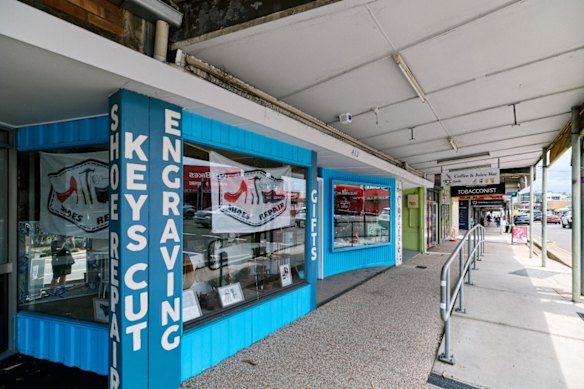
Mid-century shopfronts on Ipswich Road, Annerley. Credit: Markus Ravik
Later, while working on a photographic project with the Museum of Brisbane, I came across an archival image in the John Oxley Library depicting Chinese market gardens that once were planted along the creek – a quiet thread of history that felt strangely personal. From the 1880s onwards, Chinese gardeners leased land along many of Brisbane’s creeks, using the natural water access to grow fruit and vegetables. I suddenly felt connected to Annerley’s history in a way I hadn’t anticipated.
At just 6.5 kilometres from the CBD, with bike paths linking us to Stones Corner, Greenslopes and Tarragindi, Annerley is an ideal spot for cyclist-commuters. Our mornings begin with the ride to kindy, which is safe enough for our five-year-old to traverse on his own two wheels. Some bike lanes end abruptly, leaving us to navigate a busy intersection with a youngster. We don’t mind, as it’s an opportunity to teach him road safety.
Our local Vietnamese, Cafe O-Mai, always smells heavenly. I am a sucker for their Bun Bo Hue (spicy noodle soup), and the lychee mint frappe is especially appreciated on a sweltering hot Brisbane day. Japanese cuisine is my weakness, so the Fuji Mart at Buranda Village and Hanaro Mart in Woolloongabba (which we in Annerley claim with the same confidence Australia claims pavlova from New Zealand) are regular haunts.
With the Princess Alexandra Hospital down the road, emergency services buzz around us. That frenetic energy feels oddly comforting – it reminds me of my childhood on the Sunshine Coast’s Nicklin Way, with car crashes and drunken arguments part of the everyday soundtrack.
As I write this piece I can hear the distant thrum of a helicopter circling overhead, and someone hooning up or down the highway. My light-sleeper husband is used to it now, and our five-year-old sleeps like a log. In this small, ordinary moment, I realise how much this place has seeped into our family’s rhythm.
The sirens, the neighbours we know by name, the creek paths we’ve walked and ridden almost daily, have become markers of a life quietly taking shape. The contradictions that once felt jarring have softened into familiarity. Maybe belonging is just that: the point when a place’s oddities begin to feel like your own.
Most Viewed in National
Loading