3 months ago
27
3 months ago
27
London: There is a fury beneath the careful reaction in Europe to Donald Trump over his demand for Greenland – and it is hardening opinions about how to respond.
For the Europeans, it does not seem that long since they sent their young men and women to help the Americans in Afghanistan and Iraq after the twin towers fell in New York.
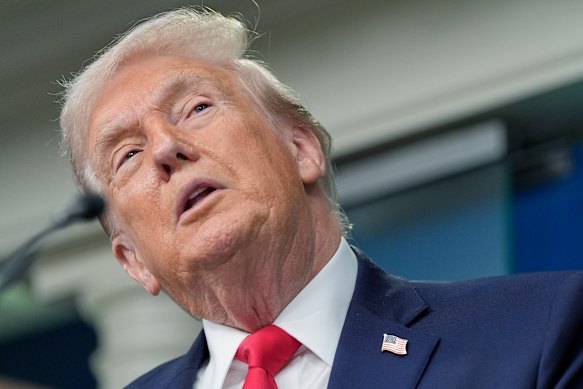
US President Donald Trump at the White House on Tuesday.Credit: AP
More than 850 soldiers from European allies died in Afghanistan alone during the war against terrorism, as part of an operation backed by NATO.
Now, under Trump as its president, the US is threatening its allies with economic pain in a brazen bid to seize Greenland, part of the Kingdom of Denmark, an American ally for eight decades.
Anders Fogh Rasmussen, a former prime minister of Denmark, says he is in a state of “angered disbelief” at the threats after 52 Danes gave their lives in Iraq and Afghanistan.
“We must draw an impassable line in the snow of Greenland,” he writes in The Economist this week.
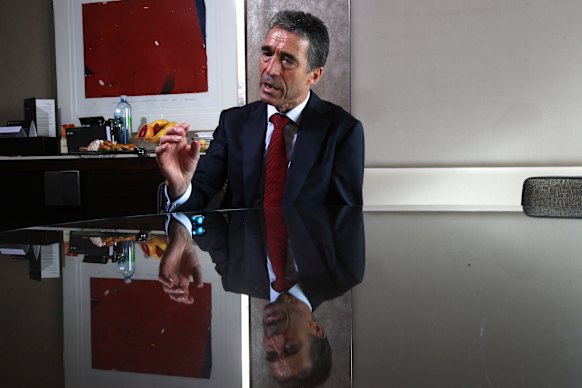
Former Denmark prime minister Anders Fogh Rasmussen in 2012.Credit: Nick Moir
“In the aftermath of Russia’s full-scale invasion of Ukraine, Europe sought to ensure we could never again be blackmailed. Yet today, we find ourselves again contending with the hostility of autocratic power politics, as our closest ally makes clear that alliances forged by the fire of history mean nothing to it at all.”
On the surface, European leaders are trying to look calm. British Prime Minister Sir Keir Starmer says he wants to avoid a trade war in response to Trump’s threat of 10 per cent tariffs next month, rising to 25 per cent in June. European Commission President Ursula von der Leyen is being firm, but not inflammatory.
French President Emmanuel Macron, however, is publicly pushing for drastic action: the use of the “trade bazooka” at the European Union to apply sweeping trade and investment sanctions on the US.
Loading
Rasmussen backs this approach. “Mr Trump may think he holds all the cards, but Europe could inflict the biggest trade blow ever dealt to the American economy. Such a move would of course have repercussions for Europe, but as history tells us, polite appeasement can have far greater consequences.”
Appeasement. It is telling that Europeans are now using a word loaded with meaning from the war against Adolf Hitler and applying it to Trump.
This leads to a more assertive European response. How assertive will it get? In this trade fight, Europe could learn from China.
Until now, Europe has naturally treated the US as a friend in talks to prevent high tariffs, while China responded like a competitor, if not an outright adversary.
Chinese President Xi Jinping did not rush to hold a summit with Trump to stop the tariffs, but ordered a retaliation that raised the cost for the White House. China raised tariffs on soybeans, for instance, so that American farmers felt the pain.
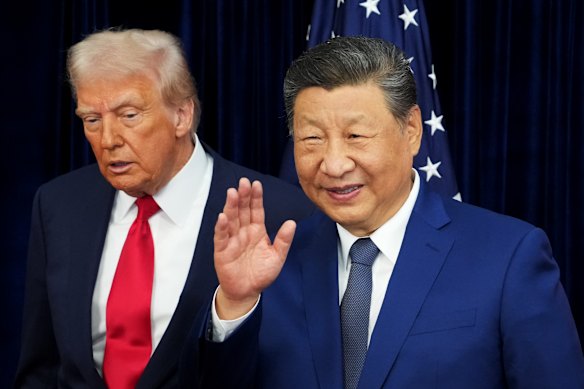
Trump and Chinese President Xi Jinping in October.Credit: Getty Images
Beijing also deployed some strategic leverage by threatening to withhold the critical minerals the US tech sector desperately needs.
This is not an argument in favour of trade wars. No side will win from an escalation. With Trump, however, you get a trade war no matter what you do.
On any assessment, the softer European response to Trump has failed. The US president looks for strength and weakness in his opponents. He saw the Europeans rush to mollify him on tariffs, so he uses the same threats again.
Loading
The imminent test for the European leaders will be on the sidelines in Davos, where German Chancellor Friedrich Merz, von der Leyen and others are likely to meet Trump after he speaks to the World Economic Forum on Wednesday, Switzerland time. Will they greet him with hearty handshakes, or will their anger show?
Europe lacks the strategic power of China. Its economy is smaller and it is reliant on the US for defence. It cannot threaten a ban on critical minerals. Most of all, it is a cacophony of democratic voices and not an autocracy.
Even so, it is an economic power in its own right. When measured by purchasing power parity, the EU makes up 14 per cent of the world economy, behind the US (at 15 per cent) and China (at 20 per cent), according to the International Monetary Fund. (The US looks bigger when measured in its own currency, of course).
The “bazooka” proposed by Macron goes beyond tariffs. It also covers intellectual property rights, access to financial markets and limits on foreign investment – many of the key factors for global US companies. And, of course, the EU buys $US3.6 billion ($5.4 billion) worth of US soybeans each year.
Europe may crumble under the pressure from Trump. The UK has different interests to the EU, especially on defence, and unity is often elusive within the EU. Almost every major European leader is unpopular right now: Starmer, Macron and Merz are all down in the polls.
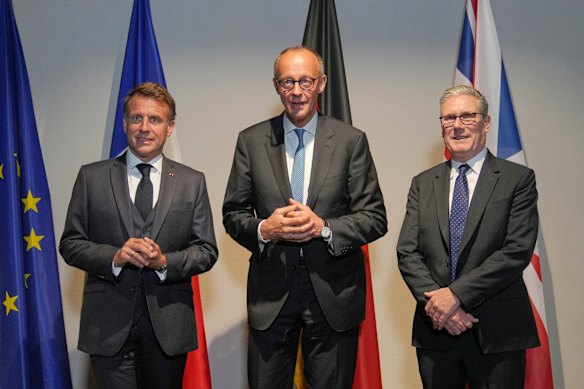
French President Emmanuel Macron, Germany’s Chancellor Friedrich Merz and British Prime Minister Keir Starmer.Credit: Getty Images
There is also a tendency in the media to blame these leaders for what Trump is doing. This is especially so in Britain, where much of the press has turned on Starmer over his poor political judgement. In truth, of course, any leader would struggle to keep their footing in the Trump tornado.
This is because Trump is rewriting the terms of the transatlantic alliance so rapidly. All nations can change their strategic policies, but Trump is doing it abruptly and chaotically, barely one year after the previous US president assured Europeans about the strength of their alliance. And he is doing it when NATO members have a war with Putin on their eastern flank.
It is no surprise that Europeans see that as a betrayal – even bastardry. The anger is real, and Rasmussen gives voice to it by calling for a strong retaliation against Trump on trade.
“Mr Trump, like Vladimir Putin and Xi Jinping, believes in power and power only,” he writes. “Europe must prepare to play by those same rules.”
Get a note directly from our foreign correspondents on what’s making headlines around the world. Sign up for our weekly What in the World newsletter.
Most Viewed in World
Loading