3 months ago
9
3 months ago
9
By Jon Gambrell and Fatma Khaled
November 6, 2025 — 7.30pm
Dubai: The first images showed blood stains on the sand and bodies. Now, fresh satellite images suggest the next step of a large-scale massacre of civilians is under way in the Sudanese city of El Fasher, which fell to a paramilitary force 11 days ago after an 18-month siege.
The images, analysed by the Yale School of Public Health’s Humanitarian Research Lab, show what appear to be mass burials being conducted this week in El Fasher, in Darfur – trenches, disturbed earth, and more apparent bodies.
“We’re seeing a velocity of killing that can only be compared to the Rwandan genocide,” Yale lab executive director Nathaniel Raymond told CNN this week, saying sources had told his lab that thousands of people were dead.
“We are looking at a mass casualty event that could exceed in a week the amount of people who have died in two years in Gaza. That’s the speed of killing we’re at based on what we’re seeing with piles of bodies on the ground.”
Paramilitary group Rapid Support Forces (RSF) seized El Fasher on October 26 after trapping and starving its population of 260,000 people amid a brutal two-year civil war against the Sudanese army.
The latest images taken over two sites in the city over the past week offer evidence of mass trench and kettle-pit graves being dug and later covered – at a mosque just north of the Saudi hospital, where some 460 people were reportedly killed, and beside a former children’s hospital that the RSF had been using as a prison, the Yale researchers said
“This activity appears consistent with RSF conducting clean-up of their alleged mass atrocities,” the Yale lab said in its latest report. “It is not possible based on the dimensions of a potential mass grave to indicate the number of bodies that may be interred; this is because those conducting body disposal often layer bodies on top of each other.”
International Criminal Court prosecutors said on Monday they were collecting evidence of alleged mass killings and rapes in the city, but the scope of the overall violence in El Fasher remains unclear because communications are poor in the region.
And as it’s likely bodies are now being buried, that also makes any full accounting of the city’s seizure that much more difficult, particularly as investigators would need to dig the bodies up in an area now held by the warring party that allegedly committed the atrocities.
“The crimes that are being committed are so horrendous,” United Nations Secretary-General Antonio Guterres said on Tuesday, warning the war in Sudan was “spiralling out of control” and calling for “mechanisms of accountability” over what had taken place in El Fasher.
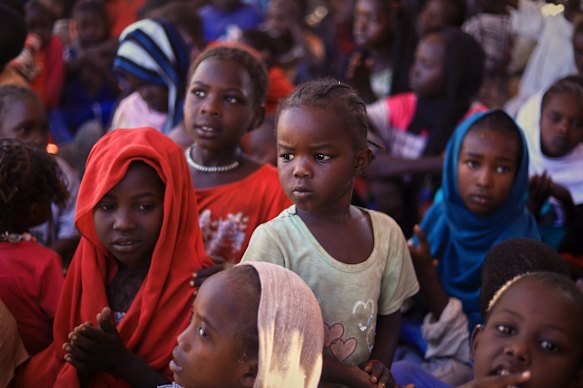
Children from El Fasher find safety at a refugee camp in Tawila.Credit: Norwegian Refugee Council/AP
On Friday, the UN said it feared hundreds were dead. But concerns are held for tens of thousands of people who are believed to have fled the city since October 26, but who have not yet reached a refugee camp at Tawila, 65 kilometres away.
Only 10,000 people have so far made it to the camp of the 62,000 believed to have fled. Those who have made it report harrowing stories of survival, and passing bodies and injured people on the way.
Earlier satellite images analysed by the lab and the Associated Press last week showed white objects on the grounds of the Saudi hospital and near the former children’s hospital, immediately after the RSF’s seizure of the city. The Yale lab identified those objects as likely to be corpses, with blood stains able to be seen from space.
The RSF has denied killing anyone at the Saudi hospital, but testimonies from those fleeing El Fasher, online videos and satellite images offer an apocalyptic version of the attack.
Satellite images last week of an earthen berm built to the north of El Fasher this year to cut off the city and trap its residents also showed white objects similar to corpses lying on the ground, alongside burnt-out vehicles.
That area corresponds to footage online showing dozens of corpses and RSF fighters moving through the area, firing and talking to those wounded in the attack. Some of those killed appeared to be armed combatants. The Yale lab said in its report on Wednesday that new satellite images suggest some of the corpses from that attack had also been taken away.
In an earlier report, published last week, when satellite images showed the first evidence of mass killings, the Yale lab said its worst fears had been realised, and it had been trying for months to warn of what was going to happen in El Fasher.
“The nations of the world might be able to say that they could not have stopped it, but they cannot reasonably say that they did not know,” the authors said, adding it appeared the city was now trapped in a “systematic and intentional process of ethnic cleansing” of non-Arab people. The RSF are predominantly ethnically Arab.
The RSF is believed to be backed by the United Arab Emirates, but the UAE has denied supporting its military campaign.
The White House said on Tuesday (Wednesday AEDT) that it was working with other nations to end the conflict. But the Sudanese military, which is backed by Egypt and Iran, has rebuffed a US proposal for a ceasefire, and says it will rally public support to fight the RSF.
Australian Foreign Minister Penny Wong said Australia was horrified by the reports of mass killings, sexual violence and deliberate attacks on civilians in El Fasher and would commit an extra $10 million in humanitarian assistance.
Loading
“We condemn the atrocities committed by the Rapid Support Forces and call for an immediate end to the violence and unhindered humanitarian access,” she said.
The war between the RSF and the military began in April 2023. More than 40,000 people have been killed, according to UN figures, but aid groups say the true death toll could be many times higher.
El Fasher was the Sudanese army’s last holdout in Darfur and its capture marks a milestone in the civil war, giving the RSF de facto control of more than a quarter of the territory.
Most Viewed in World
Loading