It's rare you hear about something good happening in Haiti. Sixteen years after the devastating earthquake which killed some 200,000 people and left more than a million homeless, the government has all but collapsed and gangs battle for control of the capital Port-au-Prince. But tonight, we want to take you to a small oasis in that besieged city, where children may be growing up behind walls, but hope is very much alive. It's an orphanage called Have Faith Haiti that's run by bestselling author Mitch Albom and his wife Janine. Since the earthquake, they've been taking in the most at-risk kids: abandoned infants, toddlers with disabilities, children begging in the streets. It hasn't been easy, but with love, faith and a focus on education, the results have been extraordinary.
It's too dangerous for international flights to land in Haiti's capital, so every month, Mitch Albom flies the two hours from Florida to the northern city of Cap-Haïtien. That's where we met him and boarded a helicopter to reach Port-au-Prince.
From the air, much of Haiti is a maze of dry riverbeds and rugged mountains stripped of trees. Then appears Port-au-Prince: a dense sprawl of chaotic streets and dilapidated buildings.
Once on the ground, heavily-armed guards drive Albom to the orphanage in a convoy of bulletproof vehicles.
Anderson Cooper: It's kind of crazy. Just what it takes for you to get in and out of here. And you do this every month?
Mitch Albom: Yeah. Back before the gangs were an issue, we had two security guards. Now we have 24.
Anderson Cooper: Wow.
From the outside it looks like a prison, the concrete walls are 30-feet-tall with barbed wire and guard towers. To enter, you have to pass through a series of locked gates, but once inside, it feels like another world.
Kids: Mr. Mitch, Mr. Mitch…
"Mr. Mitch," they're chanting.
Anderson Cooper: Oh, my goodness. Hello. So nice to see you guys. Hi. Hello.
Anderson Cooper: Do you get greeted like that every time you come?
Mitch Albom: Pretty much. Yeah. Yeah.
There are 56 children living here, and more than 50 teachers and staff. The kids range from infants and toddlers cared for by nannies, to teenagers living in dorms. Most haven't left this 7-acre compound in more than four years.
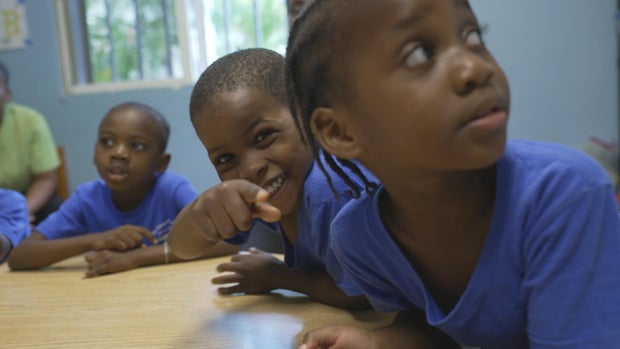 Kids at Have Faith Haiti
60 Minutes
Kids at Have Faith Haiti
60 Minutes
They play here. Do chores. Go to church. And, eight hours a day, go to school.
They're taught in both French and English, and prepared to go on to college.
Mitch Albom: All children deserve to feel like they have a future and the future is possible. And there are a lot of children right on the other side of that gate and their bellies are swollen and they're not eating. And that's not fair. And if my wife and I can do anything to change that, even if it's a drop in the bucket, that'll be our drop.
Anderson Cooper: You're not doing analysis of a 2 or 3-year-old and seeing what their cognition is and what they're capable of. You are just picking kids in the most difficult circumstances…
Mitch Albom: Love, food, prayer. Works miracles.
Mitch Albom: We don't give aptitude tests to get in here. Most of the kids that come to us aren't even speaking yet. But if you put them in the right environment and you surround them with other kids who are aspiring to do certain things, they'll grow.
Not all the kids are orphans. Many were brought here by a desperate parent or a family member who couldn't afford to feed them. Albom has to choose who gets in.
Mitch Albom: We try to set the conditions because otherwise it's hundreds and hundreds of children. So, we say only if there's one parent, not two. Only if there's no home, no actual structure home, you know, or if there's a case of sickness or something like that.
Anderson Cooper: What are those interviews like?
Mitch Albom: "I don't have any food to give my baby." "The parents died. I don't know who this child is." "We found this child under a tree. He was 6 weeks old, and he was starving." So those stories, those interviews, they broke me in half. But they also cemented me to Haiti and cemented me to this operation, which I will do for the rest of my life.
Mitch Albom is the author of 19 books, including "Tuesdays with Morrie" and his most recent bestseller "Twice." He first came to Haiti in 2010 after the earthquake. That's when Albom, who's Jewish, began fixing up a Christian orphanage run by an elderly pastor.
Mitch Albom: The pastor basically said, "I don't have any money to run this place and I'm 84 years old." And, I kind of blurted out, "Well, I could probably run it. How hard could it be?" You know? And he said, "Here you go."
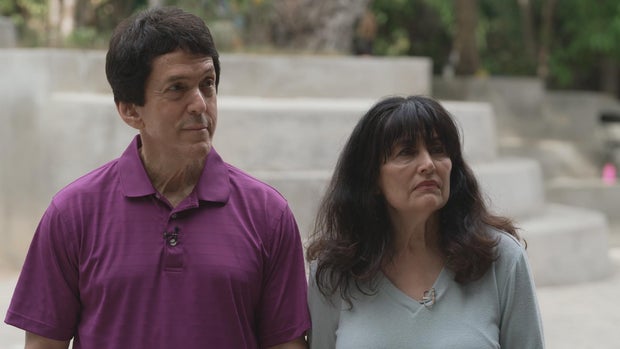 Bestselling author Mitch Albom and his wife Janine
60 Minutes
Bestselling author Mitch Albom and his wife Janine
60 Minutes
Bettinie was brought here around that time. A year and a half old, her father died in the earthquake and her mother was desperate. Lorvens was malnourished when he came at 3. And Gina was left here by her father at 5. She now wants to be a lawyer.
Gina: I felt abandoned, I could say. I was a little bit scared because there were a lot of new faces and just a lotta people staring and smiling.
Anderson Cooper: Smiling felt weird?
Gina: Yeah. It was my first time seeing an American, Mr. Mitch.
Anderson Cooper: What did you think?
Gina: I was, like, "He's so white."
Anderson Cooper: Um, were you angry at all when you learned your, your story?
Bettinie: Honestly, not really, because I know my mom is human, and I don't think it was a really bad choice for her to bring me here. Because she was looking at my future.
Anderson Cooper: Lorvens, how about for you? You'd said that there was a sense of betrayal for you early on.
Lorvens: Because I felt like, why would, like, your own family leave you in a place and stuff, where you don't know anybody.
That feeling of abandonment is something Yonel, the Haitian director of Have Faith Haiti, knows well. He was left at the old orphanage 36 years ago when he was 5.
Anderson Cooper: Do you remember coming?
Yonel: Oh yes, I remember coming. It was the worst day of my life, honestly. I did not like it.
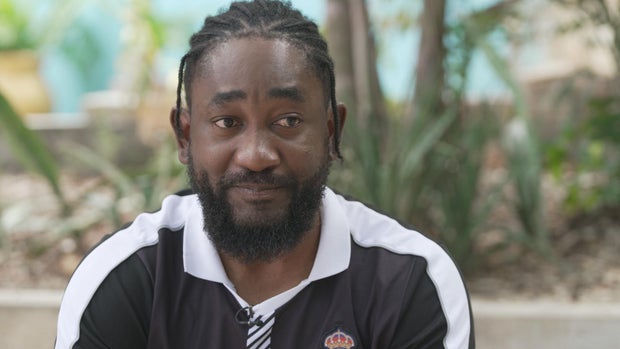 Yonel, the Haitian director of Have Faith Haiti
60 Minutes
Yonel, the Haitian director of Have Faith Haiti
60 Minutes
Yonel's father had three other children and couldn't afford another.
Yonel: I thought that they hate me back then because they just kick me out. And they didn't even tell me why. But later on I would understand why they did that. That's why I forgive him, you know? 'Cause I think they do it out of love.
Yonel: Almost all the kids when they come, they all call me "father." They need that, you know, connection. So, I put myself there for them.
Anderson Cooper: The kids, they view each other as brothers and sisters.
Yonel: I don't know how to put this, honestly. That's all we got. You know, growing up, we have to rely on each other, you know, to survive.
Anderson Cooper: That's all these kids have is each other?
Yonel: Yeah. That's all we have.
Keeping the kids safe is one of Yonel's biggest challenges.
Outside the walls of the orphanage the danger is very real. As much as 90% of the Port-au-Prince metropolitan area is now controlled by armed gangs. Rapes, robberies and murders are common. The U.N. estimates more than a million people have been displaced from their homes by violence and in just the last 24 hours in this one area, there have been three shootouts between police and gang members.
In case gunmen ever break into the compound, Yonel regularly conducts surprise emergency drills. The kids grab "go bags" and rush to a concrete bunker with steel doors.
It's got its own generator, a month's supply of food and water, and cameras to monitor outside.
Yonel wasn't happy with the results of this drill.
Yonel: Talia? Where is she?
One of the babies was left napping in the nursery.
Yonel: Not good. Not good. Can't leave no one behind.
Anderson Cooper: So, what's it like trying to keep this going?
Have Faith Haiti's budget is paid for mostly by Mitch Albom and his wife Janine, along with help from public and private donors.
Janine: And we try to give them a childhood, which is stolen from so many of the people.
Anderson Cooper: There's not a lot of kids in Haiti who get a childhood.
Janine: No.
Mitch Albom: It's very hard to fundraise for Haiti. People think, "Oh, the money always disappears or the government takes it." I hear that a lot. These children, they don't deserve to be ignored because Haiti has a checkered history.
After security and fuel, education is the biggest expense. The classes are small and if a child struggles, they're given a customized lesson plan.
Anderson Cooper: You don't see kids on phones or kids–
Mitch Albom: We don't allow that.
Anderson Cooper: --playing video games.
Mitch Albom: No kids have any computers for personal use. There are no cell phones here. There's no television. And consequently, we get to see childhood in a much purer form than I think you get to see it in the states. So, their attention span is remarkably long relative to American kids.
Sixteen kids have graduated from high school at Have Faith Haiti in the last eight years and all of them have gotten scholarships to American colleges and universities. But they won't be staying in the U.S.
Mitch Albom: All of our kids agree before they leave here that they are coming back after they finish their studies and they're going to work at our orphanage for two years for free, to give back to the community. So, they're not going to America to take jobs. They're not going to America to do anything but appreciate it and then come back and make their country a better place. You know, I hope our kids can stabilize this country. And that's part of what we're trying to raise them to do.
In December, when we visited Mitch Albom's home outside Detroit, all the Haitian college students were staying there on their winter breaks. We sat down with four of them: Widley, Bianka, J.J. and J.U.
Anderson Cooper: What's it like living in the U.S.? Like, what stands out to you?
J.J.: For me it's, like, opportunities. Like, there's lots of opportunities here.
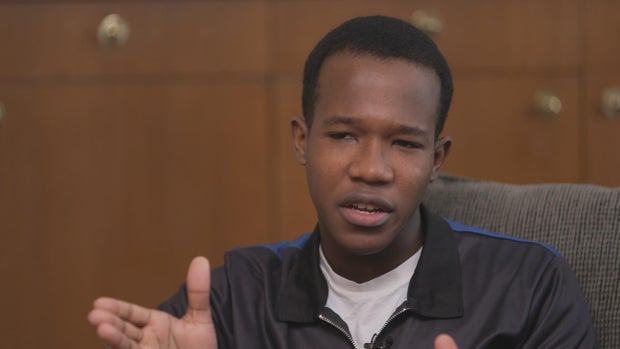 Widley
60 Minutes
Widley
60 Minutes
Widley: Just being able to see the ins and out of how an actual government works.
J.U.: I'd say it was, like, relief from all, like, the violence.
All of them said they are determined to help turn Haiti around.
Bianka: Education is one of the things I would really want to take back and I will take back in Haiti because you need a better education to lead the government and to get a good job.
Widley: Eventually I'd like to become an ambassador for my country someday.
J.U.: The end goal is to be a senator in my country one day.
Anderson Cooper: It doesn't scare you off to get involved in politics?
Widley: I mean, there is a little bit of fear, honestly. I mean, our last president got assassinated. We have to take that into account.
Anderson Cooper: It seems like all of you want your futures to be with Haiti.
J.U.: Like to me, Haiti isn't just my country. It's like my home where I was raised, and I have deep, a deep connection to Haiti, so yeah, my future is with Haiti.
Haiti's future however is uncertain. To combat the gangs, in September, the United Nations, with U.S. backing, authorized a force of 5,500 multinational troops to help the overwhelmed Haitian police. But so far less than a thousand have been deployed, and the U.S. has slashed its financial obligations to the country by more than 50%.
This spring another six students at the orphanage are set to graduate. They'll volunteer for a year of service in Haiti before applying for scholarships to study in the U.S. Even if they get them, however, it's no longer clear ithey'll be granted visas.
Anderson Cooper: Is there a difference between you and kids outside these walls who are working in the streets in terms of their potential?
Gina: No, because it could have been vice versa, and we could have been in the streets, and they could have been here. So, I think everybody has potential. They just have to be given the chance and the opportunity to explore that.
Mitch Albom: Every child has that potential inside, no matter what circumstance they come from. If you give them something beautiful and calm and-- and-- and hopeful, they'll aspire to those things. And that's what I think you see with our kids.
Produed by Denise Schrier Cetta. Associate producer, Elizabeth Germino. Broadcast associate, Grace Conley. Edited by Warren Lustig.
In: