3 months ago
13
3 months ago
13
“Everybody knows there is no fineness or accuracy of suppression,” wrote the great Jewish-American writer Saul Bellow, “if you hold down one thing you hold down the adjoining.”
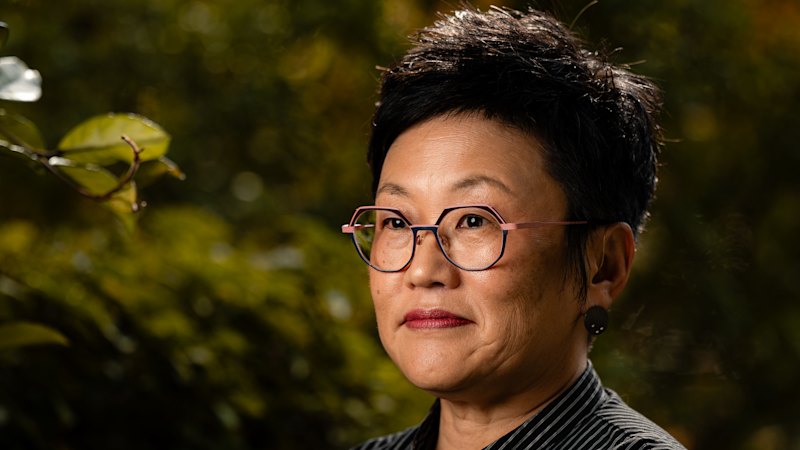
And so it is with the act of the Adelaide Festival board in disinviting Palestinian-Australian writer Randa Abdel-Fattah from Adelaide Writers’ Week. With Australians horrified by the Bondi mass murder, insidiously linking a writer with that massacre is an appalling slander, vile in itself. But in saying one Australian writer cannot speak, inevitably more and more Australian writers will find themselves also unable to speak – first at festivals, soon in universities, then on public broadcasters.
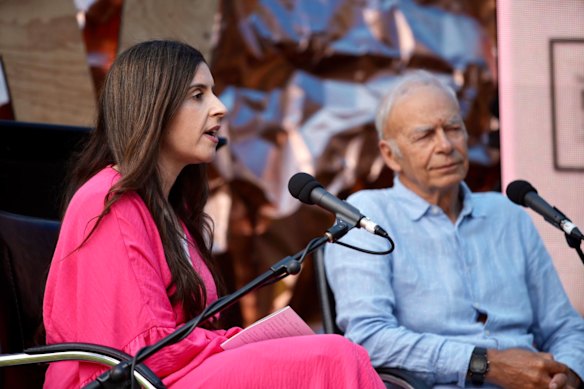
Randa Abdel-Fattah and Peter Singer at Adelaide Writers Week in 2023. This time, her invitation was withdrawn. Credit: Andrew Beveridge
And the categories of what is unsayable and who is silenced will inevitably grow. Today it is Gaza, but next it could be the environment or social policy. As we see in the United States, the slippery categories of terrorism and community cohesion are ever-growing as forces of oppression.
Randa Abdel-Fattah is charged with having given profound offence with past social media posts. Tony Abbott has also been charged with giving profound offence to many Indigenous Australians in the past. Both have new books out, both were invited to speak at the AWW, yet only Tony Abbott remains welcome.
It is no secret that this came about because of intense political pressure from the South Australian government. The festival board’s statement clearly implies this and goes further by announcing a new “special committee” to oversee all future programming that will have “ongoing engagement with relevant Government agencies and the appointment and/or advice of external experts”. For special committee read political commissars overseen by the state. For external experts read lobby groups. And yet we know that a society that allows its politicians and special interest groups to decide who gets to speak and who doesn’t is on a dangerous path.
Loading
I am writing this because Adelaide Writers’ Week director Louise Adler, herself Jewish, her grandfather murdered in Auschwitz-Birkenau, her father a member of the French resistance, did something remarkable at a critical moment in our culture. Over the past three years, she made the festival no more or less than a beacon for free speech at a time when that felt imperilled. She allowed writers once more to say what they wished and not fear that they would be cancelled or condemned for saying it. It was the republic of letters, not the tyranny of political orthodoxy.
When threatened by the powerful for the brave stand she took, Adler did not back down and the Adelaide Writers Week’ board, to their immense credit, stood firmly behind her. Writers took note. Audiences began growing and kept growing. The conversations grew real and connected, as writers once more found their voice. Issues that were not being discussed and debated elsewhere in public were discussed and debated at Adelaide. And, in consequence, Adelaide Writers Week, to my mind, became once more the best writers festival in Australia.
Writing, as Kafka, another Jewish writer, put it, is the axe that smashes the frozen sea within. Good writing is never orthodoxy. It is heresy. A writer, if they are doing their work properly, rubs against the grain of conventional thinking. Some may not like what Randa Abdel-Fattah has to say, but then others may not like what pro-Israel writers who are also to speak at AWW have to say either. And that is the point – all deserve to be heard.
In a time when the richest and the most reactionary are seeking to create and impose an information and cultural system in the form of AI – the ultimate point of which is not to benefit humanity but to enrich themselves further and consolidate the grotesqueries of their unprecedented power – we need our heretics to be heard and we need forums like the Adelaide Writers Week that allow audiences to find them more than ever.
Loading
But with this act of utter folly and appalling weakness, the Adelaide Festival board – and the politicians who direct it – have by scapegoating a Palestinian writer now destroyed Adelaide Writers Week for the foreseeable future. If it has not collapsed, discredited and disgraced, by the time this goes to print, it will within the next few days. In what was described to me as a Jack Russell race out the front door, alongside almost every Australian writer of stature, global literary superstars such as Masha Gessen, Zadie Smith and Percival Everett have all withdrawn, along with sponsors major and minor.
The issues this single act raises go far beyond the banks of the now-frozen Torrens: it speaks of a crisis in our hollowed-out democracy in which our politicians no longer have either the courage or judgment to recognise what are the appropriate spheres for their own influence.
As South Australian Premier Peter Malinauskas put it in 2023 after deciding – in spite of being upset by it – not to interfere with the AWW’s programming that year, when politicians decide what is culturally
appropriate “it leads us to a future in which politicians can directly stifle events that are themselves predicated on freedom of speech and the expression of ideas. A path, in fact, that leads us into the territory of Putin’s Russia.”
Malinauskas was right then. He’s wrong now.
And if the aim of the Adelaide Festival board members was, in their words, to act in a “culturally sensitive” way, to lessen murderous antisemitism, they have instead only engorged it, allowing their act to feed into every antisemitic trope of the vilest kind. They have both gifted antisemites and the far right their cowardly act, and with it established a dangerous precedent to further encroach on freedom of speech nationally.
Loading
I write this in support both of Louise Adler’s opposition to this silencing and of my many fellow writers who have chosen to withdraw from AWW, and call upon the Adelaide Festival Board to have the wisdom, the courage and the humility to right this wrong and reinvite Randa Abdel-Fattah.
Richard Flanagan won the 2014 Man Booker Prize for his novel The Narrow Road to the Deep North. In 2024, he won the Baillie Gifford Prize (for non-fiction) for his most recent book, Question 7.
Most Viewed in National
Loading