3 months ago
21
3 months ago
21
Opinion
November 12, 2025 — 6.00am
November 12, 2025 — 6.00am
The Coalition and the Herald, in its editorial published on Tuesday, are united on one thing this week: that Australia should give up hosting COP31 in Adelaide and hand it over to Turkey. They’re wrong.
I’m an Australian who ran strategy for COP28 in the United Arab Emirates – the largest climate conference in history. A major oil producer, the UAE had more to lose than Australia, yet the summit in 2023 was a diplomatic and economic boon, cementing the country’s global credibility as a clean tech leader.

United Nations climate chief Simon Stiell and COP28 president Sultan al-Jaber at the end of the COP28 in Dubai in 2023.Credit: AP
Since then, I’ve watched the multilateral order – and climate co-operation – buckle in real time. The consensus-based COP model, where nearly 200 parties try to agree on universal frameworks, is straining under its own weight.
But this is exactly why Australia should host. COP summits are one of the few forums where every country, large or small, still has a seat at the table – where Tuvalu sits alongside China, and the Marshall Islands can demand answers from major emitters. Flawed as the process is, it’s irreplaceable. Once that architecture breaks, it’s gone – and rebuilding would take decades we don’t have.
But stewardship alone won’t win the argument. The harder-nosed case is this: if done right, hosting COP31 in 2026 is a strategic play that can unlock billions in investment, deepen partnerships and place Australia at the centre of the next wave of economic and technological change from clean energy to artificial intelligence.
Loading
Every COP has two tracks. The first is the formal negotiations. As host, Australia would act as the custodian, a trusted broker between industrialised economies such as the EU, Japan and South Korea; emerging powers like India, Indonesia and the Gulf states; and climate-vulnerable nations across the Pacific and Africa. Australia brings rare credibility across all these camps – we’re pragmatic, trusted, and genuinely transitioning. Our diplomats have long been seen as skilled bridge-builders, deeply respected for their ability to find common ground when others can’t.
Yet, it’s the second track, the “action agenda”, where the real opportunity lies. The initiatives, business deals, meetings, and media events happen outside formal negotiations. This is the part of COP where the host country sets the agenda, and where hosting becomes a national interest: deepening partnerships with countries navigating the same growth-versus-emissions tension we face, on critical minerals, hydrogen, and AI-enabled climate technology; attracting capital into Australian projects; positioning ourselves at the centre of clean energy supply chains reshaping the Indo-Pacific.
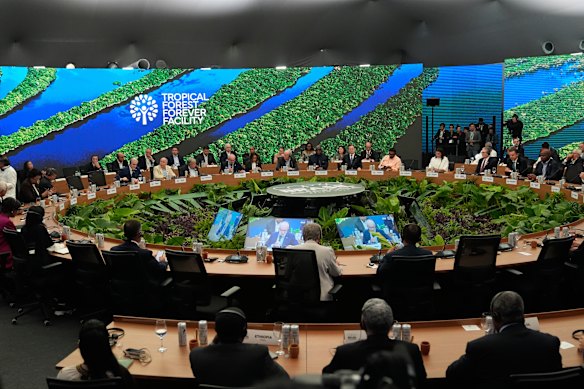
Brazil’s President Luiz Inacio Lula da Silva speaks during a roundtable at COP30.Credit: AP
Our competitors are positioning themselves for the next industrial revolution across clean energy, digital systems and artificial intelligence. Australia has what many countries need: reliable resources, renewable abundance, scientific capability and deep Pacific ties.
Hosting COP31 would amplify these strengths, turning them into influence and investment. Our heavy industries can show the world how decarbonisation makes money, from efficiency gains to green hydrogen. It would also be a historic opportunity to drive international investment in the Pacific, in early warning systems, adaptation planning and high-performance renewable energy.
And this COP could be where Australia leads on the frontier issue that’s transforming every economy: artificial intelligence.
The Pacific is watching. They see climate as their primary security threat.
AI is already reshaping how energy is produced, managed and consumed – from optimising power grids to streamlining approvals for new projects. It’s often portrayed as a climate risk – an energy hog, making things worse. Those concerns are real. But AI is also one of the few technologies capable of matching the speed and scale the climate crisis demands. It can predict extreme weather, improve crop yields and strengthen infrastructure planning – tools that matter as much for adaptation as for mitigation.
Because COP31 brings all countries to the same table, it’s a chance to ensure AI becomes a tool for all – not just a handful of tech powers. Australia can help set that example: pairing data-centre investment with renewable energy in regional Australia, turning AI’s energy appetite into local jobs and infrastructure, and building Pacific capacity to use these tools for climate resilience. Done right, it would position Australia as a trusted Indo-Pacific partner shaping how AI serves people, economies and the planet.
Loading
This isn’t risky diplomacy. It’s industrial policy and competitiveness in sectors that will define the next decade of global competition.
The Coalition frames this as a binary choice: host an expensive summit or spend the money on something useful for Australians. That’s a false choice. Hosting COP31 properly – focused on delivery, infrastructure, and Pacific partnerships – is something useful for Australians.
Ceding COP31 to Turkey isn’t fiscal responsibility; it’s strategic surrender.
The Pacific is watching. They see climate as their primary security threat. Walking away signals abandonment at precisely the moment China is expanding its influence across the region. Our trading partners are watching too: the EU is implementing carbon border adjustments and export markets are demanding clean supply chains. Hosting COP31 would show Australia is serious about the transition they’re navigating and, with the right focus, we would organise and run it better than most.
This isn’t vanity – it’s an industrial strategy for the decade ahead. Next week’s decision will show whether Australia positions itself at the centre of the partnerships and industries reshaping our region – or steps aside while others do.
Tina Latif was the director of strategy for COP28 and senior fellow at the Harvard Kennedy School. She now advises governments, corporates and philanthropy on climate and technology.
Get a weekly wrap of views that will challenge, champion and inform your own. Sign up for our Opinion newsletter.
Most Viewed in National
Loading