3 months ago
37
3 months ago
37
It’s raining and grey on this early weekday morning at the Collingwood Harriers Athletic Club. I’d much rather be in bed, but the world is awake. The rainbow lorikeets trilling in the trees seem happy, and a busy flow of traffic speeds commuters past brutalist housing commission flats.
It’s June 5, 2024, and I have now gone for a run on each of the past 156 days – rain or shine, sickness or health, no days off, no excuses – with the full intention of going for a jog, sprint, lope or shuffle every single day for the next 209 days, the goal being a full 12 months – an entire leap year, no less – of continuous daily running.
It was a new year’s resolution of sorts. I’d found myself that past December daydreaming about the summer ahead, imagining where my annual susceptibility for holiday laziness might lead. I was 46 years old (firmly middle-aged), sedentary (it happens), with sleep apnoea and exercise-induced asthma. I was also tipping the scales at 117 kilograms, a weight I came to learn qualified me (technically at least, albeit through one of those unreliable Body Mass Index indicators) as “obese”.
Running seemed like a simple solution. An elegant one. But I needed a rule to stick with it, to keep me in line, to prevent any of that internal prevarication and bargaining that might see me skip a session or two. I needed to remove the option. Which is why I’m now here, in this inner northern suburb of Melbourne, waiting for my running partner for this morning.
You see, I figured it wasn’t enough to just throw one foot in front of the other every day – not when I could deploy my experience as a sportswriter to interview experts and magpie their wisdom. I could even turn their insights – and my own – into a book.
Why run alone, I reasoned, when I could reach out to and run with Olympic silver medallist Jessica Hull, or marathon legend Steve Moneghetti, or former tennis star Jelena Dokic, or side-eye queen Grace Tame. I could – and would – stroll with sprint sensation Gout Gout, chat with ultramarathon icon Nedd Brockmann, and consult Olympic hero Peter Bol. I could run with and interview politicians and musicians, scientists and novelists, CEOs and average Joes, not just with a view to improving, but to ask them all why we run. What does it give us? And what does it take?
Today I’ve come to see what I can learn from matching someone who pumps his legs at an infinitely quicker rate than I do on the jog. I wonder what’ll happen to my hammy, that muscular band at the back of the thigh connected to the gluteus maximus – the mighty arse that drives the world’s best sprinters. Mine is already quite sore. Five months of impromptu continuous movement will do that.
I’m meeting the podcaster (and one of the Victorian nominees for Australian of the Year) Hugh van Cuylenburg for a session on a tartan athletics track. (His rump doesn’t look massive, incidentally, but rest assured he’s quick.) You probably know van Cuylenburg best as co-host of The Imperfects – a series of meandering episodic chats with guests that routinely sits near the top of the podcasting popularity ladder in Australia. The discussions are playful and vulnerable yet conversational, which is van Cuylenburg himself, writ large.
It owes in part to his backstory. He grew up in a happy, middle-class home in Melbourne, yet somewhere along the way he began to derive his extrinsic value from making people laugh. He saw that as his job basically, then it became part of his actual job as a primary school teacher, exhausting himself daily to lift the mood of the classroom.
Taking a break from that, he went backpacking in India as a young man, and the subcontinent experience was transformative. He tells a story often about an epiphanic moment while teaching in a Buddhist community with little in the way of creature comforts. A boy there one day pointed to the shoes on his feet: the sandals carrying him throughout the world.
“How lucky am I?” said the boy.
Van Cuylenburg returned to Australia and began working with disadvantaged children – riven with anxiety and at risk of tumbling out of the education system – and began to use the central tenets of what he uncovered on his trip. He took the approach into schools, and was immediately swamped with requests for more workshops and sessions. The title of his book – The Resilience Project – became a personal brand too, and the organisation spread its reach, working not just in education but also in sports. He’s worked with AFL and NRL clubs, the Queensland State of Origin rugby league team and the Australian cricket team. The “resilience guy” is highly sought after as someone who can walk people through a better way of living. I want his help with running.
At school, van Cuylenburg played all sorts of sports, but he was primarily a sprinter. It was his favourite thing in the world yet when school finished, it stopped. People play amateur footy and community netball into adulthood, but who does track in their 20s?
Instead, he fell into standard sporting fare, specifically club cricket. His team played on the oval at the University of Melbourne. Van Cuylenburg thinks it might be the only city oval in Australia where you can look in any direction and not see a road, because it’s surrounded by the storied residential colleges of the school. “But to the south side of the ground is an athletics track,” he notes. “And every single summer, I’d be standing there on that oval, fielding, and just looking at the aths track, wishing I could do that again.”
Now he does. He “retired” from cricket at 36 and jogged recreationally for years – between three and eight kilometres at most – but now sprints for fun. He started on his own, but eventually found a coach who told him he wasn’t running like a sprinter, but rather like a jogger trying to go fast. “Sprinting is about the amount of force you can put through the track in the quickest possible time, which is so different to distance running,” he says. “I had to relearn the way I move.”
He’s going to give me a crash course in the same thing now. I’m eager to charge out of the blocks but we start – disappointingly – with a 400-metre slow jog, part of a cautious approach aimed at making him “bulletproof” that includes two gym sessions, a morning on the bike, and two track sessions like this one.
We begin with a series of dynamic stretches to help teach proper sprinting technique so it becomes muscle memory: “spinal engine” work that rotates and toggles the trunk, because so much of the power in sprinting comes from countervailing forces I don’t really understand. We twist the body in ways it otherwise wouldn’t be tested, van Cuylenburg explains, taking us off the straight-line goat tracks we find ourselves stuck on in middle age.
“Think about it,” he says. “Jogging dead ahead on the trail. Swimming up and down the pool. We stay on the rails, so we need to teach ourselves to be strong moving sideways and laterally.”
The first few minutes are all about “thoracic activation”. We do “cat-cows” and “reverse nordics” and “thread the needle”. We do exercises that seem designed to crack open the chest cavity or swivel the hips or turn a leg like a corkscrew. Exercises that make sure the foot isn’t in “plantar-flexion” (toes pointing down) but rather in “dorsi-flexion” (toes up), because if the foot hits the ground when it’s dorsi-flexed, the heel hits the ground first, ready to spring into action.
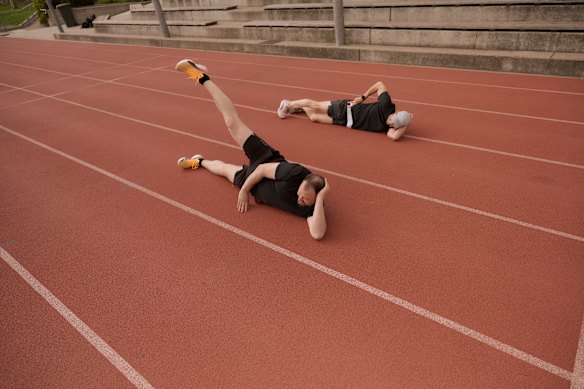
We get into dynamic drills now and the blood begins to flow. We skip forward 20 metres (actual skipping, just like a child would do), with our arms swinging like windmills. We move side to side while spreading our arms out and up and down and again, like a series of dramatic curtsies.
We do “A skips”: skipping while driving the knee upwards to chest height, and then immediately down. And we do “B skips”: the same action only flicking the leg forward at the finish, so our toes are pointing forward like a ballet dancer. Doing both, my back is straight and my head stable, and I’m certain I look like I’ve got something stuck up my arse.
Van Cuylenburg describes the postural alignment differently: “I always try to imagine there’s a string going up through my head, and someone’s holding it, like a puppeteer.”
Van Cuylenburg says the point of all these exercises is to get the muscles throughout the body “speaking” to one another, and that seems apt, because it feels a little like speaking in a foreign language. Some sounds are just impossible to make if you haven’t grown up saying them. Some movements are impossible to make if you haven’t grown up making them.
Think of the unwieldy consonant combinations in some of the Slavic languages, like this wonderful Czech sentence, entirely lacking vowels: Vlk zmrzl, zhltl hrst zrn. I can’t imagine contorting my lips and tongue to recite that line, and if I tried I’m sure it would be nonsense. But if I could speak the language properly since birth, it would be poetry: “The wolf froze, he swallowed a handful of grains.” With linguistics, as with running, we all have the same hardware to work with – lips and tongue (hips and legs) – but without extensive experience it’s always going to be hard to execute unfamiliar phonemes (or herky-jerky running drills).
It took van Cuylenburg six months to get most of these moves right, so he remembers being precisely where I am now, self-conscious and clumsy. “When you finish this session your muscles will be tired, but you’re probably also going to feel a kind of neurological fatigue, from thinking your way through it all,” he says. “The thing is, the body can do all of these motions, but it’s used to almost none of them.”
We’ve been doing stretches and drills for 45 minutes now, but there’s a few more to come. It’s not just about injury prevention, but also building tension and energy into the muscles so they’ll crackle on command. “We’re getting closer to running,” he says. “I promise.” He’s going to do 200-metre efforts today as part of his training, and I’ll pick him up after the turn, running the last 100 metres with him at a little more than 50 per cent effort, carefully, so I don’t do my hamstring a mischief.
It’s fun to walk up to the line again. I haven’t run down a 100-metre straight since I was in high school, three decades ago, and I immediately remember how that nervous twitching energy felt before a race. I can’t help but associate standing there in lane four, waiting to launch, with the feeling of being young. Back then, running fast was less about effort and grit and more about unleashing something naturally fierce – flicking the latch and letting it loose. Then we’re off, and reality rushes in: when did 100 metres get to be so long?
We walk back to our starting position after each sprint and, after our third effort, van Cuylenburg is already on a high. “It’s an incredible feeling,” he says. “There’s nothing – nothing – like the feeling of running fast. The most present I am in my life is when I’m sprinting.”
There’s a lesson here too. He says people should consider those things they loved doing as a child, and if it’s possible or appropriate, try to get back into them. “Because often we don’t – we see that as being selfish,” he says. “But I think as I’m engaging in something that has brought me so much joy, there’s a snowballing benefits effect that spills over to others, just from striving. How many things do you improve at in middle age?”
After our fourth sprint, he talks about the adaptations he’s made in order to perform. Sprinting demands that he eats and sleeps well. He does saunas and cold plunges. He spends time in Normatec boots – inflatable boots that wrap around your legs from the feet to the waist (like those Velcro cuffs doctors strap to your arm to measure blood pressure). The compression and decompression promote aggressive blood flow through the legs for faster recovery.
He gave up drinking too. “That had to go,” he says. “I don’t drink any more. I used to drink a lot, and loved that. But to run as fast as you can, you need to do so many things right, and all of those things that are right are such great health habits to get into.”
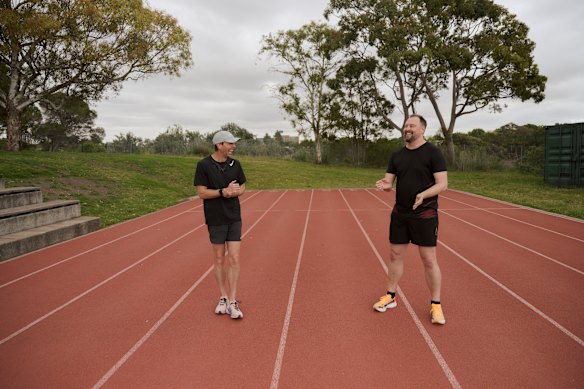
Following the fifth sprint down the track, he talks about the mental and emotional gains. Van Cuylenburg is a busy guy, with more than a few irons in the fire. He frequently gets to the track with a million things on his mind – a problem, an issue, a negative emotion – but within 10 minutes those are all gone. “I’m in flow,” he says. “And by the end of the session all these positive solutions pop up, and all these creative ideas start appearing, and you feel all these really generous, loving interpretations for things in your life.”
Finishing our sixth run, he points out something I’d forgotten. The 400 metres, despite being a sprint event, is not over quickly. It sits just below the middle distance events. It drags and it hurts. I grew up doing Little Athletics at my local track, a beautiful amphitheatre at the base of a hill. I loved it. Loved the ribbons. Loved the unfettered feeling of trying to get somewhere first. But one day it was time to step up in distance and compete in the 400 and, walking towards the starting line, I felt a wave of fear.
I sat watching the other heats, dreading the unknown. I started to cry, then got up and walked away. I couldn’t run that race. I was too scared. The full lap seemed too great a distance to cover, the grass in the centre like an ocean. We left Little Aths and I never came back. “I still have that fear today,” says van Cuylenburg. “I wake up on a Saturday to race, and I don’t want to do it. I’m sick with nerves. But then I go and put myself in that uncomfortable position. You can reverse engineer anything to be a metaphor for life, but the 400 metres, for me, is the one.”
“You see the stagger between the lanes unfold. The grandstand rises before you. It’s incredible.”
Hugh van CuylenburgAfter our seventh scurry, van Cuylenburg walks me through the anatomy of a race. The plan, he says, is simple. For the first 60 metres, get out of the blocks hard and go as fast as possible, expending whatever energy is available, because the anaerobic system is exhausted after eight seconds so you may as well use it while you can. He approaches the back straight by conserving a little energy without slowing down – keeping his leg speed the same while relaxing everything else. “Efficiency, efficiency, efficiency,” he says, somewhat inefficiently. Now at the halfway point, he hits the second bend and begins to wind up. He goes back to technique and fundamentals, and fights hard, and the feeling coming off the bend and into the straight is like nothing else.
“You see the stagger between lanes unfold. The grandstand rises before you,” he says. “It’s incredible.”
Completing our eighth hot-foot down the track, he talks about the straight, and the mad dash to the finish. Everyone is in their own lane, and the job is largely staying there and running your own race. The lactic acid has built up in the legs now and the pain is horrific, but there’s no surprise so there’s no need to panic, although he’s sure some other expression is etched into the darkness of his face. “It’s an oxymoron: fight as hard as you can, but do it in a relaxed fashion,” he says. “Watch any 400-metre runner at the finish, and you know they’re fighting for their lives.”
The first feeling that comes to mind once the race is run is “pride”, because van Cuylenburg has done something hard. When he crosses the line there’s a kind of psychic whoosh, releasing all the preparation and focus that went into the act.
After our final charge of the morning, I want to know how this will improve his busy day of podcast recording yet to come. Breathing hard now, the answers come in staggers. “If I don’t!” he says. “Do this!” he adds. “Beforehand!” he pauses. “Then I struggle!” But when he does do this, he’s more articulate and attuned, and the faster he thinks, the more connected he is to the conversation he needs to foster. Those “snowballing benefits” he mentioned earlier carry through to the end of his day, his wife and three kids under the age of seven experiencing his joy too.
I can relate. We jog a couple of slow laps to cool down and I recount to him a moment I enjoyed after a recent 16-kilometre run. As I cantered into my driveway, the song I was listening to was just beginning, so I burst into the living room where my wife and son were reading, cast the anthemic banger to a speaker, and started dancing. I jumped around like an idiot, and they joined me. I cranked up the tune – Won’t Back Down by Tom Petty – and started doing sit-ups and push-ups, and they tried to keep up, all of us in hysterics. We walked out the door for lunch soon after, each of us seemingly pumped full of the same endorphins, from a moment that would never have occurred had it not been for the simple act of going for a run.
“You feel drunk,” van Cuylenburg says, nodding. “The runner’s high is almost primal. Honestly, it feels essential to survival.”
Edited extract from Run for Your Life by Konrad Marshall (Hardie Grant, $37), out now.
Order a copy of Run For Your Life from Booktopia for the special price of $25 with the discount code RUN25. This offer is available until February 28. Shipping fees may apply.
To read more from Good Weekend magazine, visit our page at The Sydney Morning Herald, The Age and Brisbane Times.