3 months ago
16
3 months ago
16
This article is part of an opinion summer opinion series where writers share the story of a year that changed their lives.
See all 5 stories.I was 16 and standing in the doorway of my piano teacher’s studio, at what would turn out to be my final music lesson.
I had just played a rendition of a piece I would never again play as well: Beethoven’s Sonata in D minor, commonly known as The Tempest. Beneath the soft yellow light, with fingers moving across the keyboard with uncharacteristic control, I managed to catch the colours of rolling thunder and driving rain in Beethoven’s stormy soundscape. To the right, my teacher smiled as she listened. But my true critics, her three shih tzus — one a yappy little Chihuahua-cross — perched on a vintage rosewood two-seater to the left. Judging by their silent attention, they too seemed to think I had done a fine job.
It was a sliding doors moment, in front of three shih tzus and a Chihuahua cross.Credit:
“So what do you want to do now?” my piano teacher asked. She posed the question with such gentle sadness, as if she knew what was about to happen next.
Only later did I understand she had seen this ending many times before, played out in music studios around the country.
“You’re naturally quite musical,” she said. “But now you need to decide if you want to go further.”
I had started late and was an ordinary student but she had been an extraordinary teacher. A magician. She taught me to listen and my body to sway. And in one delightful moment of discovery, she unlocked something else: the way certain chords could send a quiet, colourful shiver through me. But some familiar roadblocks remained. While touch and tone had been my forte, I struggled with long allegro passages. Proper technique still eluded me when I played fast.
Loading
That gap, she said, would be best served by formal study. A piano diploma would take two years, daily practice and hours of repetitive drills. But like a doctor, she also offered informed consent. The pass rate at the end, if the rumours were true, was 25 per cent at best.
My teacher also knew I wanted to be a doctor. The difficulty was that, back then, my dream medical school required a university entrance score that left little room for error. I was about to enter senior high school and with it came a focus on schoolwork and results. Those years, marked by long hours and rising expectations, would prove trying.
What I believed then — wrongly, as it turns out — was that, given the circumstances, studying music would dilute my focus. I thought I had to choose between a future career and something I loved, to either listen to my head or follow my heart.
That day, I listened to my head.
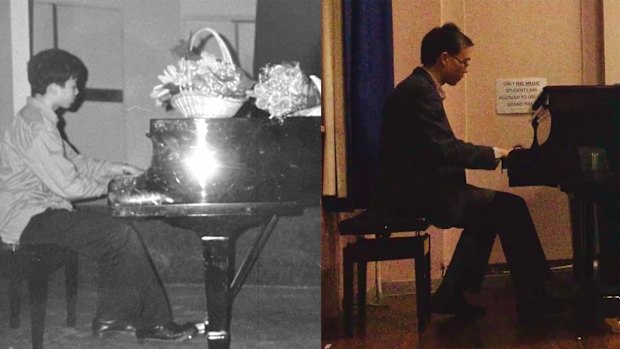
Louis Wang playing a concert aged 15, and playing the same song as an adult at a school reunion.
To others, it might have appeared an easy decision. I was not a prodigy. And yet, stopping piano sounded a deeper dissonance than giving up other subjects I enjoyed, like history and geography. Music was a refuge when life grew hard. Walking away from the piano was like muting an intrinsic part of myself.
To stop then was also to stop short of independence. Once formal lessons ended, I knew my skills would regress quickly. I understood that I was moving from making music to listening to it. Maybe forever.
“Don’t worry, just remember to keep listening. That way, you’ll never really stop being a music student,” my teacher said.
As we said our goodbyes, I vowed to return. But the pursuit of a place in medical school quickly became all-consuming.
Loading
Yet my teacher’s lessons followed me far beyond the piano. She taught me the importance of listening to others, but also to myself. From her, I learnt to trust instinct, a confidence forged through practice and rehearsal. Even now, when seeing patients, it can surface as a sense that something is off, before it is clear on paper — a recognition shaped by patterns I have seen many times before. In this way, my years at the piano became a way of practising for life.
And when life grew busy, and the days stormy, listening to music became a much-needed elixir. I came to see that my decision that day was less final than it had felt — a rest mistaken for an ending.
Decades later, after working in the clinic, and as the late afternoon melts into dusk, I sometimes find myself standing at the doorway of another piano studio. I’m late, but it’s not my lesson. In the soft glow of tungsten-yellow lights, I see two grand pianos, not one. And there are no dogs. At the closest piano, still in her high school uniform, sits a younger version of me, midway through a fast passage I don’t recognise and can barely even read. I recognise a familiar sway. Her teacher, seated at the other piano, smiles as I enter and gives me a knowing look. Trying not to interrupt, I plonk, like one of my old teacher’s shih tzus, onto the nearest sofa.
And while I sit in silent attention, closing my eyes and letting the wash of my daughter’s latest musical adventure soften the colours of my day, I hear my teacher’s parting words from all those years ago.
She had been right all along. I had never really left.
Louis Wang is a cardiologist and a medical educator.
The Opinion newsletter is a weekly wrap of views that will challenge, champion and inform your own. Sign up here.
Most Viewed in Lifestyle
Loading