3 months ago
34
3 months ago
34
Let’s start with a disclaimer: I am not one of those weird men who thinks about the Roman Empire every day, while putting out the garbage say, or walking the dog, or while pretending to be busy at work.
Yes, I am a student of history, but I don’t spend my time thinking about Roman Empire hypermasculinity or the superiority of Western civilisation foundationalism – seriously, I am not that bad.
In fact, I’m much worse.
What I do think about every day is a hokey British science fiction series that debuted more than 60 years ago on the BBC called Doctor Who. And if this wasn’t my pathway to getting my first byline in Spectrum, I would never be admitting it.
About15 years ago, when it was time to mark the end of an old life and the start of a new one, I had the whole of the British Isles at my disposal.
And it was Doctor Who that took me to a tacky cave system turned theme park in the west of England. What was I thinking? I should have stuck with Stonehenge.
Firstly, some context (and justification). Doctor Who, which concerned the adventures in space and time of the alien Time Lord the Doctor and his human companions, lasted from 1963 to 1989 in its first incarnation and has been rebooted several times since. Its next episode is shrouded in secrecy and due at Christmas.
It had a total lock on my childhood. I loved its weirdness and adventure. It widened my horizons, it opened up worlds. That was good justification then. Now, I don’t have any excuses. Even this past week, when I should have been watching Adolescence or The Pitt or any of the many fine episodes recommended by The Age’s television critics as the year’s best, I instead fired up my DVD to watch a 1973 Doctor Who episode where blobby gel monsters chase the good Doctor around a sandy gravel pit masquerading as an alien planet made of anti-matter. It looked cheap even for 1973.
But I hugely enjoyed it. It’s not you, modern television, it’s me.
The show is the prime example of the hold Britain has always had over me.
Objectively, the country is a cultural powerhouse, lavishly detailed in The Great British Dream Factory, where historian and The Rest Is History podcast host Dominic Sandbrook details the global success of cultural Britain, evidenced by The Beatles, Sherlock Holmes, Agatha Christie, James Bond, Tom Stoppard, Tomb Raider, Led Zeppelin, and many others (and yes, Doctor Who).
To be fair to me, I have a genetic predisposition to this stuff. My dad emigrated from Britain in 1949, aged 20, but remained a lifelong Englishman. My mum’s memoir, Almost An Odyssey, documents her two years in Britain in the 1960s as an Aussie hitchhiker. I was always going to go and live in Britain.
I moved from Australia days after my 30th birthday in 2003, and during the culturally enriching eight years that followed I gave everything a go: the first production of The History Boys at the National Theatre, a Eurovision Song Contest parody musical at The Edinburgh Fringe festival, Dame Judi Dench’s famous portrayal of Titania in A Midsummer Night’s Dream, Madonna at Wembley, Anything Goes, Oliver!, even a media tour of the Big Brother set.
Almost no cultural tourism stop was beyond (beneath) me. I dragged my friends to The Roald Dahl Museum and Story Centre at his old home in Great Missenden Buckinghamshire (absorbing). But I balked at entering the Jane Austen Centre in Bath after I was warned “It’s everything Jane would have hated”.
At the famed Glastonbury music festival, I clung to the side of a hill as a torrent of rain threatened to unmoor our tent and send it sliding into a gully. Clubbing in London was halted after some random walked past me in a Vauxhall nightclub and vomited on my shirt. I can still recall the smell.
What was there left to do? For my last roll of the travel dice, I decided to go in search of a childhood fever dream – Voga, the fabled lost planet of gold. That it didn’t actually exist didn’t bother me in the slightest.
Voga occupied a special place in the mythos of Doctor Who and it was the one location in the low-budget series that looked convincing on screen.
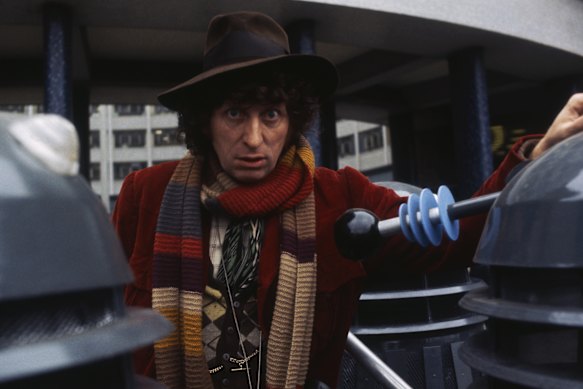
The planet was the centrepiece of the 1975 adventure Revenge of the Cybermen, where Tom Baker as the Doctor was trapped on a space station trying to prevent the Cybermen from crashing the Nerva space beacon into Voga, a rocky planetoid made entirely of gold, the one substance in the universe that was deadly to the silver robots.
While that sounds convoluted, believe me, for Australian kids watching nightly before the ABC evening news, the battles between the Cybermen and native Vogans in the atmospheric cave systems were incredibly tense. They stayed with me.
Years later I found out they were filmed at the Wookey Hole Caves, just north of Glastonbury, in England’s west.
I had found my destination.
The caverns were cool and quiet, millions of years old, formed by water seeping through limestone sediment, a peaceful dank.
I barely saw another human. I was alone with thoughts of my past and my future.
But my main thought was, what on earth was I doing here?
If Wookey Hole had had the courage of its convictions as a mildly dramatic natural phenomenon for hikers and cavers alike, that would have been fine. But no. The place had been got to, signposted as “Caves, Legend, Adventure” and as a “world of wonder” and “breathtaking”.
“The adventure doesn’t stop underground! Enjoy a fantastic mix of indoor and outdoor attractions, including adventure golf, soft play, a vintage penny arcade, a fascinating museum, and so much more.”
Fifteen years later, I can recall the penny arcade (sad), the museum (sadly not fascinating) and how one cavern stored wheels of cheese on shelves. I do not remember, or I have simply erased from my mind, the “prehistoric, Animatronic roaring dinosaurs in Dinosaur Valley”.
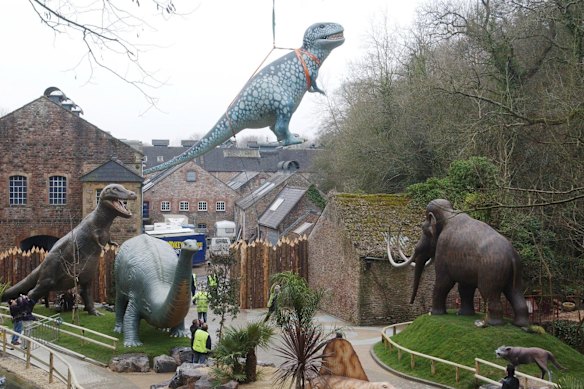
The site, open for tourists since 1927, had shoved in as many seaside pier attractions as possible, including, in one cave,a merry-go-round, a symptom of the worst kind of fake British tourism.
It had all the fun of the fair. But a fun fair with no visitors. I gave myself a moment in the stillness before decidingthat my joy at being a fan should be expressed through watching the show, not in indulgence odysseys to filming locations. It was time to leave the caves, and England. “One day I shall write about this,” I thought to myself.
Years later, while covering a science festival in London in 2000, I had the opportunity to meet Tom Baker. Instead, I hung around the edges and watched him talk to other fans. Sometimes it is better not to meet your heroes, I decided, before slinking away.