2 months ago
26
2 months ago
26
“So,” my mother says, with steely intent. “I need your help.” She is visiting from interstate, cornering me while she can. She pulls out a notebook and pen. I sit beside her at the kitchen table, try to summon patience and goodwill, and wait. “How do I send photographs from my phone?” she asks.
Mum is 89. On her own, unassisted, she flew from Queensland, where she lives independently in a house with many stairs. She can get a plumber out to repair a leaky tap but doesn’t know how to pay him online – she’d be gaily writing cheques if anyone still accepted them. She drives to her doctor’s surgery but if reception sends a follow-up text message, it’s unlikely she’ll see it. Her hearing is excellent but when she accidentally turns off her iPhone’s volume (how do you even do that?), it can take a day before she realises and another hour for me to explain over the phone how to get it back on.
More than once, she has rung me in a panic after getting calls from the ATO or other agencies threatening action over allegedly unpaid bills. And emails? In the underground 2024 hit film Thelma, the elderly protagonist asks her grandson, “What’s an inbox?” (right before she is scammed). Mum answers Thelma’s question: “It’s just one more thing to worry about.” She can access hers on her iPad but rarely does. Online shopping? Good grief, no!
So, like millions of other adult children around the country, I have, reluctantly, become my analogue mother’s bookkeeper, tech adviser, online shopper, security guard and remote help desk. “Why has my iPad done this thing?” Mum will ask and, 1000 kilometres away, I’ll try to figure out what “this thing” could possibly be. Or we’ll spend an age trying to reset one of her passwords, failing because the verification code pings to her, not me, and she can’t find it, and we try repeatedly until I’m close to tears and her frustration electrifies the phone line.
But Mum doesn’t know how lucky she is. Her digital trials are inconsequential and, mostly, I solve them or, if I can’t, act on her behalf. Many other older people, especially those who don’t have children or grand-children to call in for help, or for whom English is not their first language, find the digital world they’ve been thrust into alienating, even frightening.
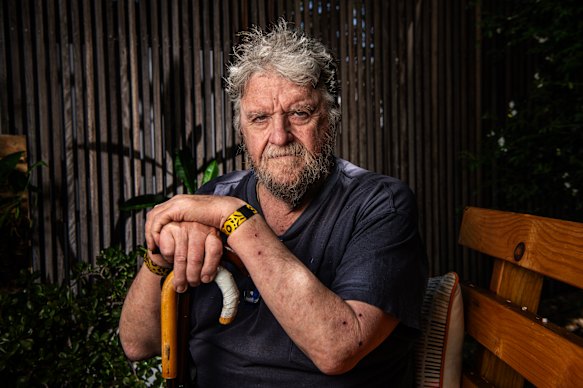
“It makes me angry, disempowered,” Robert Lovett, a 73-year-old inner-Sydney pensioner tells me. “It feels like other people are forcing you to jump through hoops you don’t want to jump through.” Lovett is single and not in the best of health. We sit together at the Newtown Neighbourhood Centre after his twice-weekly gentle exercise class and I ask him who he calls when he’s in trouble, digital or otherwise. “I don’t,” he says. Another man I meet, Colin*, 80, has similar feelings about technology. “To me, it’s not a friend, it’s an enemy and as much as I can, I avoid it,” he says.
I visit Colin, a former architect and planner, at his home south of Sydney, where he lives alone and is recovering from a serious illness. He doesn’t have children. He doesn’t have a home internet connection or a computer. “I don’t want one,” he says defiantly. His access to the world is through his smartphone. He avoids using that, too. He has five television sets around his house on which he watches SBS history documentaries, but asks me what “streaming” is.
Like Robert and Colin, about one in five people are excluded from a world most of us take for granted. The 2025 Australian Digital Inclusion Index (ADII) found that over-75s, First Nations people and public housing residents are disproportionately excluded. Not to mention those who live in remote and regional areas, where public transport is scarce and bank branches and other in-person services are dwindling in number. For these groups, limited access to digital tools or the skills to use them is an existential issue, banishing them to the fringes of daily life.
“It’s this new kind of disability we’ve created as a result of just how quickly we’ve pivoted to these new platforms,” says Robin Parkin, the CEO of the now-defunct Melbourne-based not-for-profit Lively, which trained young digital natives to offer tech help to older people. “It’s just such an unavoidable part of participating in society now. You need to have some basic digital literacy in order to access essential services … banking, some shopping, or to participate in any kind of community activity.”
Patricia Sparrow, CEO of COTA Australia, the peak advocacy body for older Australians, says the digital revolution has become an issue of equity. Even those who the ADII might count as “included” – people who cope with their devices or who have family support – vent their frustrations to her. “They talk about how everything is digital and how it impacts their daily life as much as ageism does.”
‘It’s this new kind of disability we’ve created as a result of just how quickly we’ve pivoted to these new platforms.’
Robin ParkinThe bombardment comes from all sides, from the ATO and My Aged Care and Centrelink, from insurers, medical institutions and banks (would you like your statements emailed to you and have you downloaded the app?). It lands in the form of passwords and multifactor authentication, security questions and access codes, online forms, uploads and downloads and emailed bills and BPAY and never-ending device updates.
And for older people, the cost of digital ineptitude can far exceed mere frustration. In 2024, Australians aged 65 and over reported losses of nearly $100 million to scammers – the highest loss of any age group. It can also leave them vulnerable to unscrupulous children or caregivers managing their finances and online affairs.
Governments have responded to the digital divide by funding a range of programs, but the response is inadequate in scope and strategic effect. Angela Savage, CEO of Public Libraries Victoria, says it’s “a burning issue” for the sector, with librarians often picking up the slack for government and private-sector organisations. “Device advice, one-on-one tech support, has become bread-and-butter work for libraries; there’s a gap and no one else is filling it,” she says. “In addition to just the sheer volume of workload, we’re also seeing a lot more critical incidents in libraries, because people are venting the frustration that they used to vent on Centrelink workers on library staff.”
A not-for-profit provider of free tech help in the Wollongong area, Living Connected, introduces me to several of its clients, including Colin and John*. I meet John at a local library. He’s seeking damages over a traffic incident and the stream of court forms he’s required to submit online has overwhelmed him. “People say, ‘Have a look online’ and I say, ‘Listen to me, I don’t do online, I’m 71, I wasn’t brought up on computers, never had a job where I used a computer, or nothing like that … so don’t even think about saying that to me.’ I take offence to that.” His rage seems barely contained. John’s only digital access is via his Android phone and the library’s computers. “Everybody around my age hates this computer world. Take me back to the ’70s or the ’80s. Nobody my age wants to deal with this stuff.”
In mid-2024, Cecily Grice joined the Go Gentle organisation and started to investigate the option of voluntary assisted dying for herself. Grice, lean and elegant and looking a decade younger than her 81 years, had been treated for breast cancer the year before, but it wasn’t her own health driving her to consider the method by which she wanted to die: it was her husband Alan’s deteriorating condition. The former obstetrician and gynaecologist had Parkinson’s disease and dementia, was hallucinating and having frequent falls, and the process of getting him into an aged-care facility had been protracted and distressing. “I do not want any member of my family to have to go through the experience of coping with aged-care forms and assessments that I have experienced,” Grice wrote in a diary entry. “[Services say] ‘just go online and …’ which is beyond many aged people who did not grow up with computers.”
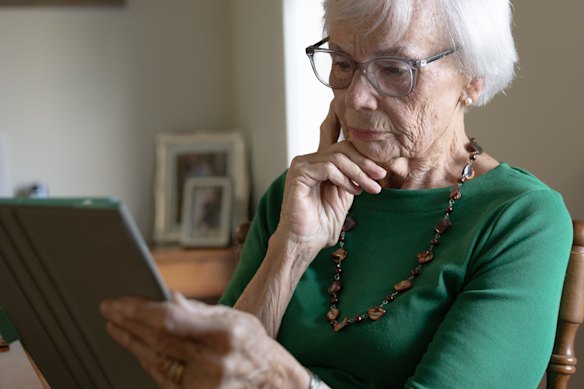
Alan, who finally went into care in July 2024, died in mid-October last year. Sitting in a pale leather lounge chair in her neat villa in a community south of Sydney, Grice tells me she would rather curtail her own life if she becomes incapacitated than subject her four children to the experience she endured through Alan’s last years. While they supported her from a distance, Grice bore most of the bureaucratic pain herself. At every step, the need to manage processes digitally added to her trauma. “I was so uptight at one stage when this was all going on that my GP sent me to a psychologist.”
Grice simultaneously needed to communicate online with government bodies including My Aged Care, MyGov, Services Australia and Centrelink, plus banks, health funds and the industry superannuation fund into which she eventually moved the couple’s money. She had a dozen or more reference numbers for various organisations and processes. When Alan was transferred from a respite ward to a dementia ward within the same nursing facility, she had to complete new paperwork with the same questions all over again. One form advised her that she could use autofill to complete the form. “I didn’t have any idea what autofill was.” Grice couldn’t print the form, so stumbled her way through filling it out on her phone. “I had to sign my name with my finger in a space, and didn’t know how to do it. When I did it, it looked nothing like my name.” Eventually she went to a Living Connected drop-in session for assistance. The pain continued even after Alan’s death. Grice had to complete online forms authorising his cremation, but autofill bamboozled her again. In the end, she printed the forms, filled them in by hand, scanned them into her phone and emailed them. It took her a day.
Grice knows she’s in a privileged position. She can text and email and print and scan and has four children and nine grandchildren, although only one of her children lives nearby. “How do homeless people and so many living on their own cope with all this?” she asks. “I’m told they don’t.” She gets up and dashes across to a table where documents and letters are neatly stacked. She returns with a page she reads from: “Further, the current requirements for online forms and computers and limited customer service in today’s society has also contributed enormously to Cecily’s stress over the past 12 months.” It’s a paragraph from a letter one of her daughters wrote to a medical practitioner outlining her concerns about her mother’s wellbeing. “Nobody that you speak to in any of these departments knows what it’s like to be 80,” Grice says. “None of them.”
Governments boast about Australia’s “digital transformation”, which accelerated during the pandemic. “The Digital Transformation Strategy sets the direction to deliver world-leading digital services for all Australians,” a 2021 Australian Public Service Commission State of the Service report noted. “Its focus is on making government easy to deal with, informed by users …”
As Grice knows, not so easy. The fallout from the pandemic rush online was far-reaching. “People started really panicking, especially seniors,” says Ciel Yuan from Counterpoint Community Services, which runs digital literacy programs and assistance for local clients, most of whom live in public housing, at the Factory Community Centre in the inner-Sydney suburb of Waterloo and its affiliate in Alexandria Town Hall.
Seniors weren’t the only ones frightened. Older people in the workforce suddenly found themselves completely out of their depth.
On the phone, I talk with Sandie Hesline, a 73-year-old retiree from the Melbourne seaside area of the Mornington Peninsula. “I thought I’d be there ’til I was a skeleton in the corner,” she says of the job she loved in Melbourne Museum’s booking office. But when Victoria went into lockdown in March 2020, the skills she needed to master a work-issued laptop and the digital demands of remote work were beyond her. She’d never had a computer or internet connection at home. “I’m really a dinosaur when it comes to technology, I’ve never used an ATM in my life – I still go into the bank and get money out.” When one of her work friends helped her get started on a new phone, another cracked a joke. “They said, ‘It’s a smartphone, just not a smart person.’ I didn’t take offence because it’s true – I’m not smart as far as technology goes.”
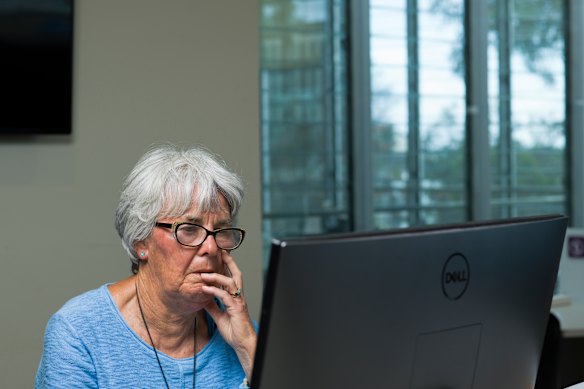
Hesline is single and childless, and while her colleagues did the best they could to help her manage the technology, it wasn’t enough.” I remember a staff meeting that the CEO ran via Zoom and I couldn’t get off mute the whole time.” In the midst of her struggle to manage the technology and the isolation, her mother died. “I got to the stage where I just couldn’t cope with everything that was going on in my life.” In May 2020, she took all her leave. In March 2021, after Melbourne’s third lockdown, she resigned. “It was really devastating, but I had no choice because I couldn’t cope with the new system,” she says. “It was a really dark time; I felt suicidal sometimes.”
Too many people like Grice and Hesline have been collateral damage in the digital revolution, the effects of which are compounded by its intersection with other societal injustices such as disadvantage and ageism. “It’s all layered on top of things like vision impairment, hearing impairment, some cognitive impairment, all those things that happen as you age – so even seeing a phone screen is ruled out,” says Jacqui Oong, manager of aged services at Newtown Neighbourhood Centre in inner-west Sydney, which informally helps clients like Robert Lovett with their technology issues.
“The older you get, the more invisible you become,” Lovett tells me. Born into a deaf family, he became a professional sign language interpreter and ran his own business, an agency for interpreters. His clients included government bodies such as courts and the old Commonwealth Employment Service. He had staff and office computers and knew Microsoft Office for Windows inside out. “I was right on top of it, became a bit of a computer junkie.”
‘I don’t want the bells and I don’t want the whistles. I want a Vee Dub, not a bloody Ferrari. It’s like technology for technology’s sake.’
Sydney pensioner Robert LovettBut Lovett stopped work in the late 1990s to care for his elderly mother. After that, he had little use for technology beyond the secondhand DVDs he likes to watch – “History Channel ones, Walking with Dinosaurs, archaeology stuff”. One day he got a PC, but never really used it. A local teenager has tried to help him with it. “The moment he opens his mouth, I’m completely lost. It’s like, ‘Please talk to me in baby language.’ ” Lovett recently acquired an Android phone – his only other technology – and someone had to download the manual from the internet. When he was working, Lovett read manuals from cover to cover, but this one? “Three hundred pages!” he exclaims. “Most of the instruction book is irrelevant to me because I don’t want to know how to take the most superlative photograph of the most beautiful sunset. I don’t want the bells and I don’t want the whistles. I want a Vee Dub, not a bloody Ferrari. It’s like technology for technology’s sake.”
For now, he manages the basics on his phone. He can access his email although “there’s not that many people I Gmail with, you know”. He watches YouTube videos, especially the British satirical puppet show Spitting Image. “Bone-breaking, hysterically funny they are,” he laughs. Lovett seems cheerful but acknowledges his isolation. His only surviving relative is an elderly aunt. The neighbourhood centre has connected him with a volunteer he sees once a week for a coffee – “just so I can have some kind of social contact; beyond that it’s pretty well non-existent”. I ask him if he worries about having to grapple with the digital demands of government bureaucracy as he ages. “Yeah, big time,” he says.
“Just a minute,” Eva* says. She’s concentrating, tapping deftly at her iPhone, copying details from an event brochure into her calendar. When she’s finished, she stands and leans on her wheelie-walker. Her sense of style becomes apparent: a floor-length purple velvet coat, strings of pearls, soft grey hair sweeping her shoulders. Eva is 85. We move slowly to an office at The Factory in inner Sydney’s Waterloo to talk. Eva has lived in the neighbourhood for 30 years but only recently learnt about The Factory – and that its staff can help her when she stumbles with technology. Neither of her two adult daughters lives nearby, but they keep an eye on her via the location-sharing app Life360.
Show me your apps, I say. “I do internet banking,” she says proudly, “and I like playing solitaire and sudoku – I use them if I’m a bit upset. It helps me settle myself, be in the now.” Eva, who lives in local public housing, has had a difficult life. She mentions a history of abuse and says she left school in year 10, later putting herself through night school to get her leaving certificate. She was close to finishing a social science degree when she had “a bit of a breakdown”. She never went back to it. But access to the internet has given her an outlet. “I’m a curious person, I love knowledge.” Eva is interested in political economy and history, loves watching big thinkers such as the Greek economist and politician Yanis Varoufakis on YouTube, and sometimes drifts off to sleep listening to videos about Jungian psychology.
“And guess what I’ve got,” Eva says, “ChatGPT!” She scrolls through her recent searches and reads a couple out to me – “capitalism and care for all; coping with being rejected”. There’s been some nastiness in her community recently. “Someone’s been gossiping bad about me; I’ve had a really bloody hard week … it just shattered my nervous system for days.” She asked the artificial intelligence assistant how she could handle it. “Oh my god, it helped me! I didn’t have to ring up and go to a psychologist; I went to GPT! Because I do not want to fall into a depression.”
ChatGPT and other AI offerings are adept at mimicking empathy, but mental health experts warn of the risks of unregulated chatbot “therapy”, including potential harm, misdiagnosis or failure to handle mental health crises. For Eva, however, digital technology is “magic”. She doesn’t ever want to stop learning about it. Others feel the same way. At The Factory’s multi-cultural affiliate centre in Alexandria, Chinese-born retiree 69-year-old GuoRong Yuan tells me via a translator that his smartphone has also been a great thing. “I play games or mah-jong, and I install lots of different apps on my phone,” says Yuan, whose only son lives in Shanghai. Better still is the translation app. “That’s how I communicate with people when I go out.” He shows me how he can take a photograph of a document in English and the app will translate it.
‘We know that digital inclusion is so important for older people’s ability to stay connected and stimulated.’
Robin ParkinThe digital divide isn’t just about access but about attitude and temperament – the polarisation between older people who loathe technology and those who embrace it. Devices can fill yawningly long days; emails, games, Facebook and family or community WhatsApp groups can mitigate isolation and loneliness. “People say, ‘Oh, my grandkids are always on the phone, and they’re on this, whatever it is – Facebook, TikTok – and I’d like to be, but I just don’t understand it,’ ” says Jacqui Oong from Newtown Neighbourhood Centre. “There’s this whole aspect of life that they miss out on.”
Robin Parkin, of the former not-for-profit organisation Lively, relates the story of a Chinese-born refugee from East Timor who came to Melbourne alone. When he first attended an English-Mandarin Lively session, he was reserved and could use his iPhone only for basic tasks. Over time, he made friends, learnt to watch YouTube videos, order food online and connect with family and friends overseas. He says the program changed his life. “Now he has friends he can talk to and things he can do when he is alone at home,” says Parkin. “We know that digital inclusion is so important for older people’s ability to stay connected and stimulated.”
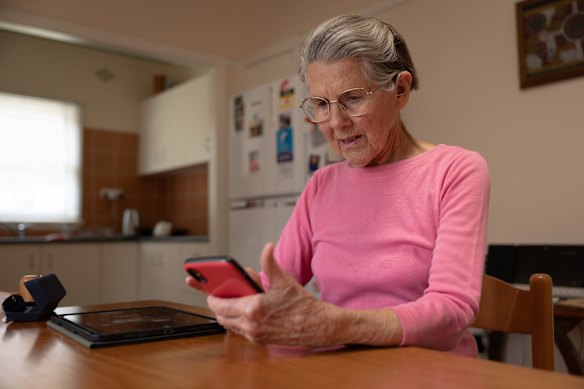
I’m sitting in Joy Donovan’s spick-and-span kitchen south of Sydney while she makes me a cup of tea. The clock ticks, the fridge hums. A dog barks elsewhere. Donovan spreads a floral-patterned cloth and napkins. And muffins – she has baked little cinnamon muffins specially for me. “I don’t get many visitors,” she says.
Donovan is 87 and tiny, with grey-bobbed hair and striking blue eyes. She was a nurse and, for years, volunteered in developing countries such as Papua New Guinea, Bangladesh, Thailand, Sierra Leone. After she retired, she joined a bushwalking group; endless walks, so much fun. She is unmarried, doesn’t have children and her two sisters are unwell; her walking friends became her family. But bushwalkers get old, too. “I’m a wobbly walker now,” she says. Her friends aren’t walking much, either. One recently had a hip replacement, another has just gone into care.
Donovan produces her iPad: she uses it for emailing and listening to ABC radio, online banking and submitting her tax return. “With difficulty,” she says, she can access her MyGov account. The device keeps her in touch with the climate and refugee advocacy groups she supports. A while back, she took part in a trial of an app which paired donors with Syrian women refugees in Jordan. “I connected with a woman who had a 10-year-old daughter; she didn’t know where her husband was,” Donovan says. “I think about her often; she told me they lived in a mouldy flat … it must have been freezing in winter.”
Devices have been a boon for Donovan, but not without stress. “They keep changing things,” she says, referring to updates. She’s been flustered by iPhone warnings that she’s out of data. Recently, she nearly fell for a scam: she ended up on the phone with a man claiming to be from the anti-virus company McAfee who insisted she had an unpaid bill. “I was getting very frustrated.” She knew she didn’t need anti-virus protection for her Apple products but he was persistent. “He said, ‘We can put this right, love.’ He wanted me to go to my account. Then I thought, ‘No, this isn’t right.’ ” She didn’t think being called “love” was right, either. The scammer sensed her hesitation and hung up.
Catriona Lowe, deputy chair of the Australian Competition and Consumer Commission, which oversees the National Anti-Scam Centre, says scammers always try to get their potential victim in “a hot state”: “They want people panicked or overwhelmed or doing things urgently, because they know that’s when some of our natural caution is abandoned.”
‘Older people don’t really like classes … There’s a lot of embarrassment and shame.’
Angela Savage, Public Libraries VictoriaDonovan had first attended a Living Connected session in 2021, when she needed help applying for a new passport online. She returned after the scam near-miss. “They said, ‘We’ve got to give you some quick training on scams!’ ”
Australia’s digital literacy training landscape is a crazy quilt of programs supported by various levels of government and not-for-profit organisations. The federal government funds Be Connected for older Australians and Digital Sisters for women, both run by social impact organisation Good Things Australia. COTA Australia is piloting a Digital Champions project to teach older Australians about the likes of My Health Record and e-scripts. And libraries pick up the pieces with one-on-one assistance. “It’s very time-intensive,” says Public Libraries Victoria’s Angela Savage. “Older people don’t really like classes … There’s a lot of embarrassment and shame. They might feel reluctant to ask their questions in front of others. So there’s a real gap around that, and a complete lack of acknowledgment by government and business of the sort of impacts that they’ve had.”
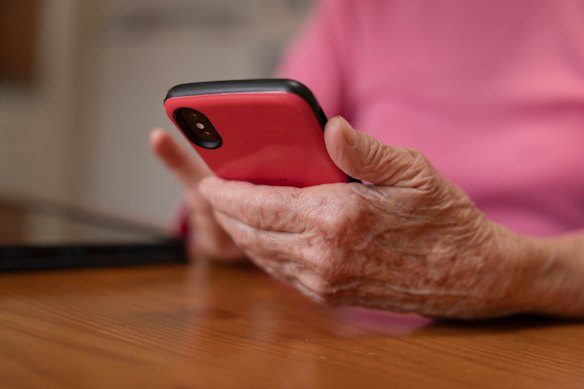
It doesn’t take long to find the gaps. Be Connected, in what seems an optimistic turn of thinking, has a slick website offering “free online learning”, presupposing that tech beginners can find and follow an -online course in the first place. It says it offers free in-person computer classes, but when I enter my mother’s postcode on its “computer classes near you” page, the response is “no organisations found for that location”. As a test, I look up my postcode and a number of providers come up including the State Library of NSW, but none appear to have any current classes. The State Library tells me it doesn’t do such classes and suggests I contact my local library. (A Department of Social Services spokesperson tells me the department “is undertaking an evaluation of the program to ensure it is fit for purpose”.) Meanwhile, Tech Savvy Seniors, a NSW government-Telstra training initiative, offers nothing in my area.
Lively, the Melbourne organisation that trained digital natives to help their elders navigate tech, closed late last year due to lack of funding. It was devastating news for Sandie Hesline. At the start of 2024, she learnt by chance that her local library would host Lively’s one-on-one tech help sessions. A young helper guided her through applying for the pension – documents needed to be scanned, bank statements located, an application filled out. Hesline doesn’t think she could have done it alone. Beyond that, she finds learning new digital skills “really exciting”: “I come out of the library feeling really confident and smiling because I had a good session.”
My mother gets a buzz out of mastering new things on her devices, too. For years, she has spent hours a day playing Words with Friends and solitaire on her iPad. She also enjoys a flutter on the horses. During her recent visit to Sydney, I downloaded the TAB app to her phone and, to the best of my limited knowledge, got her started. Mum switched between writing furiously in her notebook and swiping the phone screen with sweeping, emphatic finger movements (as if the more exaggerated the gesture, the better the result). I went into the kitchen to prepare dinner. When I looked up from chopping vegetables, Mum was bent over the phone, absorbed.
* Names have been changed. Lifeline: 13 11 14.
Get the best of Good Weekend delivered to your inbox every Saturday morning. Sign up for our newsletter.
Read more from Good Weekend:
Inside the world of ABC chair Kim Williams
The Ipswich schoolboy turned $6 million man
Michelle Payne’s rise to the top was swift – then came stalkers, the agony and the heartbreak