
 3 months ago
76
3 months ago
76
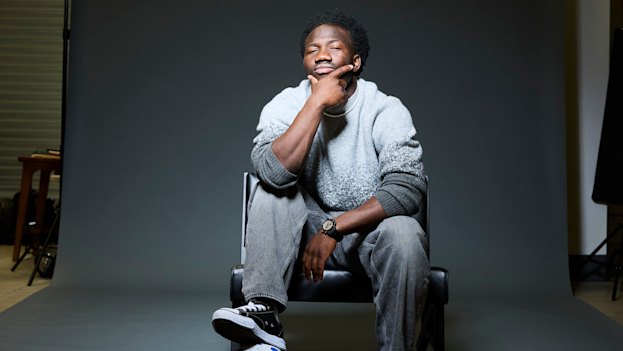
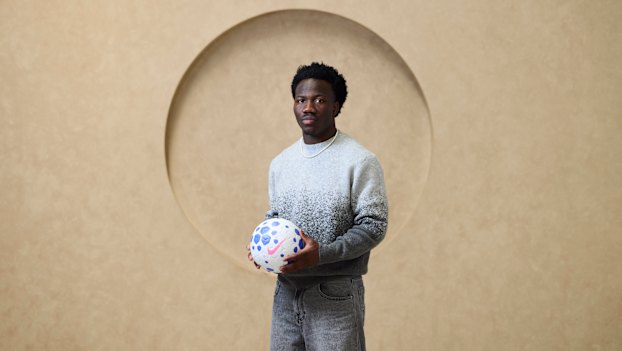
Nestory Irankunda is 45 minutes late, and I’m starting to worry. Setting up this photo shoot and interview with the rising Socceroos superstar had already felt a bit like watching him play: exhilarating, unpredictable and occasionally chaotic. After weeks of haggling with his minders about the timing, location and logistics, it was only locked in the day prior – and even that brought little comfort, because nobody seemed entirely convinced he wanted to do it or that he would actually turn up.
Finally, Irankunda’s white 4WD parks outside the warehouse studio in Adelaide’s inner north-west where we have agreed to meet, but I’m still not relieved. He’s a bit moody. This is his one week back home – between the end of his season with Watford, his club in the English Championship (the national competition below the Premier League), and the start of Australia’s pre-World Cup training camp in Florida – and we are grateful he has squeezed us in. But he’s still jet-lagged, tired from the early-morning training session that delayed his arrival and quietly annoyed with himself that he signed up for this.
If you don’t know about him yet, now’s the time to learn. Australian football has spent years searching for its next mainstream male star player, an heir to the throne left vacant by Tim Cahill. Well, here he is: meet Nestory Irankunda, the Socceroos’ wildcard at this World Cup, the jewel of the national team’s exciting new generation. We’ve had plenty of good players before, but none quite like this guy. He has blistering pace, incredible power, a healthy streak of arrogance and a shot that fires like a bazooka. Others could go through three careers and not compile half of the highlight reel he already has – and he’s only 20 years old.
Irankunda’s ex-teammate at Adelaide United, Spanish import Javi López, once said the only player he’d seen who was as impressive at his age was Lionel Messi. Former Socceroos coach Graham Arnold once tipped him to become Australia’s greatest ever player – or that he could be. These are heavy labels to wear, but they are a natural consequence of his otherworldly ability, and he has had to learn how to navigate all of that on the run.
Thankfully, Irankunda’s frosty attitude is just a facade. There’s a shy, playful kid behind the swagger, and the swagger, it turns out, is partly armour. “When he walks into a room, if he doesn’t really know anyone, he’ll be so shy,” his older sister Susana explains to me later. “But once he gets comfortable ... he starts to open up. That’s how he is. He acts shy for a bit, and then he just, boom, explodes.”
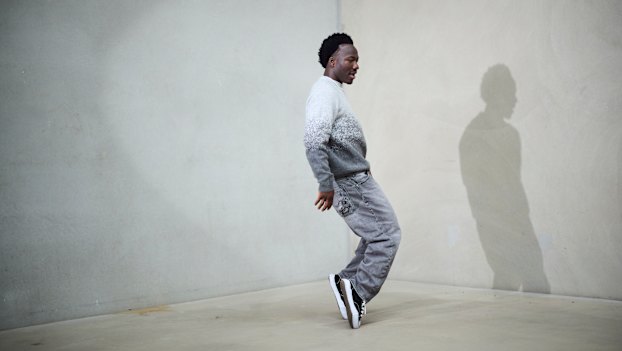
True to her words, we soon stumble on the right combination with our small talk, and the real Nestory – or just Nestor, or Ness to his family and mates – is unlocked. Once he gets a read on all the characters in the studio, he becomes relaxed and chatty, peeking at the photographer’s laptop between shots to check the results. At the end of the shoot, he gladly gives us a rendition of the Michael Jackson-inspired dance move he recently debuted after scoring a goal (minus the sequinned glove) and explained where his fandom comes from: his family, and in particular his older brother, Jotham, who always listened to Jackson’s music at home. “When he passed away, my mum was crying,” he says. His favourite song is Smooth Criminal, and he can run through Jackson’s set list from the 1993 NFL half-time Super Bowl show at California’s Rose Bowl stadium – where the Socceroos played a warm-up game against Mexico last month – off the top of his head. He has also seen the new biopic Michael three times. (Susana is still annoyed he didn’t wait to see it with her first, like he told her he would.)
When we finally sit down for our interview, Irankunda admits that being the centre of attention is much harder to deal with than it looks. His phone confirms this, constantly rattling with notifications: text messages, phone calls, DMs, group video chats. Everybody wants a piece of him, and it’s kind of always been that way. For as long as he can remember, Irankunda has felt like people watch him play differently to others, as if they’re expecting him to do something crazy every time he gets the ball.
“Mentally, it has affected me,” he says. “But I’ve learnt to just let it be for what it is, and it’s not going to change, I guess. It’s part of the game.”
Irankunda reckons he gets what he calls the “bad side” (quick-tempered) of his personality from his mother, Dafroza, who, he says, is also quick to get upset. (That sounds a lot harsher than he meant it.) The “happy side” comes from his dad – along with all of his footballing ability.
Gideon Irankunda was a player of some repute when younger, and stories of his exploits on the field followed him all the way to Adelaide. “Before Ness even started playing football,” says Susana, “we used to go out around the community, and when people recognised us, they’d say: ‘Oh, we know your dad. Do you know your dad used to break the goalpost? He had the most powerful shot ever, like, he was the most famous person, everyone in Burundi and Tanzania knew him.’ Just hearing that and then seeing Ness, we’re like, ‘Yeah, he got it from Dad.’ ”
Irankunda was born on February 9, 2006 in a refugee camp in Kigoma, Tanzania. Originally from neighbouring Burundi, his parents had fled the country due to civil war and were eventually resettled in Australia: first in Perth when he was three months old, then in the thick of Adelaide’s working-class northern suburbs. He is the fifth-oldest of seven siblings: Gideon, 31, Susana, 26, Gabriel, 24, Jotham, 22, Blessing, 16, and Mary, 12. Most of them played football, or still do, and all of the brothers can backflip like Nestor. “I used to be able to do it,” says Susana, a mother of two who herself plays for the Playford Patriots (in Adelaide’s local league). She describes herself as his guardian angel, constantly nagging him about making the right decisions, including turning up to the Good Weekend photo shoot.
Though they’re a proper footballing family, Nestor has always stood out from the rest of the clan. He used to tag along to training and games with his older siblings and show them up. “Imagine seeing an eight-year-old playing with, like, 14-year-olds, and taking all of us on. He made us look so shit,” Susana says. “He’s eight and he’s literally going through us. So instead of playing under-8s, under-9s, under-10s, he would play with us. That’s when we realised, ‘This kid is crazy. He’s going places.’ ”
Susana lost count long ago of the number of broken windows that Nestor was responsible for at the Irankunda family home. “Even when we go play outside – when he takes a shot, we all hide from that shot, because if he hits us, we know we’re finished,” she says. Spare a thought for poor old Rai Marchán, the former Melbourne Victory midfielder who once got in the way and wore one of Irankunda’s typical bombs to the head during an A-League match. He missed almost two months with concussion.
Irankunda’s phenomenal ball-striking power – and the audacity he has to shoot (and usually score) from long distances where other players would cross – stands out as his greatest asset. His shot placement is also consistent and precise; it is a rare Irankunda goal that doesn’t hit the top corner. Brad Maloney, who gave him his junior international debut for Australia’s under-17s, has seen him literally break the net. “I mean, that’s kind of a cliché, but he actually did it. He hit the ball through the net,” she says. “I don’t think I’ve seen anyone else in the world at any level strike a ball as hard as I’ve seen him hit a ball.”
Kevin Ball is a sports biomechanist at Victoria University with 25 years of experience across all of the major “kicking codes”. To balance the partisan views of those close to Irankunda, Ball agreed to provide us with an independent appraisal of his technique, which sent him down a thrilling YouTube rabbit hole of not only his greatest hits, but also Cristiano Ronaldo and Roberto Carlos highlights for comparison. “It’s been a fun week,” he says. “A bit of my real work’s backed up as a result.”
Irankunda is capable of his extraordinary force, Ball explains, because of his compact, explosive and efficient movements, a stable support leg and a remarkably “rigid” striking foot. Unlike other players, whose body shapes hint at where and how they are about to shoot, Irankunda barely seems to need a backswing – which means he is more difficult for goalkeepers to read, particularly from set pieces. Ball was also fascinated by Irankunda’s ability to generate movement on the ball without sacrificing accuracy, producing the kind of swerving, “floater” shots that can become unstable in flight and dip or veer unexpectedly. Finding any flaws in his technique was difficult.
“His impact is pure,” Ball says. “As good as any kicker across all the footy codes I have seen.”
Raw talent, however, is not enough. That’s a lesson Irankunda had to learn the hard way – and so has Mohamed Touré, 22, his Socceroos teammate and closest friend, another refugee in Adelaide (by way of Guinea, in west Africa). He, too, knows what it’s like to be hyped up as the next big thing.
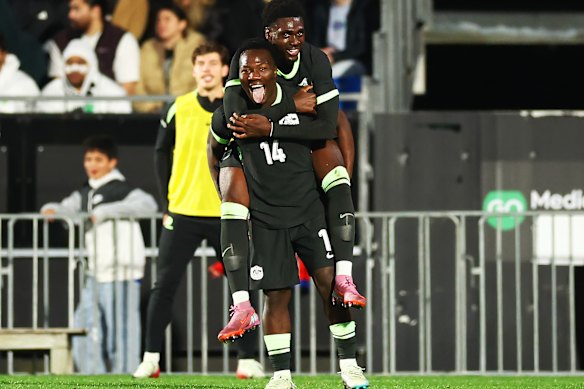
They crossed paths for the first time during a school tournament in Adelaide; Touré was already playing for Adelaide United by that stage and was the talk of the city’s tight-knit football community, a mantle he would soon pass on. Touré’s school won 3-1, but Irankunda was by far his school’s best player. “You know when you have one of those teams that has that one player who does everything? He was that one player,” Touré remembers. “I was just like, ‘Who is this guy?’ ”
After the game, Irankunda told Touré he was a big fan and asked for his shin pads. “I messaged him [afterwards] on Instagram,” Touré says. “I was like, ‘You’re welcome to come around the boys, me and my brothers and my cousins. We kick ball all the time at the local park.’ He said, ‘Easy.’ And from that day on, we just had a connection.”
Touré had already been sold to a club in France when Irankunda made his debut for Adelaide United at just 15, but he watched the younger player’s progression from afar. Irankunda scored his first goal in just his third game, the sort of spectacular goal that he’s since scored with regularity: a thunderous free kick that helped Adelaide United steal a late 2-1 win away to the Newcastle Jets. A month later, he speared one into the top corner from an acute angle in the 92nd minute at home to seal a 2-1 comeback. Then he did it again. And again. And again. None of these were normal goals, and many felt like ones that only he could be capable of, surging past hapless defenders before firing off unstoppable drives from ridiculous locations.
“I don’t know how to stop scoring bangers,” he says. “It’s just a gift, I guess, every time it happens. It’s also a God-given gift, so I’ve got to thank Him as well for what He gives to me and what He gives to everyone out there. But I do mean some of them.”
FIFA rules prohibit players from transferring to a club in another country until they turn 18, but there was interest in Irankunda long before then. After two years and 16 freakish goals in the A-League, during which time he became Australia’s most talked-about prospect, he joined Bayern Munich, one of the biggest clubs in the world. Adelaide sold him for an upfront fee of around $1.3 million, which could have scaled up to almost $6 million through various performance-based add-ons, with extra money unlocked through him making senior appearances for Bayern or the Socceroos.
Irankunda had been able to climb the football ladder off the back of sheer ability, but struggled with some of the other parts of being a footballer: discipline, attentiveness, punctuality. Teammates and coaches at his hometown club were prepared to give him grace when he was late to meetings, not training properly or lost his temper in a match, because they were looking out for him. In Europe, though, he was just another talented kid among thousands, and nobody was going to do him any favours. And in Germany, he was in a place where he didn’t speak the language, didn’t like the food and was separated from his family and friends for the first time.
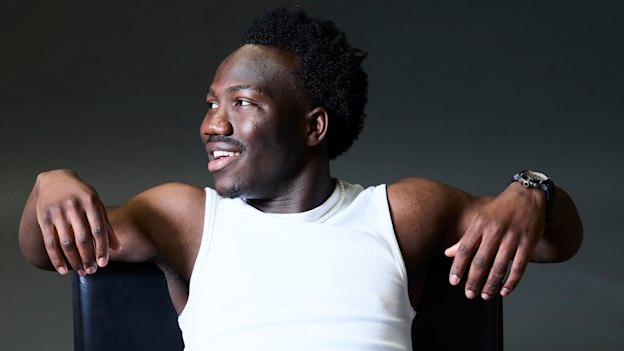
“There was like a switch, you know?” Irankunda says. “When I first got to Bayern, I thought it was going to be sunny days, that it would be not easy, but eventually my talent would get me to where people expect me to be. And then reality hit, and it wasn’t like that. Then I started to look at the older boys and how they were doing it, and you could see the hunger, the determination, the hard work and the right attitude to try and achieve great things.”
Fortunately, some of Bayern’s stars took him under their wings. He became close mates with Canadian international Alphonso Davies, Germany’s Jamal Musiala and England captain Harry Kane, the best striker on the planet right now. “Very good guys,” he says. Seeing how Kane handled himself on and off the pitch was an education in itself: “You learn a lot in terms of the way he plays and how he finishes, how composed he is, the way he tracks back.”
Irankunda is part of a group chat with nearly a dozen fellow Aussie footballers of a similar age and background, including the two Kuol brothers, the two Yengi brothers, plus Touré and his two brothers. They share stories and advice from their experiences trying to make their way in the game and support one another through tough times, which came in handy for Irankunda during the darker periods at Bayern.
Touré admits he’s harder on him than anyone else – but only because he knows he could become the best of the lot. “I like to research football players and their stories, and a lot of them struggled,” Touré says. “The greatest players, they always go through something. You see [Kylian] Mbappé nowadays getting booed at the Bernabéu [Real Madrid’s stadium]. Vinny [Vinícius Júnior] once got booed. Lamine Yamal was too arrogant. Jude Bellingham was overrated. These are the best in the world. If they can get criticised and go through hard times, who are we? So I just told him, ‘Bro, better days to come.’ When good things happen, don’t enjoy it so much and stay focused. And that’s the same with bad things: when you’re going through a bad thing, just know it’s a time, it’s a phase and it’ll go by.”
After just one year on their books – half of which was spent on loan at Swiss club Grasshoppers Club Zurich, the other for Bayern’s reserve team in Germany’s lower leagues – Irankunda was sold to Watford for a reported fee in the vicinity of €3 million to €4 million (about $4.9-$6.5 million). Bayern could see his potential, but decided he wasn’t ready to play a role for their first team (which was always going to be a long shot), and that he’d be better off continuing to develop at a club where he would. But they haven’t completely washed their hands of him: the deal included a buy-back clause which means that, if his career takes off, Bayern can sign him again for a pre-agreed fee, rather than his market value.
Still, not once while he was in Germany, not even in the most difficult moments, did Irankunda doubt himself. “No,” he says to that question. “I always thought I could do it. Even now, I still have the belief that eventually, maybe in a few years, I can be there again and achieve good things.”
The penny seems to have dropped. Irankunda has been a standout for Watford in the English Championship, immediately announcing himself to his new club by scoring two almost identical jaw-dropping free kicks in back-to-back games, early in his tenure. He has had his challenges: in one match, he was subbed off in the 35th minute – first-half substitutions are rarely made except for injury – and reacted to his coach’s decision by punching a chair in the dugout, throwing a water bottle and storming down the tunnel. He was not exactly in a stable environment, either, with Watford churning through four different coaches this season, but he worked hard to come back from being dropped to the bench midway through to re-establishing himself as a starter. The defensive side of his game has clearly improved, and so has his ability to remain dialled in during periods where things aren’t going his way and to stop letting opposition players get under his skin. When he gets his moment, he rarely wastes it.
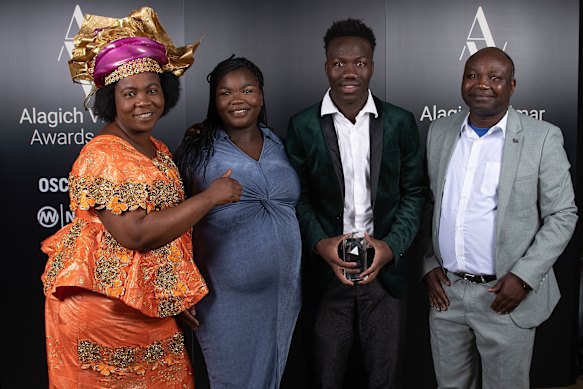
Susana paid him a visit a few months ago and marvelled at the man she can see he is becoming. “Oh my goodness, he’s progressed,” she says. “Mentally, the way he speaks, the way he represents himself, he’s come a long way. Just watching the way he played football there was the best thing I’ve actually ever witnessed … on the stage in London, a lot more people, and the energy he had, I was like, ‘What the hell? I’ve never seen this.’ ” Though Watford fell well short of promotion to the Premier League, Irankunda might find his own way there soon: he is reportedly being monitored by Crystal Palace and Everton, plus Italy’s Fiorentina and Germany’s Bayer Leverkusen. A good World Cup will only boost interest in him. “Whatever happens, happens for me,” he says. “All this noise that’s out there, I don’t really care about it.”
No matter what comes next, Irankunda has already earned an amount of money that has proven life-changing for his family. Growing up, he was aware that they didn’t have much of it. Two of his brothers had to stop playing football so that they could afford Irankunda’s registration fees, which can tally into the thousands for elite development programs. This user-pays system is a source of great controversy in the Australian game, and Irankunda still doesn’t understand why it’s so expensive, arguing that lower-income families are at risk of being priced out. “The fees here, goddamn, it’s ridiculous,” he says. “They need to drop it. First of all, they don’t even like the sport that much here. They prefer AFL more than soccer. If that’s the case, just drop the fees, because there’s going to be so much talent wasted.”
Earlier this year, this masthead reported Irankunda was on an estimated £780,000 (about $1.5 million) at Watford, making him one of the highest-paid Australian athletes aged under 23 in world sport. He loves the fact that he can now buy his parents or his siblings something nice for no reason. “I do that a lot,” he says. “They deserve it.” He is too young to know what they went through back in Africa, but Susana isn’t: shootings, bombings, kidnappings, which have squeezed the happier memories out of her brain. It’s why they’re so grateful that Australia took them in.
“Every now and then I look back, and I think to myself, my parents probably went through so much,” Irankunda says. “My older sister especially – because we had an older sibling who passed, a very long time ago. I’m just glad they’re here now, living a happy life, because if it wasn’t for Australia accepting us, I don’t know where we’d be. And no one would know me. There would be no Nestor Irankunda without Australia.”
Irankunda was recently named by the UN Refugee Agency in a “Gamechanging XI” of players from the upcoming World Cup with a refugee or displacement background, alongside Touré. They both take their status as role models within their community seriously. The African diaspora in suburban Adelaide is proving to be a rich pipeline for the Australian game, and they want to make sure it keeps producing. “We’re all inspiration to each other. We all show togetherness so the young boys who are coming up, when they look at us, they want to be exactly like us,” Touré says. “And then it’s just a chain reaction, and we keep getting more and more very good footballers. We’re showing the community that it is possible to play at the highest level. You’ve just gotta work.”
As his phone continues to ping with notifications, Irankunda fondly recalls sliding into the DMs of the players at Adelaide United he once looked up to. “It would probably be the same with the kids who look up to us now. They’d probably try and message us,” he says. “Eventually, if one of them makes it as a professional footballer, they’ll remember it. Imagine we become friends, they’ll always tell the story. I really thank all the kids who support me and Mo [Touré] because we just try to bring the joy to the game for them and try to make them happy and make the nation, and especially South Australia, proud.”
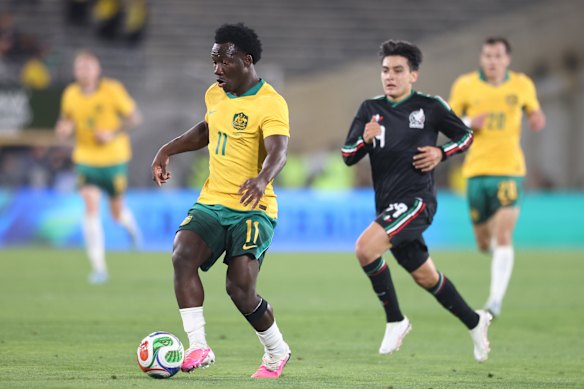
Irankunda is getting plenty of practice in front of the camera lately. He was the star of the Nike ad for the launch of the Socceroos’ uniforms for this World Cup, in which he drives a bulldozer over the Sydney Harbour Bridge with the phrase “MISSION TO WRECK” painted onto its blade.
“You just want to go out there and do what that says,” he says. “As a kid, you always want to be able to do what the guys before you were doing – Nike shoots and all that. When I got the opportunity to do it, I was super happy. I hope to do many more.”
The campaign hints at the lowly external expectations of the Socceroos, who have been drawn in Group D with Türkiye, who they face in their opening match on Sunday (June 14, 2pm AEST), plus co-hosts the United States and Paraguay. It is one of the hardest groups at the tournament to call, since each team would believe – rightly – that they are capable of beating all the others.
Naturally, few outside of Australia give the Socceroos much of a chance. When the draw was conducted in December, pundits from the US couldn’t help themselves when the Socceroos landed in their group: Mike Grella, a retired player from New York, described the Socceroos as a “lay-up” for the US, while former international Alexi Lalas said the group was a “gift from the soccer gods”.
Irankunda hasn’t forgotten. “I feel like most countries underestimate us until they come up against us,” he says. “Let these people talk, and we’ll show them on the day.”
All possibilities are on the table for the Socceroos: this could be a World Cup of gallant failures that will be looked back upon as the start of a new era, like Brazil 2014, or they could have their most successful run ever, like they did four years ago in Qatar.
The latter outcome would be a boon for the sport in this country. The public profile of the Socceroos has fallen dramatically over many years, to the point that the average Aussie sports fan right now would probably scan the list of names included in the squad and not recognise a single one.
That wasn’t always the case. For most of the past quarter-century or more, there has been a talismanic figure or two to rally behind, whether Tim Cahill or Harry Kewell, John Aloisi or Mark Viduka. Even casual local fans would have recognised surnames like Jedinak and Emerton, Neill and Bresciano. That kind of mainstream, household name status now belongs to various Matildas instead, such as Kerr, Fowler, Catley and Foord. Irankunda could be the man to redress that imbalance, with talents capable of carrying a team to prominence – on and off the pitch.
If he catches fire in the US, then look out. “In my heart, I truly believe that we can go pretty far – if not all the way – because we’ve got a strong team,” Irankunda says. “Why not?” As long as he is out there, the Socceroos will always feel like they have a chance at something extraordinary – and if he scores one of those goals for which he is known, on the biggest stage his sport has to offer, he will become an instant international sensation.
In Adelaide, at least, he already attracts the sort of attention usually reserved for AFL stars, to the point where Susana is reluctant to be seen in public with him. “I can’t lie, sometimes it gets so overwhelming,” she says. “As long as I’m not with Ness, I’m good – because when I’m with Ness, like, in the shops, people come running up to me, and I try to hide.”
Unfortunately, the closer he gets to fulfilling his potential, the harder it will be for Irankunda to go incognito anywhere. He is still just a young man with a gift, trying to figure it all out. But he is getting used to the spotlight and increasingly comfortable with being the player who people come to watch. “I just want to make people enjoy the game,” he says.
Read more from Good Weekend:
- Elijah was 10 when his friend typed ‘porn’ into a search engine. He was afraid – but unable to look away
- Exploitative and callous, or excellence and innovation? The man who wants athletes to push their bodies to the limit
- How Luke Bateman became Australia’s most unlikely book influencer
- Ant was at the peak of his career. Then it clicked: he had to put himself on the line
Get the best of Good Weekend delivered to your inbox every Saturday morning. Sign up for our newsletter.

















































