
 4 months ago
60
4 months ago
60
Cosmetics heiress Marianne Farrère, the titular figure in The Richest Woman in the World, thinks of money in round millions. When her grandson has his bar mitzvah, she hands him a cheque for a million euros, saying it will be fun to see what he does with it.
In the middle of a conversation about art, it strikes her that her new best friend, a middle-aged photographer, would really be able to spread his wings if he didn’t have to earn a living. How would he feel about a sponsorship? Would €2 million a year help? It’s my money, she insists when her daughter objects. Not that it’s so extravagant a gift as far as she’s concerned. A million euros is nothing.
The Richest Woman in the World is a fictional retelling of the Bettencourt affair which, over the course of a series of court battles that lasted almost a decade from 2007, gripped the imaginations of people who didn’t have quite so many millions to play with. Isabelle Huppert plays the plutocrat. Like everyone else, she has a new name, but the bones of the real story are all there. The only significant change the writers have made is to set it in the ’80s, possibly for the opportunity to relive some terrible haircuts.
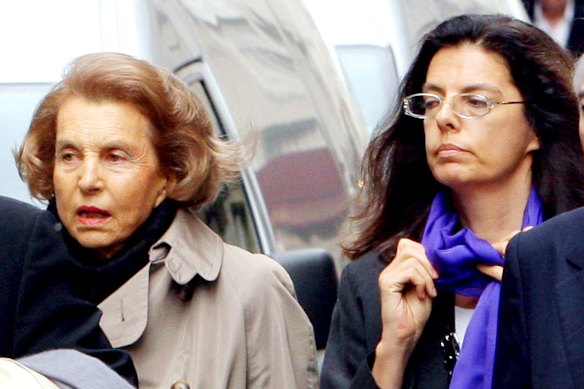
Liliane Bettencourt, the blueprint for Marianne, was indeed for a time the world’s richest woman. When she died aged 94 in 2017, she was worth an estimated $US44 billion. In the early ’90s, she had started bestowing money and artworks on Francois-Marie Banier, whom she met when he came to take her picture for a magazine. Her daughter, Francoise Bettencourt Meyers – who had largely eschewed the family business, preferring to play the piano – endured Banier for years before turning the full force of French law against him. By then, he had squirrelled away an estimated $US700 million – maybe a full billion – in Bettencourt largesse.
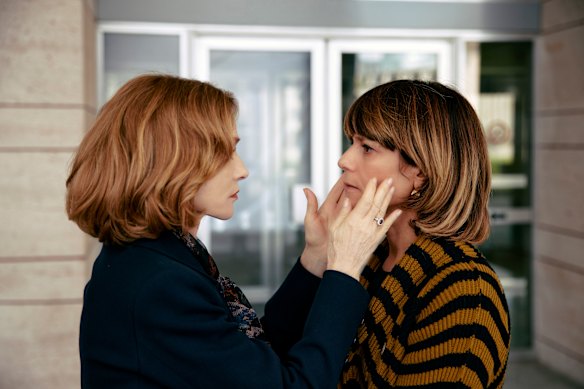
Francoise becomes Frédérique (Marina Foïs) for the film’s purposes, but is otherwise recognisably the furious daughter. As in life, she is in thrillingly underhanded cahoots with the family butler, who secretly records his boss’ conversations while she is having tea with her pet-shop boy. Also as in life, further scandals emerge as the case progresses. Bettencourt’s father, who built the business she inherited, wrote propaganda for the Nazis. More recent financial crimes – tax dodges and eye-watering political bribes – were uncovered. Francoise herself was investigated for bribing witnesses. The whole saga was a winning brew of money, misery and misdeeds: a real-life precursor to Succession.
Isabelle Huppert is 15 years younger than Bettencourt was at the time of the court case, but she slips into the role of Marianne as if donning an expensive kid glove, her customary froideur becoming the visible manifestation of this inconceivably rich woman’s distance from the world at large. What makes Marianne tick? We don’t know. Speaking in Cannes, where the film had its premiere last year, Huppert says that what appealed to her most about the script was that it wasn’t attempting a psychological study.
“There was something a bit theatrical about it,” she says. “It never enters her psyche. It’s not Emma Bovary; it’s very different from that. I think it was a lot more interesting to really do the film almost as a kind of a sociological study of how it works. That’s how the movie is modern, I think.” We don’t witness her pain as her family fractures and betrays her, assuming she feels any; instead, we see this business grandee going through the motions associated with wealth and power.
As a result, Huppert says frankly, she didn’t have to do a great deal to build a character. “You have to trust cinema in this case. As soon as you are being described and defined by what surrounds you – which is the house, the clothes, the way I was made up, the hair which is indicative of a certain bourgeois class – part of the job is done.”
As Marianne, she wears 70 different costumes over two hours, all of them redolent of quiet luxury and none of them branded; so much money doesn’t require labels. Her hair is set into a wave that seems to hold even in her sleep. If Huppert brought anything to this construct, she says, it was a particular “bodily attitude”. “There is no reason for her to be nervous or afraid of anything. She’s very calm.”
That kind of calm, however, may easily shade into ennui. When Banier’s fictional equivalent, now called Pierre-Alain Fantin (Laurent Lafitte) bursts into her tasteful Xanadu and starts telling her to muss up her hair, get new furniture and get rid of her Degas, (which he says is a fake as he scratches off some of the paint with his fingernail,) she is thrilled with his effrontery. This is the beginning of a passionate friendship. Her amiable, quietly corrupt husband Guy (André Marcon) can only watch from the sidelines.
“It is a kind of love,” says Huppert. Pierre-Alain is camp to the max. He thrives on outrageousness, peppering conversation with jokes about sex that leave Frédérique and her husband Jean-Marc (Mathieu Demy) ashen-faced. He has a live-in lover at home; there is no question that his relationship with Marianne will be consummated. “But there are scenes of physical closeness and I think there is a real attraction,” says Huppert. “He’s very charming, very much alive, a little dangerous and she is seduced by him. He makes her laugh – and she was ready to laugh. It’s like she was asleep.”
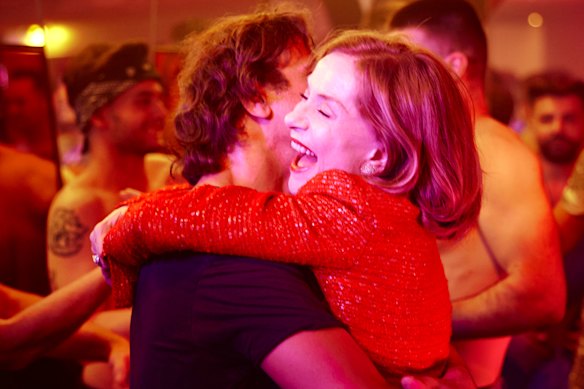
Pierre-Alain takes her dancing and pokes amyl up her nose; he curates a new art collection that leaves no space in the sitting room for photos of Frédérique; he crashes their family holidays. Whatever the weaknesses of the film – and critics have picked out quite a few – there is no question that the ambiguously exploitative relationship at its heart is common enough in life, but something that we don’t usually see on the screen.
There is another interesting twist on the facts of the case. Marianne shows little sign of Bettencourt’s dementia. She is still running the company, giving orders, impeccably coiffed right to the final titles. The point here is that she is never seen as a victim: another aspect of the script that appealed to Huppert, who points out that when Bettencourt was forced to sever her ties with Banier, it was “the first price she ever had to pay”. Neither she nor the film sympathises with Bettencourt, which was fundamental to Huppert’s performance.
“Maybe what I did mainly is not be moving,” she says. “You don’t care about her in those terms. We guess what she thinks, I was not interested in that. What makes the movie interesting, I think, is the mechanism of this immense fortune.”
Huppert says she knew only as much about the Bettencourt affair as anyone else who reads newspapers. She had never met her – surprisingly, given L’Oreal’s links and support for the French movie industry – and didn’t try to find out what she was like. “The film is a film, and I have very little in common with this woman. So it’s really a step into a fictional world. But in French, we say also that most of the time reality goes beyond fiction. And in this case, it’s really true.”
The Richest Woman in the World opens on May 21.
Want more Movies? We’ve got you.
- Newsletter: See our critical guide to what’s showing on a screen near you. Get Screening Room delivered every Thursday.
- The Mandalorian and Grogu: Michael Idato speaks to the team behind the latest Star Wars outing. LINK TO COME
- Pike River: Why the story of a real-life mining disaster drew Melanie Lynskey home to New Zealand.

















































