3 months ago
27
3 months ago
27
Australian households are carrying almost three times as much debt as they were in 1990, most of which is housing debt, Australian Bureau of Statistics data shows.
Experts said the increased debt load was magnifying the impact of interest-rate movements on household budgets.
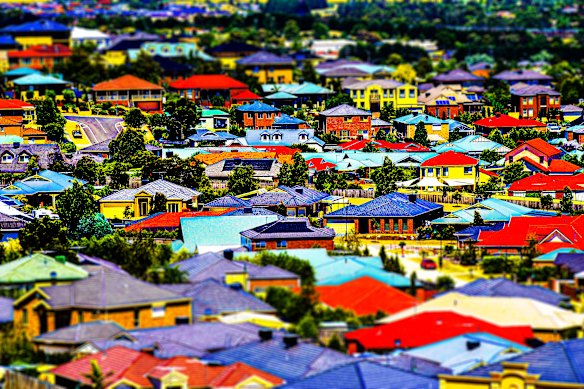
Households’ higher debt loads are magnifying the impact of rate movements, experts say.Credit: Wayne Taylor & Matt Davidson
“Interest rates are essentially the cost of debt, so if households have higher levels of debt, they’re going to be a lot more sensitive to the cost of that debt,” said Tim Lawless, Cotality research director, which crunched the data.
Australian households’ ratio of debt to annualised disposable income was 176.1 per cent in September 2025, the data showed.
The ratio of housing debt – that is, home loans – to annualised household disposable income was 132.4 per cent in the same period.
The cash rate in September 2025 was 3.60 per cent, 25 basis points below its current level.
In 1990, when Australia underwent a recession, interest rates were much higher, reaching 17 per cent in March 1990.
But debt levels at the time were significantly lower.
Households’ ratio of debt to annualised disposable income was 67.9 per cent in March 1990, and the ratio of housing debt to annualised disposable income was just 31.5 per cent.
“When you look at the trajectory of debt from the early 1990s to now, not only has overall debt risen significantly, but the housing-debt component has risen from less than half to about three quarters,” said Lawless.
“Today, household debt is at near-record highs.”
Independent economist Saul Eslake said widespread changes in Australia’s banking sector in the early 1990s made it easier for households to start borrowing more.
For one, lenders began including female earners when assessing household income.
Loading
“It was incredibly sexist, but until the early 1990s banks would typically disregard the earnings of a female partner because they assumed that she would soon be stopping work and having babies,” Eslake said.
Concurrently, deregulation and the privatisation of some financial institutions increased competition between the banks, prompting some to relax their lending standards.
“This was generally perceived as a good thing: people could borrow more money, so they were more likely to become home owners,” Eslake said.
The 1990s also marked the beginning of the run-up in Australian property prices that continues today, Eslake said.
“Since then, house prices have risen more than twice as much as incomes have risen.”

Lack of housing supply has been a key driver of Australian property prices.Credit: Oscar Colman
He said a lack of housing supply had been the key driver of Australian property prices, but financial, taxation and other economic policies had also played a part.
In 1999, for example, changes to the capital gains tax regime made negative gearing an attractive investment strategy, encouraging more Australians to buy investment properties with debt.
“Anything that allows Australians to spend more on housing than they’d otherwise be able to – be it easier credit conditions, tax breaks for investors, stamp duty concessions or first home owner schemes – results in more expensive housing,” Eslake said.
Despite the current high levels of household debt, Lawless said the risk of large numbers of Australians defaulting on their loans was low.
“We still have very strong prudential standards, where borrowers are assessed on their ability to repay their debt under certain stress situations.”
Those standards meant Australian borrowers were generally “swimming between the flags” where it was relatively safe to do so.
“Mortgage arrears rates are about 1.6 per cent, which is extraordinarily small, and I think reflects the responsible lending standards that Australian lenders and regulators have imposed.”
Eslake said Australians had accumulated not just debt, but also assets like property, helping offset the nation’s current debt burden.
“Although debt is near a record high as a percentage of income, it is well below the 2009 record high as a percentage of the assets against which it’s secured.”
Loading
For the current debt situation to become a mortgage-default crisis, unemployment would need to rise significantly, said Lawless.
“At the moment, labour markets are very tight, and they’re forecast to remain tight for the next couple of years. Most people who want a job have a job, and that acts as another safety blanket for the Australian housing sector.”
Eslake said the importance of home ownership in Australia’s psyche meant most borrowers would “do anything” to avoid defaulting.
“We Australians are pretty shameless about lots of things, but that’s something we’ll go to extraordinary lengths to avoid. We’ll take our kids out of private schools. We’ll not go on holidays. We’ll go to Macca’s instead of better restaurants, or not go to Macca’s at all,” he said.
Despite their reassurances, both Eslake and Lawless said Australia had entered a new era of financial angst.
“A decade ago, hardly anyone was tuning in to the Reserve Bank’s interest-rate decision on the first Tuesday of the month,” said Lawless. ”Now, everybody does.”
Most Viewed in Property
Loading