3 months ago
26
3 months ago
26
Jesse Welles can’t pinpoint the precise moment when he went from low-profile struggling musician to one of the hottest country-folk properties on the planet. But he has a rough idea.
“I think it was February 2024,” he says. “That was when I decided I was going to make tunes all the time and just throw them up on my cell phone and put them on social media, and do topical songs about things that interest me, and say things that I really mean,” he says.
With a slew of protest songs such as War Isn’t Murder, Join ICE and United Health (released a week after the assassination of the private health insurer’s CEO Brian Thompson in December 2024), Welles’ retooled approach rapidly found him a global audience. But the motivation for the change of approach came from close to home.
“My old man had a heart attack, and I think that had something to do with it,” he says. “He lived. But I just thought, ‘I don’t have long, and the clock is ticking’, so I got into a big hurry about things.”
The momentum that change of direction created has garnered Welles a hefty following on social media – 2 million followers on Instagram, almost 26 million likes on TikTok, over 100 million views on YouTube – and guest slots with Stephen Colbert and Jimmy Kimmel. An equal opportunity social commentator, he’s also been a guest on the Joe Rogan Experience (where his left-leaning humanist views rubbed uncomfortably against Rogan’s right-leaning conspiracies).
Now, it will carry him all the way to Australia for his first shows here in January, and to the Grammys the following month, where he is nominated for four awards (best folk album for Under The Powerlines (April 24 – September 24), best Americana album for Middle, best American roots song for Middle, and best Americana performance for Horses).
Welles was, in fact, originally scheduled to play at the Corner Hotel in Melbourne on the night of the Grammys; the Australian tour dates have now been rescheduled so he can attend the ceremony, and perhaps collect one or more of those famous gramophone-shaped statuettes.
Welles, 33, has been recording and releasing music since 2012, under the names Jeh Sea Wells (Wells is how his surname is spelled on his birth certificate), and with the bands Welles, Dead Indian and Cosmic American.
He moved from his native Arkansas to Nashville a decade ago, and began releasing records in a steady stream that has picked up pace in recent times. Discogs records eight albums, all non-label releases, between 2012 and 2018; the indie-label Welles band release Red Trees and White Noise (a grunge-tinged rock album, with a big dash of Nirvana) came out in 2018, and Wikipedia records another four releases under that moniker up to 2023.
Since 2024, he’s become even more prolific, with eight album releases to his name. The big difference now is that people are paying attention.
“As far as making tunes goes, I have just always made a couple of songs a week,” says Welles, chatting from his home in Arkansas for his only Australian interview ahead of this tour. “And if you do that for like 10 years, and then finally people start digging it, well, then you’re primed and ready to go.”
But he says he’s not using his newfound profile to clear the cupboards of old material. “I’ve got albums and albums worth of stuff from back in the day, but I don’t want to listen to it, and I certainly don’t want to put it out or anything like that because the only thing that interests me is the song I made yesterday, and then I’m on to the next thing,” he says.
That said, Welles wouldn’t object if some of his tunes did stand the test of time. It’s just that right now, he’s more focused on pumping them out than curating a nominal best-of release.
“I feel like you’re a very fortunate person if you’re able to grow tired of a song that everybody else loves to hear,” he says. “Think of someone like Sheryl Crow, she’s playing things from a long time ago and almost every time she gets up they want to hear that song, but she seems to still do it with such joy, and I think that’s probably because she’s tapped into [a sense of], ‘boy, have I had good fortune to make people happy with this tune’.
“I would love for that to happen,” he says. “I like playing my tunes, but as far as being proud of any tune or anything like that, not yet. Being proud of it, you have to kind of stop and think about it, and I just don’t want to. Now is not the time.”
I like playing my tunes, but as far as being proud of any tune or anything like that, not yet. Now is not the time.
Flooding the market with material isn’t necessarily good business – or at least not good traditional business. But it’s the way Welles works, for now at least.
“There’s been no promise on quality, there’s no satisfaction guaranteed on any of it,” he says, smiling impishly. “As many songs as people remember, that many again have fallen through the cracks. I just think it’s important to put out every single tune that you do as you do it, or else you’ll never know what people like. If you get too myopic or precious with songs, or really any kind of art, you could clog yourself up.
“This is just how I work, and maybe next year I’ll put out one album, and I’ll be really honed in on it. But I really don’t like the sound of that.”
Loading
Music has always been a fact of life for Welles. He grew up in a working-class household, but everyone in it had a sideline creative pursuit. His was the guitar, and then songwriting and singing.
In fact, he even owes his marriage to wife Kara to the instrument, in a roundabout way.
“We met when I was 14, and her guitar teacher had just skipped town,” he says. “We were both in junior high, and she was like, ‘will you give me some guitar lessons?’. And of course, everything I showed her she already knew. I couldn’t really show her anything. I couldn’t really impress her. But we were fast friends, and … well, we eventually got married.”
They’ve been married six years, and moved to Nashville together in 2014, for a shot at the music business as most people understand it.
“If the goal was to have fun and make friends, then I was very successful,” he says of the seven years he spent in the country music capital of the world (though he was playing something much closer to indie rock). “If it was to be in a touring band – and that was the goal for me – I was very successful.
“I really enjoyed Nashville. I think I just missed nature, though, which I didn’t really realise until we were a little ways into the pandemic. I had gone back to Arkansas to visit for Thanksgiving or something, and I was driving through the mountains, and I was just kind of overcome with this sense of, ‘Oh, I gotta get back out in the woods; this is what has been missing’. And so I asked my wife if she’d be keen to come back to Arkansas and she said ‘yeah’. And by the end of 2021, we were here again.”
Most of Welles’ videos – typically shot on a phone, in portrait mode – feature him singing and playing guitar alone in the woods, or maybe beside a railway line. Jeans, check or denim shirt, shaggy hair, sometimes with harmonica too. It screams Americana, home-made, authentic.
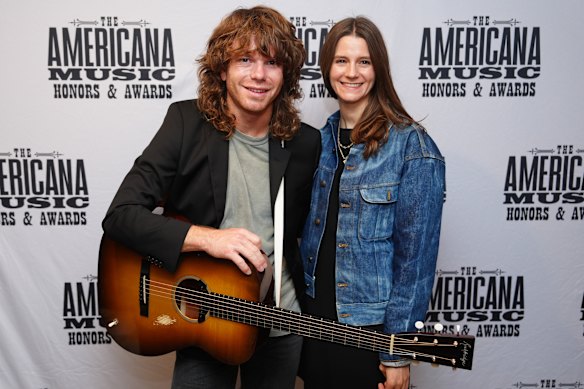
Jess and Kara Welles in Nashville in September. Credit: Getty Images for Americana Music Association
In some ways, he’s emerged from the same milieu – poor, white-trash America – that gave birth to JD Vance, though their world views could hardly be more diametrically opposed. And the success of this politicised incarnation of Welles arguably owes much to the rise of Donald Trump and the need for a voice that speaks for working-class people who aspire to something more than mere personal gain.
Take the song that’s done most to put him on the map, War Isn’t Murder, on which he sings:
“War isn’t murder, there’s money at stake,
Girl, even Kushner agrees it’s good real estate
War isn’t murder, ask Netanyahu
He’s got a song for that and a bomb for you.”
Not everything he produces is political, of course. Alongside the critiques of late-stage capitalism, there are amusing ditties about insects and cows and birds and friends.
“I try to have 50 per cent research and 50 per cent whimsy,” he says of his approach. “I’ll do some topical tunes, I’ll do some research on things that interest me – because you’re really just seeing a reflection of my interests in song – and then whimsy, things that interest me. Sometimes we get a little metaphysical, sometimes I turn into a weird wizard, but then other times I’m talking about health insurance. I contain multiple dudes.”
Some of his work is undoubtedly political – how else to understand lyrics like “if you’re in need of a gig that’ll help you feel big, come with me and put some folks in detention” (Join ICE)? – but Welles isn’t keen on being pigeonholed on party lines.
“That’s a huge problem, where folks feel as though they personally need to be one [Republican or Democrat] or the other, or they find great comfort in being one or the other,” he says. “If you really do feel totally and utterly at home in one of these groups, I think you’ve got some soul-searching to do. Because we’re nuanced, and we’re complicated, and we’re not always the same, even in our own lifetimes.
“People grow, people regress, people change. And to not acknowledge that is setting yourself up for disappointment – existential disappointment.”
In fact, the one thing Welles is unabashedly against is certainty, in whatever form it takes.

Jesse Welles spent seven years in Nashville but missed the wilds of Arkansas and moved home in 2021.Credit: NYT
“I just don’t think anyone can really purport to know, and you should be wary of anyone who does, and that goes across the board,” he says. “The same people that come up and tell you, ‘I know what this Bible means, boy’, just anyone who’s really assured, is someone to keep your distance from. Certainty is such an illusion, and so is control.”
Musically and lyrically, Welles seems grounded in the tradition of Woody Guthrie and Bob Dylan (in live shows he has done recently, he has been joined on stage by Joan Baez). Much of his material is grounded in very real American specifics – songs about Walmart consumerism, rustbelt unemployment, the unaffordability of healthcare. He admits to some surprise that these songs have resonated around the world in the way they have – but also, why not?
“One of America’s finest exports is chaos,” he says. “I get a big kick out of being in Berlin, playing Walmart, and listening to everybody with their accents sing about a grocery store they’ve never been to, with great gusto. I think it’s an attitude, it’s just a general malaise that we are having with multinational corporations in our world, and the dissolution with this kind of late-stage ultra-capitalism.”
Perhaps the key to understanding why his music is transcending borders and resonating is that it ultimately is not about political talking points so much as how politics and economics hit ordinary people where they live.
“Everybody’s got an opinion until it comes into their house,” he says. “And then you realise that we are, by and large, compassionate people and loving people and we’re open to new and strange ideas when we are actually confronted with them face to face, and they inhabit somebody that we love or are close to, somebody that we care a lot about.”
Jesse Welles’ rescheduled Australian tour now runs from January 19 at the Corner Hotel in Melbourne and winds up at The Gov in Adelaide on January 29. Details and full dates at wellesmusic.com