3 months ago
22
3 months ago
22
By Lisa Miller
January 20, 2026 — 5.00am
Not to be all Russell Crowe about it, but this morning, I biked to the gym before dawn, loaded up a barbell and did three sets of five squats with the weight of a small washing machine on my back. Then, having done that without too much trouble, I picked more than 45 kilograms of metal off the floor. I am 62 years old and feeling pretty proud of myself.
When I was first diagnosed with osteoporosis, at age 58, I argued with the endocrinologist. I am healthy, I told him. I am fit. I have been a runner, a swimmer, a yoga practitioner all my life. The doctor, a cold fish, was unmoved. “You have had cancer and a pulmonary embolism in the last five years,” he told me. “You aren’t as healthy as all that.” I sulked. At 60, I started taking a statin.
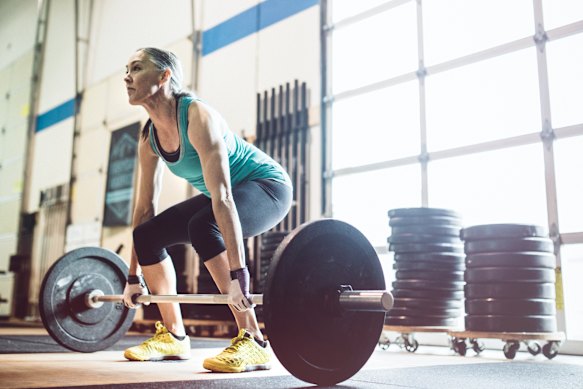
Weight training is one of the best ways to combat the weight gain that often accompanies ageing.Credit: Getty Images
Then, last summer, I gained more than four kilograms. The weight gain was perfectly explicable: I had a new job, came home each evening ravenous and depleted and regularly needed a cheese plate and a tequila beverage to revive before dinner. This time, my beloved gynaecologist issued a gentler warning. Weight training, she reminded me, is one of the best ways to combat the weight gain that often accompanies ageing. In addition to building muscle strength and bone density, it can also boost metabolism.
I knew this, of course. “Lift heavy” has become a mantra on social media, prescribed as a cure not just for age-related ailments but for better posture, low self-image and depression. But I am suspicious of trendy remedies and frankly thought of myself as indomitable, so I had relegated weight training – like ageing itself – into the category of things that other people do.
If I’m honest, it was vanity and not health-seeking that led me to register for Starting Strength, a thrice-weekly weight training class at the CrossFit gym near my home in New York. I wanted my trousers to fit me in a more flattering way. Developed by a Texas-based powerlifting coach named Mark Rippetoe, “Starting Strength” is both the title of Rippetoe’s 2005 book and a course that instructs weight lifters of all levels in five primary lifts: squat, bench press, shoulder press, deadlift and power clean.
Loading
Rippetoe’s acolytes tend to disdain boot camps and weight machines and other newfangled exercise trends, believing that physical strength is built by learning the proper technique for lifting barbells loaded with increasingly heavy weight over time. My husband, always a gym guy, had taken the course and stressed the importance of learning to lift heavy under supervision to minimise the risk of injury.
The art of heavy lifting is learning to operate in the margin between success and failure. You ask your body to move so much weight that it forces an argument in your mind. Can I, can’t I? Will I, won’t I? One of my classmates calls each lift “an act of courage”. Our coach, a soft-spoken, wry man named Jeremy Fisher (who, at age 48, can shoulder press 117 kilograms), will quickly eyeball a new student and assess their limits.
“You start where you are,” the lifters say, and in my class there are people – men and women, old and young – who are squatting two kilograms and others who are squatting more than 90. In July, when I started, I had never used a barbell before. I yoked my shoulders to a nine-kilogram bar, moved my butt down below my arthritic knees, then pushed myself back to standing. After three sets of five, I saw stars.
As you age, stuff happens that no amount of mental toughness can forestall. The pulmonary embolism, brought on by a long flight at age 56, scared the hell out of me. For months afterward, I was shaken. I could have died. The breast cancer, the following year, was less existentially scary but far more painful. My bones started thinning around then, thanks to the medication I took to prevent a recurrence of cancer. By the time I joined Starting Strength, the osteoarthritis in my knees was causing a limp.
Loading
When you lift heavy over time, you build reserves of strength. You accrue power for now, and also for later. It requires facing your own physical limitations (and maybe your own mortality). This self-knowledge can come at any age, but it came to me late and only when the evidence was undeniable.
In class, we proceed slowly and carefully. With every lift, Jeremy observes the alignment of our joints and the angles of our backs, occasionally issuing corrections: “chest up,” “drive with your hips”. In the squat, after shouldering the weight, I back up from the rack and consider my feet, how they feel on the floor. I suck in my breath, pull my shoulders back and fiercely compress every muscle in my core. I am making my body into something firm and hard: a lever, a hinge. I sink down, then push with my hamstrings, glutes and quads until I am standing again. Then I exhale.
I keep a record of my progress on my phone. It’s two steps forward and one step back. I am squatting 29 kilograms right now, which is more than I was squatting at Christmas and less than at Halloween. In the culture of my gym, it’s all baby weight. I am a novice here, a fresh beginner; sometimes, with my grey hair and arm flab, I worry that I’m ludicrous. But the gym is cool. Nirvana is playing, and we cheer each other on through whatever we, individually, are struggling with. Whatever the number on the iron plates, this is hard. I have a goal for my squat, but I won’t say it out loud. That would be getting ahead of myself.
Here’s what I’ve noticed. My trousers fit. I can carry the cat litter bag up four flights of stairs without any fuss. I can move the biggest cast-iron pan out of the oven and easily lift my suitcase into the overhead rack. My walk to the subway is pleasurable again, and my last bone scan showed improvement.
The New York Times
Get a weekly wrap of views that will challenge, champion and inform your own. Sign up for our Opinion newsletter.
Most Viewed in Lifestyle
Loading