3 months ago
14
3 months ago
14
Prince William calls him “a brilliant ambassador” for his causes. His mother, Terri, says, “he’s just got this beautiful soul”. And his co-host on I’m A Celebrity Get Me Out of Here, Julia Morris, says his authenticity was key to creating their chemistry: “There’s just a yumminess that can’t be faked.”
Robert Irwin – famous son, wildlife adventurer, photographer, TV host and now TV contestant – has even charmed all three of America’s Dancing with the Stars judges Derek Hough, Carrie Ann Inaba and Bruno Tonioli, which is not as easy as it sounds given the reality TV genre’s affection for spicy rulings.
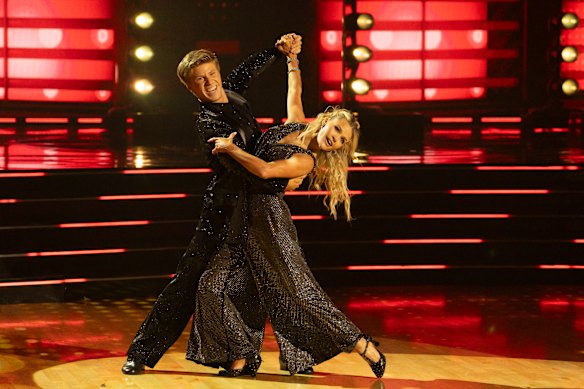
Robert Irwin and Witney Carson have won Season 34 of Dancing with the Stars.Credit: Disney
Hough complimented Irwin’s “infectious energy that just makes everyone smile”. Inaba said he brings “such a pure joy to the ballroom”. And Tonioli said: “The charisma, the charm, it’s all there.”
Tonight, all of Irwin’s charisma was funnelled into a charm offensive which propelled him to victory in the 34th season of Dancing with the Stars. The physical prize: a garish crystal trophy. The real prize? An injection of brand capital that will transform Irwin’s global fame.
The series finished with a spectacle: Irwin slugged his way through a heated, three-round, three-hour live season finale in Los Angeles. He had a rib injury. But he had already won the love of the American heartland, whose affection - along with grit - propelled him into the win.
So, does that make him TV’s new Six Million Dollar Man? Try 30, says Eric Schiffer, a leading US consultant on reputation and brand. “If I had to say in dollar terms, this has probably increased his brand equity in the $US10 million to $US30 million range, and additional opportunities that will be available to him with sponsors, brands and tie-ins,” Schiffer says. “It’s significant.”
Part of that springs from the established value of his personal brand, a confluence of emotional touchpoints that collectively create a positive halo: the legacy of his much-loved father, the “Crocodile Hunter” Steve Irwin, the tightness of his family relationships, particularly mum Terri and sister Bindi, and Bindi’s success as a winner of Dancing with the Stars herself.
Uniquely too, landing in 2025 has made Irwin’s Dancing with the Stars journey an extremely positive story in an otherwise overwhelmingly negative news cycle. As audiences desperately twist the dial, looking for alternatives to the US government shutdown, the stalled Gaza ceasefire, Trump’s on-again-off-again tariffs and gloomy forecasts for the global economy, Irwin’s story is all net positives.
“The Irwin franchise sells wonder not warfare, or negativity, and that’s why it keeps indicating to new generations,” Schiffer says. “Positivity travels across party lines, across geographic lines. You can’t fake joy every Tuesday [US time, when Dancing with the Stars airs]. The ballroom has been a lie detector. I think in a market drunk on cynicism, kindness is contrary and valuable from an investor’s standpoint.”
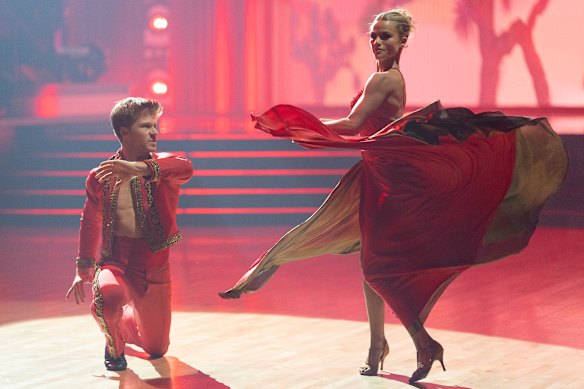
“Where do you think we’d be if everyone went around making up their own steps?” Robert Irwin and Witney Carson tear up the floor.Credit: Disney/ABC
Central to all of this is Irwin’s authenticity. He is dedicated to conservation, like his father, and involves himself in environmental causes. His brand is family focused, appealing across ages and demographics. And – critically – he just seems like a really nice guy.
In the spotlight this season, he’s worn his emotions like a sequinned vest. In one of his most memorable performances, a contemporary dance to Phil Collins’ You’ll Be In My Heart – dedicated to his mother – he spun dance partner Witney Carson into the shadows, only to have mum Terri take her place and step into the performance for its final turn.

Mother and son embrace: Terri and Robert Irwin share an emotional moment after one of Robert’s winning performances on Dancing with the Stars.
Irwin was unable to hold back his tears. Even Love Island-hardened TV critics were left sobbing and clutching their Kleenex boxes.
It should come as no surprise that all of this is happening a month after Irwin topped the 2025 Australian Talent Index’s Top Talent Report. The report, released annually, measures positive and negative consumer sentiment around specific celebrities, and ranks them in terms of inclusive campaign value to marketers, media buyers and brands.
Speaking to the US magazine People earlier this year, Irwin credited his family – “the dad that I had, the mum that I have” – for giving him incredible guidance. “I was born and raised and grew up in a family business and a family environment, you know, creating this amazing empire of conservation and a positivity,” he said.
The real value of authenticity is difficult to pin a number on, but Schiffer goes one step further, saying authenticity can be optimised but never faked. “You can optimise someone’s ability to be at their most authentic self,” Schiffer says. “I think his father, Steve, was an authentic man who lived a life of passion and adventure and Robert modelled that and was able to tap into his own authenticity.
“But can you manufacture it? You can’t manufacture authenticity that isn’t real,” Schiffer says. “You can help someone optimise, to have them be their most authentic self and be the most connected to what brings them joy and happiness and a sense of importance in their life. All of those things come across glaringly with Robert on our screens.”
Why this experience will be so transformative, compared to other “viral” moments or clock-stopping events in popular culture, is difficult to discern. Unlike social media platforms, television still has the unique power to claim a single moment universally and equitably, with the audience all in the one place at the one time.
“There’s a tribal element to television because of the temporality, and the greatest example of that would be the Super Bowl,” Schiffer says.
“It’s different from social media, where it’s asymmetric to time. You just are not going to get the number of people who are tuning in at the same time. That created its own excitement, adrenaline and thrill, and also meaning.
Loading
“We get joy from connecting with people,” Schiffer adds. “And if it’s happening at the same time, even though they may be on social and talking about things, you’re still connected with others, and you know others are watching this. There’s a connectedness that’s different to watching it or seeing it on social. It can bring joy, but it also can bring meaning.”
Find out the next TV, streaming series and movies to add to your must-sees. Get The Watchlist delivered every Thursday.
Most Viewed in Culture
Loading