3 months ago
8
3 months ago
8
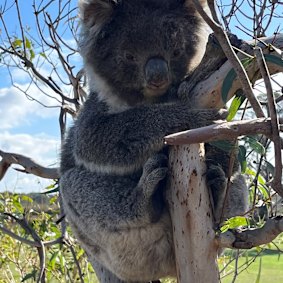
A koala clings to a mostly stripped tree on French Island.Credit: Scott Coutts
The koalas on French Island, which is almost free from feral cats and foxes and two-thirds national park, don’t suffer from the deadly chlamydia that has devastated populations elsewhere.
However, the fragmentation of Victoria’s remnant koala populations leaves them vulnerable to localised conditions, including drought and overpopulation.
The Victorian Koala Management Strategy, developed in 2023, notes that without fertility control, the “chlamydia-free koala population of French Island will double itself within five years”.
Scott Coutts retired four years ago as a park ranger of 35 years’ experience on French Island, where he was helping manage its koala population.
He estimated the population had grown from a relatively stable 5000 to up to 12,000 in the past decade as the number of koalas translocated to other islands dwindled.
“No translocations have happened since [2015], and not enough female koalas have been implanted [with birth control] to do anything about the population, which doubles every three or four years because they don’t have any diseases,” Coutts said.
“In the koala population on French Island, it’s always been known that they’re a very fecund population.”
Associate Professor Desley Whisson said while koalas could reproduce at the rate of only one joey a year, there was no way for them to disperse off French Island, meaning their numbers steadily increased.
She said the levels of suffering endured by the koalas on French Island were frustrating and distressing, and said the government had failed to take swift action to alleviate suffering.
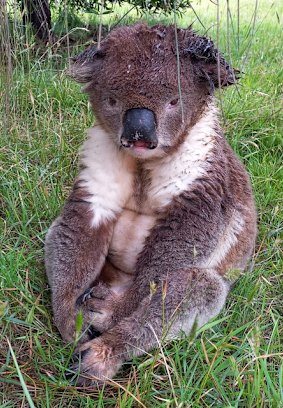
A distressed and unwell koala on French Island.Credit: Kathryn Shain
In 2013, she surveyed starving koalas in Cape Otway trying to eat bracken, grass and even dirt.
“I think I’m still traumatised by that,” said Whisson, who has advised governments on koala management strategy for almost 20 years.
Of the situation on French Island, Whisson said: “It’s just horrific.
“It shouldn’t be something that needs discussion ... there should be something done to alleviate that suffering, and it should never have got to this point to start with if there had been effective management implemented years ago.”
In the recent National Parks Act annual report, Parks Victoria reported it had conducted health checks and fertility control programs at Budj Bim National Park, Raymond Island and French Island last spring and this autumn, although it did not provide details of how many animals were sterilised.
When this masthead visited last month, the prominence of koalas sitting in spindly trees low to the ground was striking. One koala was observed in a tree largely stripped of leaves, about two metres off the ground.
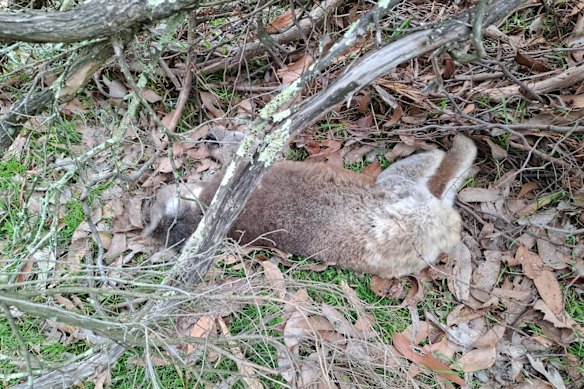
A koala lies dead on French Island in a recent photo taken by former park ranger Scott Coutts.Credit: Scott Coutts
French Island resident Kathryn Shain started a petition calling on the Department of Energy, Environment and Climate Action to find humane solutions to the starvation of local koalas and the destruction of French Island’s delicate environment.
“We’re losing the koalas to starvation at a rapid rate, but we’re also losing our trees,” Shain said.
“The ecological balance on the island is right out of kilter ... there needs to be a major intervention right now.”
Fellow resident David Paonetti said he had seen some koalas so sick they could no longer climb trees and simply sat beneath them.
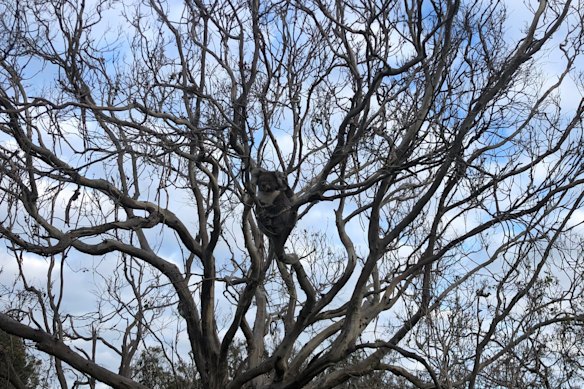
Koalas are rapidly running out of food as residents urge the government to send more resources to French Island.Credit: Sue Jenkins
“You see them wandering from one tree to the other, but there is really no food for them,” he said. “They’re trying to eat other stuff. It’s not good for them, you know, it makes them sick ... you can see them in a pine tree, trying to eat the pine needles.”
Paonetti, who has planted hundreds of trees since moving to the island in 1998, said residents were facing the heartbreaking decision to put bands around some trees so they weren’t killed by starving koalas.
Loading
“I would say [of] 400 to 500 trees [on my property], I think half of them are dead,” he said.
“We are suffering as people of French Island to see that because, of course, we love the koala. So it’s putting a toll on us. It’s putting the toll on the koala.”
Moving koala populations has been attempted in several locations across Australia, but is a difficult process. The Guardian reported in May that more than half of a group of 13 koalas translocated to a forest on the NSW South Coast died.
Friends of the Earth has documented “boom and bust” patterns that have emerged with translocated koalas in Cape Otway, French island and Phillip Island.
French Island resident Sue Jenkins said in more than 25 years, she had never seen conditions so bad.
“All the [tree] species koalas like are leafless. It’s tragic,” she said.
Animal Justice Party MP Georgie Purcell said a catastrophe was unfolding in public view.
“At its core, this is a habitat restoration crisis. This is a problem created by government decisions – and now it’s their responsibility to fix it.”
Get to the heart of what’s happening with climate change and the environment. Sign up for our fortnightly Environment newsletter.