3 months ago
15
3 months ago
15
How do you follow a surprise heavyweight hit such as Adolescence, the confronting, harrowing and complex miniseries about the arrest of a teenage boy for murder, which dominated pop culture and political debates almost immediately on its release last March?
If you’re Jack Thorne, you just keep writing. It’s a method that’s worked well for the past two decades for the British screenwriter and playwright behind venerated dramas such as This Is England, National Treasure and Toxic Town, as well as the pop culture hits Enola Holmes and Harry Potter and the Cursed Child. That’s not to say he and Adolescence co-creator and star Stephen Graham don’t feel the pressure, with preliminary talks under way with Netflix for a second season.
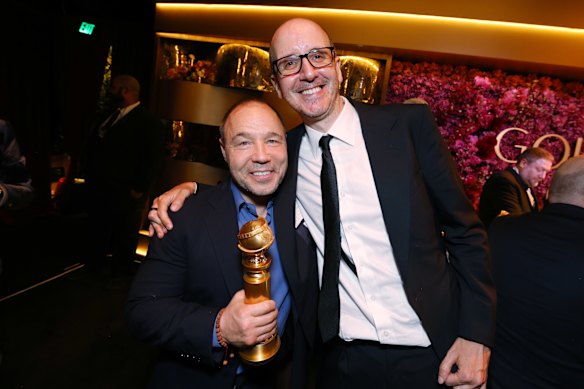
“It’s certainly something I’m still processing,” says Thorne of the past year, speaking over Zoom fresh after landing in London after the Golden Globes awards in Los Angeles, where Adolescence won four awards.
“Stephen and I’ve talked a lot in terms of, ‘[We] have a bit more power than what we’re used to for a brief moment, and what do you do with that?’ And the truth is, we’ve tried to be thoughtful, rather than ‘OK, now we need to take this big swing.’ But because there were things already under way, or even shooting literally at the same time as Adolescence, I was spared that [angst], which is quite a good thing. There wasn’t any, ‘Oh, what do I do next?’”
Still, his next project is a fascinating companion to Adolescence: The first-ever direct TV adaptation of Lord of the Flies, William Golding’s classic 1954 novel about a group of British school boys who are stranded on an uninhabited island after surviving a plane crash that leaves no adult survivors.
Studied in schools across the globe, Golding’s vision of unleashed adolescent violence and deadly brutality continues to shock more than 70 years after its release. Thorne remembers talking at length as a kid about the novel to his mum, an English teacher, trying to untangle his confusion and fear.
“It left a scar on me like no other,” says Thorne, adding that one particular death floored him. “It was a book I read again and again and again. I was just haunted by it … And the older you get, the more layers you find. It’s an astonishing book.”
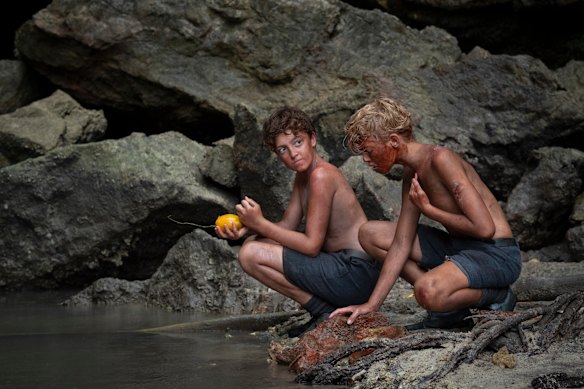
A dream project for Thorne, the writer sold the Golding estate on a pitch that stays true to the book’s 1950s setting and plot, with each of its four episodes shifting focus to a different character as they tussle for control.
The approach is remarkably similar to another of Thorne’s pinch-me projects, the upcoming The Beatles – A Four-Film Cinematic Event, where each film will release simultaneously in 2028 and centre on one of the Fab Four. One of three screenwriters on the project, Thorne was tight-lipped, but shared that it proved an excellent if not “very intense” distraction last year from Adolescence’s reception.
A BBC One and *Stan co-production, the series was originally slated to film in Australia, but director Marc Munden insisted on relocating to Malaysia – creating a tropical landscape truly foreign for these young English lads.
For the most part, the adaptation remains faithful, with Thorne reluctant to add much that was not present in the novel. Light on dialogue and heavy on ambience, this moody adaptation lets tension rise and rise, pierced repeatedly by an ominous, tropical score – reminiscent of The White Lotus mixed with Inception – composed by Cristobal Tapia de Veer and Hans Zimmer with his collaborator, Kara Talve.
“What I didn’t want is lots of monologues where the kids explain their position on everything, and lots of situations where you get kids giving psychological insight to themselves,” says Thorne. “Because that wasn’t my relationship with childhood, and I don’t think that’s how Golding writes these young people.”
We start with Piggy (David McKenna), the bespectacled pragmatist focused on survival essentials, whose rational plans are ignored by bullies who see him as just a weak, overweight nerd.
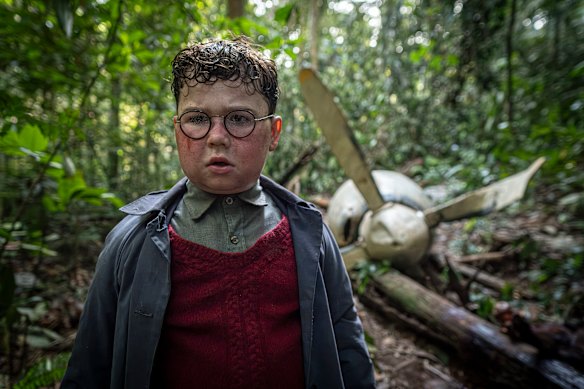
Next is Jack (Lox Pratt), an arrogant popular boy whose ego is bruised when the survivors vote the affable Ralph (Winston Sawyers) their leader – and leads a revolt with other boys more interested in adventure and pig hunting than rations and logistics. Then there’s Simon (Ike Talbut), a quiet, sensitive outsider with whom Thorne always identified most as a child.
Much like Adolescence, Lord of the Flies is a debut acting role for most of its young cast, who are frenetic, terrifying and tragic, increasingly glazed by layers of sunburn, sweat and blood.
Pratt will likely stand out the most, as his portrayal of Jack is a terrifying mix of anger, resentment and violent bursts, reminiscent of Malcolm McDowell in A Clockwork Orange – and, of course, Owen Cooper in Adolescence, the two characters bleeding into each other.
Written and filmed concurrently, Thorne’s Lord of the Flies and Adolescence are worlds apart in context, but linked by a shared question: Where does this violence come from? And can it be stopped?
Where Golding wrote Lord of the Flies to articulate a more esoteric sense that a newfound brutality had been unleashed on everyday life after World War II, Adolescence’s central crime – where 13-year-old Jamie murders his classmate, Katie – was initially inspired by similar knife crimes in the UK committed by underage boys.
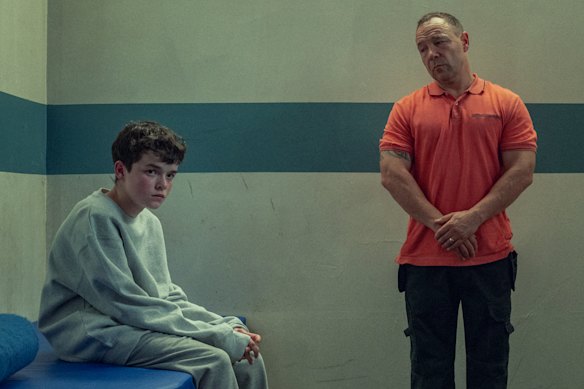
Thorne, father to a nine-year-old boy, refuses to believe violence is inherent in any of the characters in either Lord of the Flies or Adolescence, or the boys they represent.
While accepting the Golden Globe for best limited series, Thorne clarified that even though newcomer Cooper is terrifying as 13-year-old Jamie, the show’s message is not fear. “Some think our show is about how we should be frightened of young people,” he said. “It’s not. It’s about the filth and the debris we have laid in their path. Removing hate is our generation’s responsibility. It requires thought from the top down. The possibility seems remote right now, but hope is a beautiful thing. ”
Over Zoom, he elaborates: “We, as adults, are failing quite a lot at the moment to create a world in which children feel safe. We’ve created technological problems but also social problems for how young people negotiate this world … And I think that’s true of Lord of the Flies, too.
“As a child, I felt like Golding was very clear on who he liked and who he didn’t, but it’s a much more complicated portrait. His care comes through when you read it as an adult.”
While millions of English essays argue that the deserted island detethers Lord of The Flies’ “big ′uns and little ’uns” from the rules of decent society, Thorne says even the most wild constantly model themselves off their fathers.
“In the book, they [constantly] talk about grown-ups and play at being grown-ups,” he says. “‘What would grown-ups do?’ But the grown-ups they’re playing at are clearly people that are scarred. I think that’s really true for our world right now, and the book’s incredibly resonant for where we are right now.”
Critics who see Lord of the Flies as miserable and misanthropic often cite a real-world antidote, where six Tongan teenagers lived harmoniously for 15 months on the uninhabited island of ’Ata after being shipwrecked in 1965 – only a decade after Golding’s novel.
But Thorne has developed his own – a necessity from writing two dark stories back-to-back.
“My son may now get tighter hugs than he perhaps wants sometimes at night,” he says, laughing. “But the banal truth is that I stop [writing] each day at his bedtime, at about half past seven each night. We have our routine, where we go through books and talk. He’s the centre of it all for me.”
*Lord of the Flies streams on Stan, which is owned by Nine, the publisher of this masthead, from February 8.
Find out the next TV, streaming series and movies to add to your must-sees. Get The Watchlist delivered every Thursday.