3 months ago
10
3 months ago
10
FILM
Hamnet ★★★★
(M) 126 minutes
Germaine Greer was the first writer to set about rehabilitating the reputation of Shakespeare’s wife, Anne Hathaway.
Must-see movies, interviews and all the latest from the world of film delivered to your inbox. Sign up for our Screening Room newsletter.
Her speculative biography, Shakespeare’s Wife (2007), was an eloquently forthright feminist look at a woman who had been dismissed by several other scholars as an illiterate opportunist who forced the young playwright into a loveless marriage through pregnancy.
Hathaway’s detractors had let their imaginations loose on a meagre supply of known facts. So had Greer. But she backed up her interpretation with a hefty amount of research into Elizabethan history and custom. Hathaway’s social status, Greer wrote, suggested that not only could she read and write, she might have been considered more eligible than Shakespeare himself.
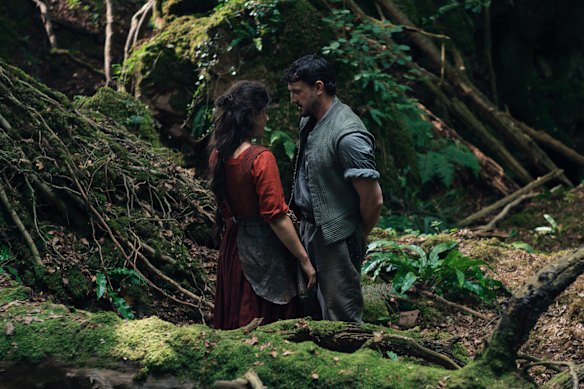
Jessie Buckley (left) and Paul Mescal in Hamnet.
Then in 2020, Irish novelist Maggie O’Farrell offered up an even more audacious portrait of Hathaway in Hamnet, her lyrically heartfelt treatment of Shakespeare’s most personal tragedy – the death of Hamnet, his 11-year-old son, from the plague.
O’Farrell co-wrote the script for this adaptation – which has just won a Golden Globe – with the film’s director, Chloé Zhao (Nomadland), and with a few changes, it maintains the novel’s shape, mood and themes. O’Farrell’s Anne – or Agnes, as she’s called – is a healer, more at home with the plants and animals of the forest than she is in the house where she lives with her father and straitlaced stepmother.
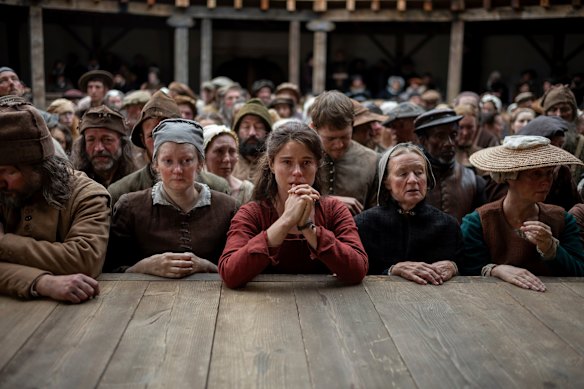
Buckley (centre) is a revelation in Hamnet, and won the Golden Globe for best female actor in a drama.Credit: AP
The book conjures a setting in intimate contact with the natural world and the film’s design vividly evokes its ambience. These families may have grand houses by Stratford standards but their nearness to the surrounding woodlands hints at the presence of something untamed and unpredictable. That threat is borne out when the plague comes to town.
Agnes’ intuitions make her aware of all this but the only person who makes any effort to understand and appreciate the acuteness of her instincts is her brother, Bartholomew (Joe Alwyn). Then Will, a neighbour’s son making a living of sorts as a Latin tutor, falls in love with her and everything changes.
Will is played by Irish actor Paul Mescal, who hasn’t stopped working since the TV adaptation of Sally Rooney’s Normal People made him a star.
Loading
Inevitably perhaps, he’s been wrong for some of his recent roles, but he makes a plausible and attractive Shakespeare. He’s no firebrand. O’Farrell and Zhao have avoided the cliches that often go with portrayals of the “artistic temperament”, but Mescal makes Will’s ambitions and frustrations plain enough. Because Agnes recognises the strength of these passions she agrees to a marriage that means he will spend much of his time in London while she stays in Stratford with their children, until they can join him.
Jessie Buckley, also Irish, won her Golden Globe this week by giving us a wonderfully complex character in Agnes. A rebellious stepdaughter and a fiercely protective mother with an intelligence reflected in the way she makes up her medicinal remedies, she’s indomitable. But the death of her son (a heart-breaking Jacobi Jupe) pushes her and her marriage to the limit.
The film’s storyline is more straightforward than the book’s and its main points are spelt out more emphatically but if the plot loses some of its delicacy on screen, the impact of its ending makes up for it. The film’s second half is all about grief, the many forms it can take and the strains caused when one person’s sorrow can’t be adequately conveyed to the person with the greatest need to hear about it.
It’s a desperately sad film but it finishes on a note of reconciliation. Anne Hathaway is not the only character to be re-invented here. Shakespeare, too, is given his due as a father. The ending can also be read as a touching tribute to the healing power of art itself.
Hamnet is in cinemas from Thursday
Most Viewed in Culture
Loading