3 months ago
8
3 months ago
8
Barbie has created its first autistic doll in a move towards greater inclusion and diversity for the iconic brand, owned by US toymaker Mattel.
Heartbreak High actor and disability advocate Chloe Hayden grew up loving Barbie, and celebrates the new doll.
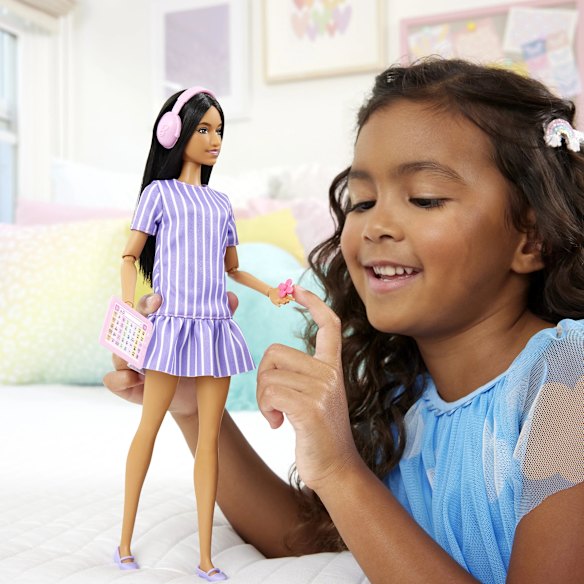
Mattel’s first autistic Barbie wears noise-cancelling headphones and carries a fidget spinner and Augmentative and Alternative Communication device.Credit: Mattel
“I always loved Barbie because even when I couldn’t see representation of the person I was currently, I saw dreams of the person I wanted to be.
“When I was three and wanted to be a mermaid, I had mermaid Barbie. When I was four and wanted to be a marine biologist, I had marine biologist Barbie … I had the Midge, and Rapunzel, and cowgirl Barbie, and vet Barbie, and a Barbie-Big-Sister for every stage of my life,” said Hayden, who has a paid partnership with the brand to promote the new doll.
“To now have a Barbie that is autistic is so genuinely groundbreaking. She’s cool, and she’s beautiful, and she uses an Augmentative and Alternative Communication device and headphones and sensory toys … and she’s showing little girls that who they are, right now, is enough. You can still be Barbie while requiring support, or being different.”
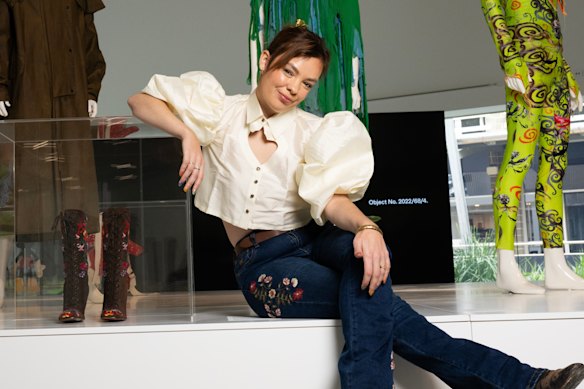
Chloe Hayden, actor and disability rights advocate, says the first autistic Barbie is “genuinely groundbreaking”.Credit: Louise Kennerley
Designed with American charity The Autistic Self-Advocacy Network, the doll has features designed to reflect the experiences of those on the autism spectrum, including articulated elbows, wrists to enable “stimming” (repetitive behaviours used by people with autism to reduce stress) and eyes that veer slightly to the side to reflect how some autistic people avoid direct eye contact.
She also wears flat shoes, a sensory-friendly purple striped dress and noise-cancelling headphones, and holds a hot pink fidget spinner as well as an Augmentative and Alternative Communication Device.
Paul Faulkner, Mattel’s Asia Pacific senior vice president and managing director, said in a press release: “Our goal is to ensure more children can find a Barbie that feels familiar to them and reflects the way they experience and express their world.”
Loading
In 2022, there were 290,000 autistic Australians, with higher prevalence in those under 25. Historically, the way autism is diagnosed and represented has been gendered. While recognition is growing for the nuanced ways in which autism presents in girls, there is still a way to go. Boys are currently four times more likely than girls to receive a diagnosis.
Katie Koullas is the chief executive of Yellow Ladybugs, a non-government organisation dedicated to supporting autistic women and girls that has partnered with Mattel for the Australian launch of the doll.
“This matters because autistic girls and women are so often missed, misunderstood, or told they don’t fit the picture people have of autism,” Koullas said.
“Our community spans many races, genders, body types, cultures, ages, and ways of expressing ourselves. No single doll can reflect that diversity. And it shouldn’t be expected to. This Barbie is one character who happens to be autistic. She doesn’t define autism. She adds another option.”
Autistic Barbie is the latest addition to Mattel’s “Fashionistas” collection, an “inclusive” line of dolls that includes a Type 1 Diabetes Barbie doll and models with a range of hair textures, body types, skin colours and abilities.
Mattel launched its first Barbie in 1959 – the blonde, white and thin doll most people still associate with the brand – but it wasn’t until 2019 that it introduced its first doll with disability: a wheelchair-using doll.
Chris Varney, founder of I Can, Australia’s largest autistic-led organisation, praises the move from such a recognisable brand.
”It builds up people’s positive autistic identities and strengthens their belonging. It helps them feel seen,” he said.
“This is a big signal to a lot of other toy makers out there, so it’s very exciting in that way. It’s a watershed moment.”
Varney is “thrilled” the doll was designed in collaboration with autistic-led organisations, and hopes it helps reduce the stigma around autism for both parents and children.
“This is a massive brand coming out, and I think it helps break down the intense shame we have towards labels with kids … This is another thing that helps parents who are a bit overwhelmed and a bit resistant to the label to just embrace it.”
For Hayden, 28, having an autistic Barbie in her stable of beloved dolls growing up would have been huge.
Loading
“If I knew I was autistic when I was a little girl, having a character that genuinely is canonically like me would have made me feel so much safer outside of my make-believe games and toys,” she said.
“An autistic Barbie doesn’t necessarily change the way kids will see themselves in the toys, it will change the way they see themselves outside of the toys.”
Make the most of your health, relationships, fitness and nutrition with our Live Well newsletter. Get it in your inbox every Monday.
Most Viewed in Lifestyle
Loading