3 months ago
19
3 months ago
19
Goolagong ★★★★
If you were to judge this three-part drama about Australian tennis champion Evonne Goolagong on the merits of its sporting sequences, you’d find much to fault. The tennis is … well, genteel. The atmosphere at what are supposed to be some of the biggest games on the planet is church-mouse quiet. The athleticism barely rises above the level of gentle workout.
But if you were to assess it as a biopic about an exceptional woman who rose from the humblest of origins to attain the highest of accolades in her chosen field (seven grand slam singles titles), it’s a smash.
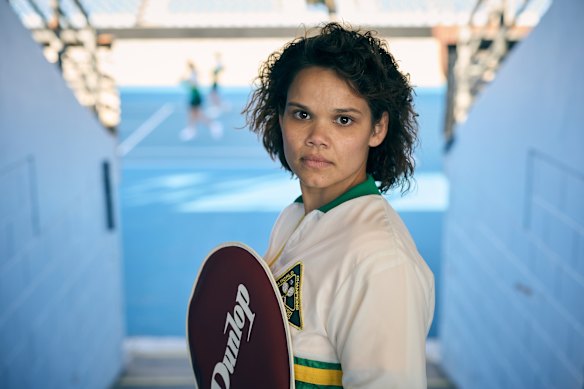
Lila McGuire as Evonne Goolagong in the ABC series Goolagong.Credit: ABC
Presumably for budgetary reasons, it trades wide shot for close crop, stadium for bedroom and dressing room. But in doing so, it takes us closer to the heart of the woman.
We first meet Evonne as a child of five or so (played by Eloise Hart with an abundance of unaffected charm) as she and her family are moving into their first home. It’s a weatherboard shack in a dirt-poor pocket of regional NSW, but at least it’s theirs, and the kids are relatively safe from the threat of being whisked away to the Mission.
Young Evonne has natural felicity with a tennis racquet, which is first spotted by a coach at the local clay court. Years later, he invites Vic Edwards (Marton Csokas), a coach from Sydney, to check out the teenage player, and Edwards is impressed enough to offer to train her properly. She’ll have to move to Sydney, though, to board with him and his family. She may have dodged the Mish, but she’s being separated from her family all the same.
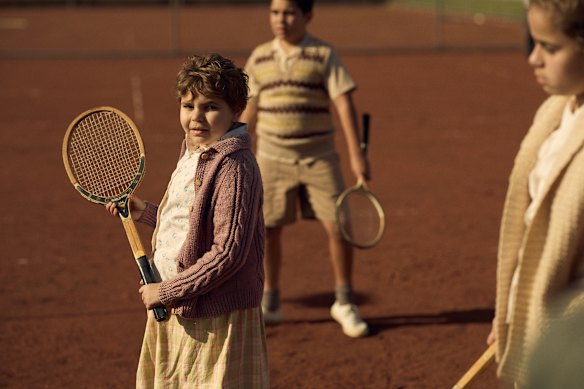
Eloise Hart plays Evonne as a child.Credit: ABC
In a sense, Goolagong is the story not just of its subject, but of the three men who most profoundly influenced her career and her life. First, her father, Kenny (Luke Carroll), who believed in her, encouraged her, and urged her to follow her dream. Second, Edwards, who spotted her raw talent, helped develop it, pushed her to become the best player she could – but also, on this telling, manipulated her, controlled her financially and emotionally and sexually harassed her (the show treads lightly here, but the implication is clear). And finally, Roger Cawley (Felix Mallard), the former British junior tennis player to whom she has been married since 1975.
None of that, though, is to detract from the core portrait: Lila McGuire as the adult Goolagong. Hers is a tremendous performance, and the woman who emerges is admirably, but understatedly, complex. She is steely yet soft, innocent but not naive, determined but not fanatical.
Proudly Indigenous, she declines to be a spokesperson, preferring to let her actions on the court prove that a blackfella is every bit the equal of a white. A high-achieving woman, she declines to join the fight for equal pay, telling a reporter at one point that it’s such an honour to play at Wimbledon she’d do it for nothing. And when Edwards threatens to sue her for unpaid commissions, she urges her husband to settle up so they can move on, when in truth, the show suggests, she could be suing him for sexual abuse, embezzlement and more.
What you’re left with is a picture of a woman who did her fighting on the court, and made an indelible impression in the process. The first Indigenous Australian to win a tennis grand slam, the first mother to win Wimbledon in the modern era (post 1916), the only woman to have beaten each of Martina Navratilova, Margaret Court and Chris Evert in grand slam finals.
It’s a record well worth celebrating, and Goolagong does it justice.
Goolagong premieres at 8.20pm on Sunday, January 4, on the ABC; all three episodes are on ABC iview.
Most Viewed in Culture
Loading