3 months ago
18
3 months ago
18
Google’s parent company Alphabet is getting ready to bring its Waymo self-driving taxis to Australian roads. The tech giant is engaging Transport for NSW about testing its robotaxis in Sydney.
Transport for NSW has confirmed that Waymo is in contact with the department, which is planning an initial meeting with Waymo before the end of the year to discuss the company’s potential interest in Australia.
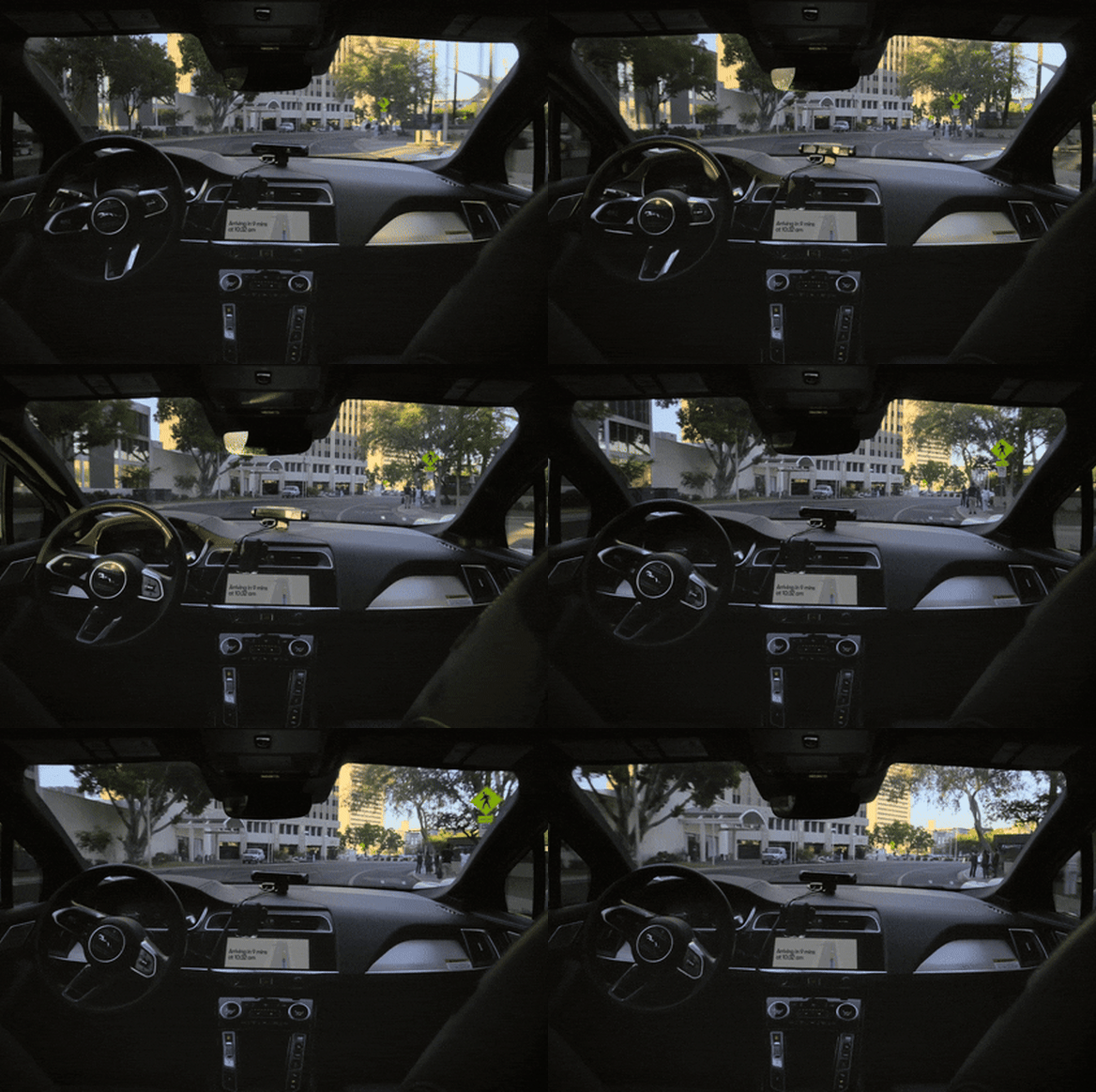
Waymo driverless cabs have become conspicuous on the streets of San Francisco.Credit: YouTube
The development, first reported by Crikey, marks a significant escalation in the race to bring fully autonomous vehicles to Australia, with Waymo’s technology representing “level four autonomy” – fully driverless operation requiring no human supervision. Think an Uber, but with no driver, and a steering wheel that turns itself. It contrasts with Tesla’s full self-driving system, which launched in Australia last month and still requires constant human oversight.
“There is no human in the vehicle that is ready to take control of the steering wheel. There’s no one in the vehicle who needs a driver’s licence,” said Nick Pelly, Waymo’s director of engineering, in a forthcoming podcast interview.
Waymo hasn’t officially applied for a trial permit, yet, but has appointed lobbying firm GRACosway to represent it in Canberra, with the firm listing Waymo LLC as a client on federal, NSW and Victorian lobbyist registers, as Crikey reported.
Under NSW law, anyone wanting to trial new automotive technology must seek approval for an “automotive technology trial” from Transport for NSW.
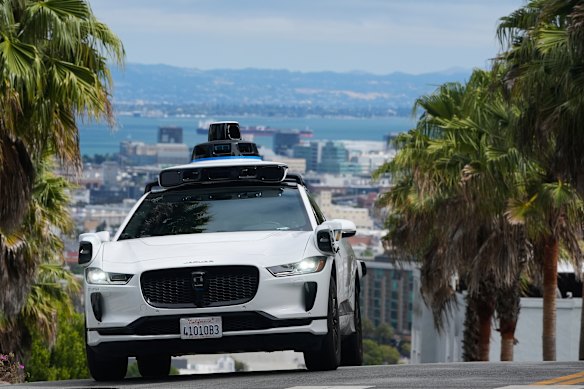
A Waymo taxi drives in San Francisco. Australia’s left-hand driving would require comprehensive retraining of Waymo’s AI for traffic rules, driving behaviours and patterns.Credit: AP
“While we are eager to bring the Waymo Driver to more people in more places, we do not have specific plans or a timeline to share regarding Waymo’s future in Australia at this time,” a Waymo spokeswoman told this masthead.
“Waymo has global ambitions. We actively engage with regulators and lawmakers around the world, including Australian officials.”
The company did not address questions about whether it was in discussions with regulators in cities other than Sydney. Waymo has driven more than 160 million fully autonomous kilometres globally and claims “consistently” reducing injury-causing collisions compared with human drivers. Data from the US National Highway Traffic Safety Administration (NHTSA) shows Waymo is involved in 80 per cent fewer injury-causing crashes than human-controlled vehicles.

Waymo’s head of engineering is Australian Nick Pelly.Credit:
It comes as the company just announced a major milestone this week: the first-ever driverless freeway rides for paying customers in the US, connecting San Francisco to Silicon Valley and expanding freeway access across Phoenix and Los Angeles.
“What we think a lot about is the 40,000 road deaths just in the US per year that are completely avoidable,” Pelly, an Australian, told the Tech Overflow podcast in an episode to be released on Monday.
However, Australia’s regulatory landscape presents perhaps the most significant hurdle. The company has urged legislation by 2026, but Australia’s framework won’t be ready until 2027. A 2016 review identified more than 700 barriers to autonomous vehicle deployment in Australian laws.
A Transport for NSW spokesperson said the state is committed to preparing: “Transport for NSW is committed to ensuring our road network and regulatory framework is ready to embrace the benefits, and address the challenges, arising from the introduction of vehicles with increasing levels of automation.”
The proposed framework involves a new Commonwealth Automated Vehicle Safety Law that establishes a national regulator, addressing liability, insurance, data privacy and cybersecurity.
“Ahead of any reforms being implemented, deployment of autonomous vehicles would need to be authorised on a trial basis,” the spokeswoman said.
NSW has supported autonomous vehicle development since 2017 legislative changes. Previous trials included automated shuttles and the Dubbo Smart ute. The state operates a Future Mobility Testing and Research Centre in Cudal. But these constrained trials don’t approach the scale of Waymo’s citywide robotaxis.
“In San Francisco and Phoenix, this is a mainstream product,” Pelly said. The company is testing in Tokyo and plans London operations in 2026.
Waymo uses Jaguar I-Pace electric vehicles retrofitted with cameras, radars, LiDAR and inertial motion units, creating a 360-degree view. Pelly’s work focuses on backup systems that ensure safe operation even when major components fail.
Bringing Waymo to Australia presents significant technical challenges beyond simply adapting from driving on the right-hand side of the road in America to driving on the left in Australia. Driving on Australia roads would require comprehensive retraining of Waymo’s AI for traffic rules, driving behaviours and patterns.
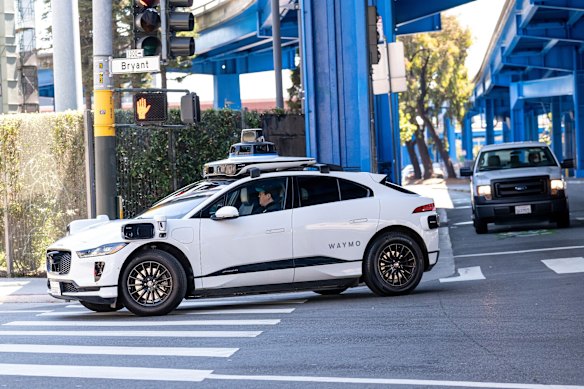
Waymo cars are ubiquitous on the streets of San Francisco, a city with sedate traffic and a large technology industry.Credit: Bloomberg
Australian roads also present unique hazards. Kangaroos, which can appear suddenly and hop unpredictably across roads, represent a detection challenge, while Sydney’s narrow, winding streets contrast with Phoenix’s grids or San Francisco’s wider boulevards. Many roads feature parallel parking on both sides, reducing lane width and requiring vigilance for opening doors and emerging pedestrians.
Waymo is confident in overcoming those challenges, however. “Generally, the fundamentals of driving are largely the same wherever you go,” the company told this masthead, pointing to successful Tokyo testing as evidence of adaptation to left-hand traffic.
Beyond robotaxis, Waymo’s ambitions extend far beyond city streets. Co-CEO Tekedra Mawakana recently outlined the company’s business roadmap at TechCrunch Disrupt: “We’re building a generalisable driver. That driver through our ride-hailing service is our first application, then local delivery, then long-haul trucking, and then eventually, we will license this technology to automotive companies for personally owned cars.”
Waymo has partnered with local ride-sharing platforms in Tokyo and London, and works with Uber and Lyft in the US. Uber, which dominates Australian ride-sharing, did not respond to a request for comment about a potential Australian partnership.
The question of technological capability may be easier to answer than the question of public acceptance. While Waymo’s technology has proven itself in US cities, Australians have had virtually no exposure to truly driverless vehicles.
A recent survey of 562 Australians found that 47 per cent view autonomous vehicles as a desirable travel option – suggesting cautious optimism. However, 74 per cent want vehicles to retain the option of human control, indicating a preference more aligned with Tesla’s supervised approach than Waymo’s fully driverless model.
Waymo is effectively asking Australians to trust their safety entirely to artificial intelligence, in what would be a major cultural shift.
Loading
The challenge is both practical and psychological – not just convincing regulators that the technology is safe, but convincing millions of potential riders to take that first driverless trip.
Pelly believes the technology’s inherent safety becomes apparent quickly. “Even after the first ride, people can appreciate the safety,” he said. “It doesn’t get distracted. It’s looking 360 degrees all the time.”
If approved, Waymo’s Sydney trial would be a watershed moment for autonomous vehicles in Australia, potentially accelerating regulatory development and testing whether Australians are ready to embrace what Pelly calls a technology that will be as “ubiquitous” as smartphones within five years.
“We look forward to one day bringing these same benefits to riders in Australia,” the Waymo spokeswoman said.
Get news and reviews on technology, gadgets and gaming in our Technology newsletter every Friday. Sign up here.
Most Viewed in Technology
Loading