3 months ago
6
3 months ago
6
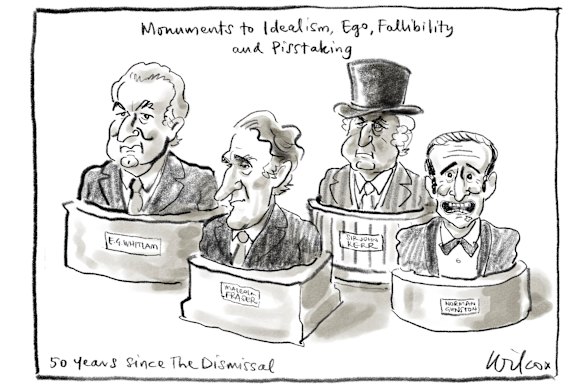
While I don’t disagree with Sean Kelly that Anthony Albanese is being too cautious, I think many of us understand why, with Gough Whitlam being a case in point (“Show us what you really believe, Albanese: This lesson in politics stretches 50 years”, November 10). Besides the argument that governing from the centre is the way of getting and holding government in the 21st century (the exception being a certain US election), Albo’s brave political stand was smashed by mis- and disinformation when the Voice to Parliament referendum was voted down for all the wrong reasons. Of course, being politically battered and bruised is what our pollies sign up for, so Albo must move on from this and be more visionary, creative and daring in the near future to medium future. And just six months on from an election with a sizeable majority and a none-too-credible opposition opens up opportunities. Albo, we’ve got your back on this, so take a punt on something brave and leave a legacy. Paul Bugeja, Varsity Lakes
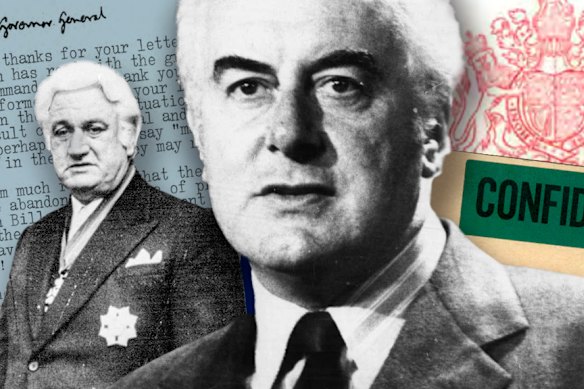
Prime Minister Gough Whitlam was given a letter of dismissal by Governor-General John Kerr in 1975.Credit: Nine
On November 11, 1975, I was returning to my office and turned on the car radio to listen to the ABC’s parliamentary broadcast (“A huge mistake that changed history: Whitlam failed to tell the right people he’d been sacked”, November 10). The first words I heard were Speaker Gordon Scholes, saying: “I call the member for Werriwa.” He was calling Gough Whitlam. I knew instantly what that must have meant. I knew with shock and total clarity that the Whitlam government must have been dismissed; otherwise the call would have been “I call the Right Honourable the Prime Minister”. Labor, with its program of exciting and enduring reforms, had ended 23 years of Coalition torpor in 1972. Millions of Australians had their hopes dashed. The trauma of that day still lives with me. It was a day which, to steal from Franklin Delano Roosevelt, “should live in infamy”. I didn’t make it back to the office. I went home in a daze. Alan Phillips, Mosman
With the 50th anniversary of the sacking of the economically incompetent Whitlam government, out of the cupboard will come the groupies, still outraged that their hero was dethroned firstly by the umpire, Sir John Kerr, and secondly pummelled by the voters in the 1975 election. The subsequent belittling and ostracising of Kerr just for making a decision Labor did not like shows their true mettle. A new song could be: “It’s time to move on.” Ian Morison, Forrest (ACT)
Credit: Cathy Wilcox
Net zero no-brainer
Liberal senators Andrew Bragg and Jane Hume rightly highlight the significance of the net zero climate target (“Bragg will quit frontbench if Coalition walks away from net zero, Paris Agreement”, November 10). The Liberal Party has lost 35 metropolitan seats over the past two elections, largely due to inaction on climate change. And, more importantly, the Coalition’s inertia has cost Australia both in rising climate pollution and in missed economic opportunities tied to the shift toward clean energy and industry. By rejecting a net zero climate pollution target, the National Party has shown it doesn’t care about climate disasters and Australia’s economic future. Will Sussan Ley’s Liberal Party follow them into political oblivion? Karen Lamb, Geelong (Vic)
Liberal Senator Jane Hume comments that “everybody wants to reduce emissions”. Well said. Aside from fossil fuel corporations, who wants to keep damaging our atmosphere and air with coal, oil and gas pollution? Sadly, it seems the National Party, who supposedly represent the regional Australians bearing the brunt of climate disasters, have chosen to sit with the fossil fuel companies that cause 75 per cent of climate change. This is shameful. And, as the COP30 UN Climate Change Conference begins in Brazil, it is extraordinary that the Liberal Party is still debating whether to continue any commitment to pursuing net zero climate pollution. Australians deserve leadership that prioritises their future over fossil fuel interests. Net zero isn’t a debate – it’s a deadline. Amy Hiller, Kew (Vic)
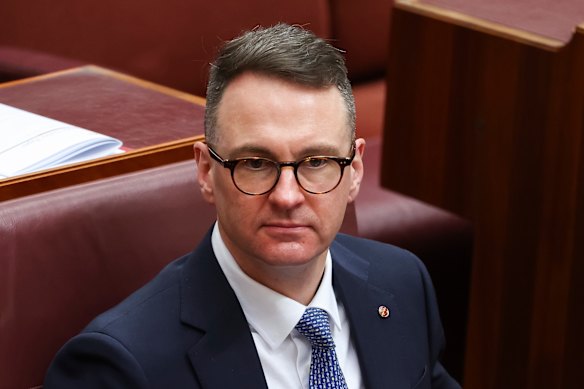
Leading moderate Andrew Bragg insists the Coalition retain a net zero commitment in some form.Credit: Alex Ellinghausen
Slow but steady
Nick O’Malley asks why are we still facing increasing climate disasters year after year when this year for the first time renewables have provided more energy than coal (“If this is the world’s most hopeful chart, then why are we staring at catastrophe?” November 10)? Why – when the sun which is a giant nuclear energy plant sends us free energy through sunshine, wind and tides – do we continue to accelerate climate change by adding more CO2 to the atmosphere? Why are we winning with renewables but not winning fast enough? Why, when science has clearly told us that we have to move faster to escape the worst disasters, does the world go slow? The answer, of course, is people with entrenched interests in fossil fuels. They have been handed a giant new megaphone for disinformation by the internet and social media and now AI. We have seen how lies have been no barrier to Donald Trump taking over the US and tearing down climate action. This is a whole new world and truth is not guaranteed to prevail. But individual action can still make a difference. More houses with solar panels and batteries to flood the grid with power can help you feel better, even if the financial reward is slow in coming. Gary Barnes, Mosman
Silly men in silly uniforms
There is another way of looking at the kerfuffle over the neo-Nazi rally outside Parliament House (“Racial hatred has no place anywhere in Australia”, November 10). If police had refused permission, there may have been a court challenge with likely media coverage (which is what the NSN seeks) and, given that there were no public safety issues, possible court approval and precedent. If it had been ignored, these silly men could have just dressed up in their silly uniforms and stood in Macquarie Street on a Saturday afternoon with hardly anybody noticing. Yes, they would have posted footage on social media, but they do that all the time anyway. And yes, it was in front of Parliament House, but that is the site of regular protests that go almost unnoticed. Now it has been blown out of proportion, with demands for the heads of everyone from the premier down, when it could have just been ignored. We know these crackpots are antisemitic and potentially dangerous in their attempts to undermine our democratic state, but their little outing last Saturday was inconsequential. John Ure, Mount Hutton
Neo-Nazis everywhere must be rejoicing at the sight of Australian fascists outside Parliament House making antisemitic speeches. I’ve received emails from shocked friends around the world asking if I feel safe. Actually, I feel disgusted and embarrassed that this image of Australia has gone viral. What happened to our race hate laws? Diane Armstrong, Rose Bay
The letter writers, and others, who are making a fuss about the neo-Nazi gathering outside state parliament are on exactly the wrong track. The best thing to do is to ignore these nasty people altogether. That is apparently what largely happened on the day. A small group stood around for a while, with their sign; nobody took much notice of them and then they walked away. Their pathetic little egos must have taken quite a knock. Let everyone else take the same stance – just ignore that group altogether and make them feel totally irrelevant. David Fraser, Ballina
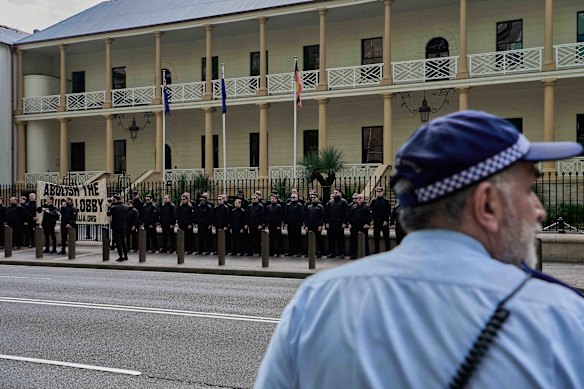
Police monitor the National Socialist Network rally outside parliament on Saturday.Credit: Flavio Brancaleone
Let me get this right. A communications error by NSW Police failed to inform the NSW government of the neo-Nazi gathering (“Nazis previously held ‘end immigration’ rally outside NSW parliament”, November 10). Cue the outrage from the community. Premier’s first response: NSW Police need more powers despite failing to use the ones they have? Sounds like a scripted response. Police stuff-up equals greater police powers. Gary Todd, Burradoo
Perhaps allowing the rally outside Parliament House was a very clever move by the police. They now have photos of faces and will be able to identify all participants. The internet has done the rest, so employers and other groups will be aware of identities. Know thine enemy. Del Heuke, Forster
We have seen two years of Hezbollah and Hamas flags and chants on our streets, and now neo-Nazis openly rally? Free speech is important, but what will it take for the police to break up these protests by radicalised and intolerant groups of the far left and the far right who seek to destroy everything we hold dear? Anthony Nassif, Caringbah
Nauru deal amiss
The alleged corruption that was part of the Nauruan detention deals between 2019 and 2021 should be fully investigated (“Official calls out alleged Nauru rort”, November 10). Like anything that smells bad, it seems the initial reaction from those who could investigate is that there is nothing to see here. What do you have to say about the allegations, home affairs minister? The standard a government walks past is the standard a government accepts. John Kingsmill, Fairlight
High standards
The Howard government’s privatisation of Standards Australia was but one of its many ideologically driven mistakes (“Steep cost of Australia’s safety standards revealed”, November 10). If organisations or individuals are expected to adhere to regulations, those regulations should be available free of charge. Fund that arrangement by enforcement and fines where regulations are ignored. Mike Salon, Darlinghurst
I strongly agree with the report that the exorbitant cost of Australian standards documents is impacting on our productivity. It also unfairly penalises small businesses. Another galling point is that many volunteers and companies have freely given their time and expertise to prepare these standards, while private distribution companies take the rewards. Graeme Pattison, Lilyfield
Dubious role model
George Brandis says that Liberal hope Andrew Hastie seems to be channelling everyone from Enoch Powell through to Vladimir Putin but warns him about embracing the ideas of Donald Trump and Nigel Farage (“This man wants to lead the Liberal Party. He won’t if he keeps savaging the ‘liberal’ bit”, November 10). Instead, Brandis suggests that Hastie should be emulating philosopher and politician Edmund Burke, the founder of conservatism. Burke was a devout monarchist who did not believe in universal suffrage and advocated for representation dependent upon property ownership and social standing. At the time, he was castigated by Mary Wollstonecraft for his defence of a system of inherited privilege obtained due to either class or gender. Mr Brandis would have been wiser to have suggested a recent erudite humanist upon which Hastie could model himself. Peter Nash, Fairlight
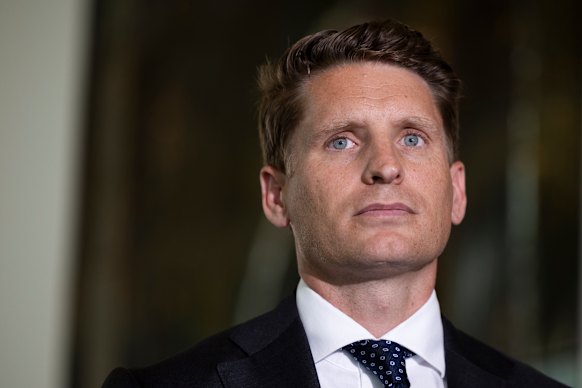
West Australian MP Andrew Hastie said it was too unsafe for Australian troops to help secure the peace in Gaza.Credit: The Sydney Morning Herald
It’s equity, not envy
Rob Fraser, criticising the private school system is not the politics of envy, it is asking for fairness and equity in education for all children in order to give them all the same chances in life (Letters, November 10). If you want a Bentley, then you pay for it. The same should be said of education. If you want a school with bigger and better facilities, more teaching staff and a lot fewer troubled and troublesome children, then you are welcome to pay for it. But why should those who earn less and have few to no tax breaks contribute to a system that their children will never be able to be included in, while the public system remains chronically underfunded and under-resourced? Why should a large group of children be disadvantaged educationally due to postcode and parental income? It is not giving all children a fair go. Vivienne Freeman, Freshwater
I am not envious of private schools, as claimed by your correspondent. I agree we don’t need to tear down the private school system, but we taxpayers simply need to stop paying for private schools. They can happily exist side by side with public schools. But can you imagine how much the public schools would improve given the billions of extra dollars they would receive? Private paid for privately. Public paid by public. Problem solved. Janine Burdeu, Mona Vale
Rob Fraser mistakes equity for envy. Public education isn’t about levelling down but ensuring opportunity isn’t reserved for the well-resourced. His Bentley analogy is as tone-deaf as his caricature of “communist New York”, led by a mayor advancing social justice in a city whose progressive values are hardly unfamiliar to Balmain. Perhaps Rob should consider relocating if he finds his own suburb too “radical”. Vivien Clark-Ferraino, Duckmaloi
Schools are not museums
As a retired school principal, I am left with some disturbing thoughts about the future of Catholic schools (“TikTok generation meets Socrates: Liberal arts enjoys schools revival”, November 10). It appears there is a push (eg Hartford College all-male school) to return Catholic education to some halcyon time when things were more understandable and life was simple. Yes, it is always easier to step backwards into known, comfortable territory but schools are not museums intent on curating quaint artefacts from the idealised past. To earn their stripes, schools must be forward-looking, adaptive and dynamic. Present Australian mainstream Catholic schools have a curriculum that is comprehensive, complex and under constant review. I would be very hesitant to import a conservative US idea into Australia. Indeed, I would apply a 100 per cent tariff. Des Connolly, Loftus
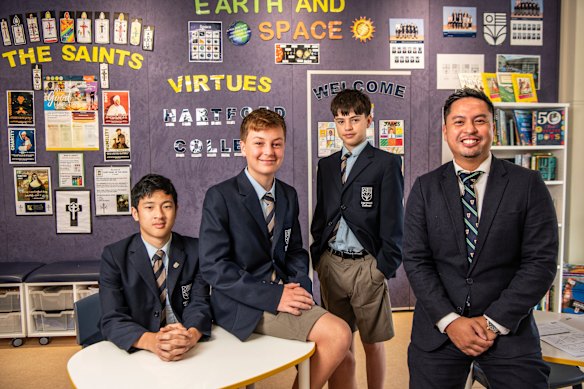
Hartford College principal Ian Mejia with students Matthew Hiu, Ben Mitchell and Will Brown. Credit: Steven Siewert
Archbishop Anthony Fisher, state schools also shape character, develop moral virtues and promote the joys of learning. But they do differ from Hartford College in one important area. They give their students the freedom to question, challenge and explore alternative views where diverse perspectives are welcomed, not silenced. Rod Tuck, Katoomba
- To submit a letter to the Sydney Morning Herald, email [email protected]. Click here for tips on how to submit letters.
- The Opinion newsletter is a weekly wrap of views that will challenge, champion and inform. Sign up here.