3 months ago
3
3 months ago
3
In the first few months of Stephanie Gilmore’s globe-trotting, tequila-launching, Spiderbait-joining sabbatical, Molly Picklum offered an earnest question to be asked of female surfing’s GOAT.
“Ask Steph how she’s going to do it,” Australia’s newest world champion advised in early 2024.
“Seriously, it’s incredible what she’s done her whole career, for 17 years. So ask how she’s going to go about coming back”.
Gilmore responded with a “cheeky shit”, a laugh and acknowledgement that the bar set since by Picklum (22), and an emerging generation led by Caity Simmers (20), Caroline Marks (23) and Erin Brooks (18), is arguably higher than any seen in professional women’s surfing.
Don’t look now. But Gilmore, with a record eight world titles, is back for season No.19, and will be 38 by the time it starts. Long-time sparring partner Carissa Moore (five titles and an Olympic gold medal) also returns after giving birth in February, at age 33.
And the question of why is just as instructive as how.
The tip in surfing circles is that without the WSL’s dramatic overhaul of a season structure that most surfers were at best, ambivalent about, at worst loathed, then two of the true greats would have happily given the tour another miss.
Lucrative sponsorship deals (Gilmore’s eight-year contract with Rip Curl is regarded as one of the biggest in Australian surfing history) are of course most visible on the WSL circuit.
And often forgotten with surfers - again particularly with the perpetually sunny, ‘Happy’ Gilmore - is just how competitive some of them can be.
As Gilmore and Moore return from two-year breaks, they are joined on the men’s side by comebacks from Hawaiian three-time world champion John John Florence, and Brazil’s Gabriel Medina (two titles), who has recovered from a torn pectoral.
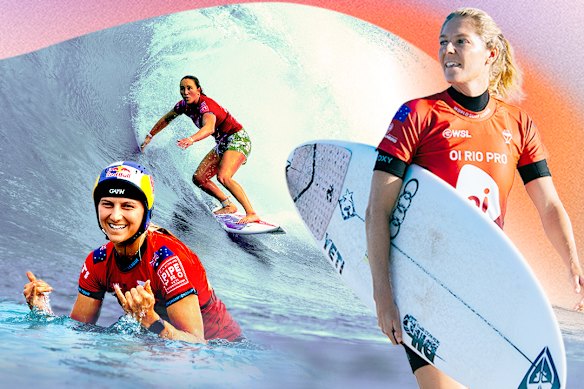
Generations collide: Molly Picklum, Carissa Moore and Stephanie Gilmore.Credit: Matt Willis
It all makes for a perfect storm of 19 world titles returning to a WSL tour more aligned with surfing’s traditional season structure.
Gone is the controversial mid-season cut that Gilmore almost fell foul of in May 2022, a campaign which ended with the most remarkable of her eight world titles.
The one-day, winner-takes-all final five format also hits the bricks, with the 2026 world champion to be crowned once more based on cumulative points accrued across the entire season.
Despite her stunning 2022 triumph running the field from fifth place, and knocking off that year’s first-place finisher Moore, Gilmore summed up the thoughts of most surfers on the finals format in the hours after lifting her trophy.
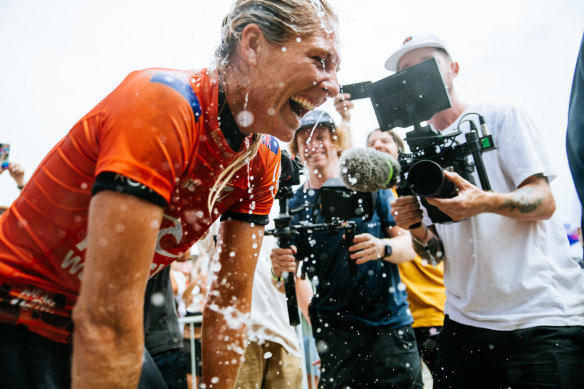
Stephanie Gilmore celebrates her record eighth world title in 2022.Credit: Beatriz Ryder/World Surf League
“Carissa in my mind is the real world champ this year,” Gilmore said at the time.
“She had such a stellar year. She had so many wonderful performances. I disliked this format, to be honest.
“I was like, the world champion should be crowned in all the different waves over the entire period of the year. Now [after winning the final from fifth-place] I love it.”
Moore’s two runner-up finishes to Gilmore (2022) and Marks in 2023 despite dominating all season were held up by many as cause enough to ditch the finals format, though the Hawaiian has always been typically gracious about being beaten on the day.
The 2026 format sets up an especially enticing season, with a historic world title crowning regardless of who wins it.
For the first time, the world title will be crowned in the final event at Hawaii’s Pipeline - as it was in the men’s competition for years, but never the women’s. The wave was long deemed too dangerous for the girls.
Picklum, Simmers and a slew of the world’s best women have smashed that perception, and now the iconic break shapes as pivotal to the 2026 championship, given a win there is worth 1.5 times a victory anywhere else.
For Gilmore and Moore, the 2026 circuit could be tailor-made with an April kick-off at Bells Beach, followed by Margaret River and the Gold Coast.
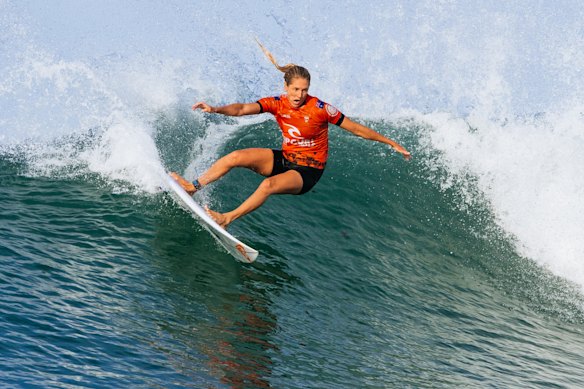
Stephanie Gilmore: one of the smoothest surfers in history.Credit: Pat Nolan/World Surf League
Picklum, Simmers and Tyler Wright are all strong at Bells, but Gilmore is on another level - her four Bells triumphs sit behind only local icon Gail Couper’s record 10 wins in the 60s and 70s.
Gilmore is even better in her own backyard at Snapper Rocks. Again, no-one comes close to her six event wins from 18 appearances.
How the veterans return is the unknown, but history says Gilmore and Moore (eight wins herself across the three Australian events) could leave these shores well in the title race.
Both have had previous wins at 2026 tour stops in Brazil, South Africa and California, with Gilmore also prevailing in El Salvador and Moore winning two competitions of the four contests held in wave pools.
Locations in surfing are a bit like tennis grand slam surfaces and foreign pitches in cricket - a variety of waves play to certain surfing strengths and weaknesses.
In announcing her comeback, Gilmore noted the tour’s heaviest waves - Teahupo’o (Tahiti), Cloudbreak (Fiji) and Pipeline - are “locations where I don’t have great results”. To be fair, she’s rarely competed at them because the tour just didn’t stop there for women for so long.
Loading
Now it does, Picklum and Simmers are especially intimidating in performing well in heavy surf.
It’s not quite Roger Federer taking on Rafael Nadal on clay. But incredibly for a woman with eight world titles, Gilmore seemingly returns with unfinished business.
At 38 when the season rolls around, with more history to make, Gilmore might just have the circumstances to do it.
Most Viewed in Sport
Loading