
 3 months ago
71
3 months ago
71
It seems curious, but in a space so full of promise about transformative experiences, travel comes with surprisingly few guarantees.
Beyond the trifling disruptions, missed connections and disagreeable weather that can derail even the best-laid plans, there are some adventures you can travel to the ends of the earth for, with no promise you’ll get to experience them at all.
Sometimes experiencing something magical on the road comes down to exquisite, indifferent luck. My sleepless nights staring at a cloudy Scandinavian sky yielded no sight of the Aurora Borealis.
Meanwhile, thanks to a particularly strong solar storm, a neighbour managed to catch the Aurora Australis last year from the rooftop carpark of Westfield Miranda in Sydney.
In Africa, I travelled for months overland from Cape Town to Kenya, desperate to glimpse a leopard, only to see a spotted tail blur into the bush. And my spur-of-the-moment flight to Venice to see the canals frozen? Melted mush.
Luckily, rolling the dice has also made the best travel memories, from seeing a blue whale in Mexico and polar bears on the ice in the Arctic, to quieter acts of generosity such as being invited for a meal, or offered a place to sleep on the floor of someone’s home.
Sign up for the Traveller Deals newsletter
Get exclusive travel deals delivered straight to your inbox. Sign up now.
What makes these travel experiences exceptional is that there was never any guarantee they would happen at all. And perhaps that’s the sweet spot where the real magic of travel still lies: in witnessing something so special that it might never have happened if you hadn’t set out in the first place.
But even when things don’t go to plan, it’s worth remembering that often, even if you missed out, you’re still miles ahead of those who never left home at all.
Chile: Watch the desert bloom
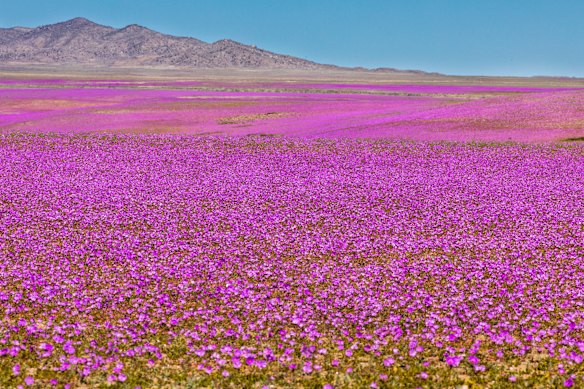
The Atacama Desert is one of the driest places in the world: a long sliver of desert between the Andes and the Pacific that most years sees just 15 millimetres of rain. However, when it really pours down, the magic happens, as 200 species of wildflower, some of them endemic, germinate, engulfing the desert floor in pulsating colour. Known as the Atacama Desert superbloom, the event normally happens every five to seven years. However, researchers believe the changing climate and rainfall patterns have meant the floral phenomenon is happening more frequently.
Make it happen Luckily for anthophiles, there’s a comparatively generous lead time to get on the ground and glimpse the area drenched in colour, with the superbloom lasting a few weeks once it occurs. Generally, superblooms tend to occur in spring, following El Nino weather patterns.
Local operator Alaya Tour can create custom itineraries, and also advise you if a bloom is occurring. See alayatour.cl
Argentina: Dance in the Street

Some cities in the world are synonymous with dance: salsa in Havana, tango in Buenos Aires, and flamenco in Seville. It’s one thing to see a show, but seeing the dance on the street, with its raw energy and passion, can transform a trip. Being able to join in? Even better. However, don’t expect a Dirty Dancing moment: if you really want to dance on the cobblestones with the crowd, commit to staying a few days, do your research before you go, and put your shoulders and hips into intensive group or private lessons.
Make it happen In Buenos Aires, head to one of the traditional milongas (dance halls) or see it on the street on Sundays in San Telmo and La Boca. In Havana, nothing beats a Sunday salsa session. Impromptu social dancing often takes place along the Malecon; Callejon de Hamel is also popular. But don’t forget to look around closer to home; Sydney’s Darling Harbour offers alfresco salsa sessions most Friday nights during summer. See darlingharbour.com
Antarctica: Be astonished at Blood Falls
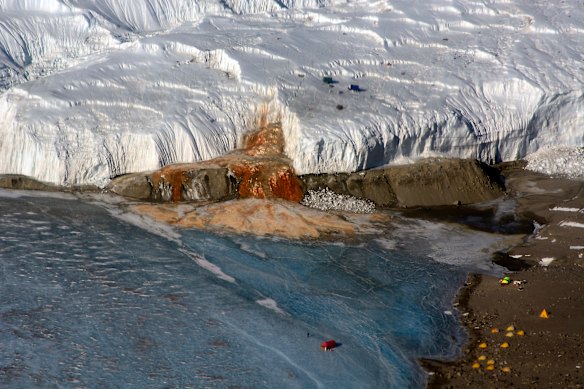
This continent is a palace of impenetrable ice, the driest, windiest, coldest place on Earth. And at the heart of this deadly kingdom lies arguably one of the world’s most terrifying phenomena: Blood Falls. Discovered during the heroic age of polar expeditions by Australian geologist Thomas Griffith Taylor, the blood-red meltwater outflow appeared almost otherworldly. A century later, science has revealed the cause: microscopic, iron-rich nanospheres in meltwater oxidise and turn red when they are pushed to the oxygen-rich surface. But for those who see it (and it’s possibly the most difficult to see on this list), Blood Falls remains an astonishing sight.
Make it happen Your chances of seeing Blood Falls are slim: for now, access is limited to researchers and scientists, and those on private expeditions. However, as technology improves, and operators push the boundaries of Antarctic travel, anything is possible – watch this space.
US and China: Hear the sand dunes sing
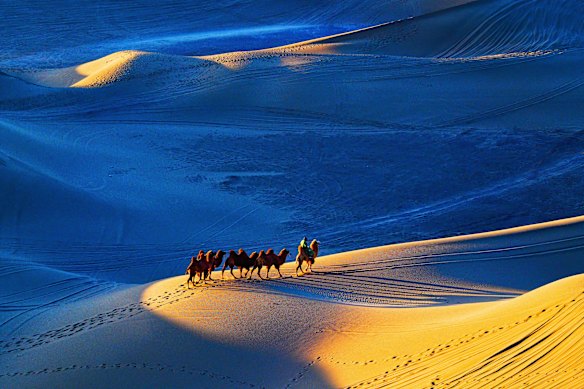
Listen closely to the ancient desert landscape, you’ll hear it gently sing: a low humming sound that resonates through the dunes and chills you to the bone. The phenomenon occurs when fine grains of silica-rich sand avalanche down the dunes, although weather and humidity can influence the sound. Now, the idea of sand making noise isn’t news to any Australian who spent their summer holidays burning their feet on squeaky sand on the way back to the carpark after a morning at the beach. However, in around 35 locations around the world, crescent-shaped dunes produce a low “hum” that can reach over 100 decibels and be heard from up to a kilometre away.
Make it happen Dunes well known for their acoustic abilities include Great Sand Dunes National Park in Colorado, where Indigenous tribes have recorded them singing for thousands of years (nps.gov/grsa/index.htm), and the loudest are the UNESCO World Heritage Listed Badain Jaran Desert Dunes in Inner Mongolia, China.
Mexico: Get mugged by a grey whale
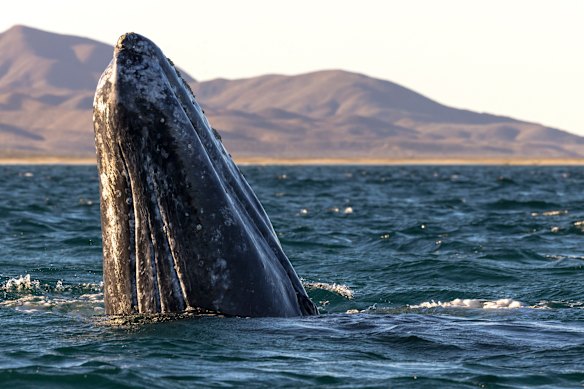
Whales have a terrible habit of stealing your heart, but before they do, you’ll most likely be the victim of a mugging. It might sound dire, but being “mugged” simply means whales have surfaced up close next to you to give you the once-over (occasionally covering you in whale snot in the process). Inherently curious creatures, Australians are familiar with the migrating humpbacks that move up the east and west coasts during the cooler months. But in Baja California, the grey whales that rest in the waters off Mexico have become well-acquainted with local boat crews that bring tourists to meet them: so much so that the whales are often eager to mug the pangas, or small fishing boats, in the San Ignacio Lagoon, with a few repeat offenders angling for a scratch from the drivers.
Make it happen Lindblad Expeditions eight-day Baja Whale Watching cruise gets you up close to the whales in San Ignacio Lagoon. See au.expeditions.com
Queensland: Watch sea-turtles hatch
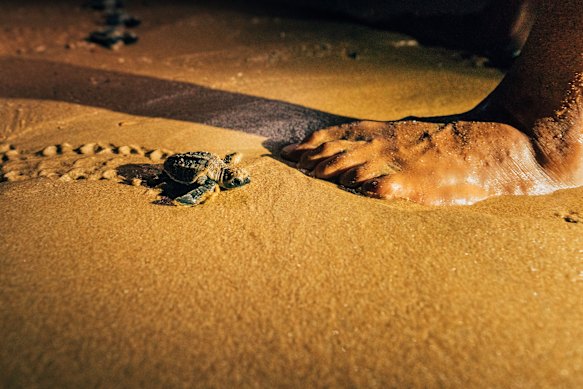
With no sound and no warning, they appear: dozens of turtle hatchlings, instinct driving them towards the ocean. Freshly hatched and with flippers flapping in a frantic fight for survival, seeing a nest of turtles erupt from the sand will send your heart racing. Only one in 1000 hatchlings will survive to adulthood; in a full circle-of-life moment, studies have shown that those who do survive return to the same beach they were hatched on to lay eggs decades later.
Make it happen Queensland’s Mon Repos is home to one of the most significant turtle-nesting sites in the country, including endangered loggerhead turtles. The nesting season runs from late November, when the adults lay eggs, to March, when the final nests hatch. After 6pm, visitors can only access the beach on a pre-booked tour to see the hatchlings. See parks.qld.gov.au
South Australia: Sail on Lake Eyre
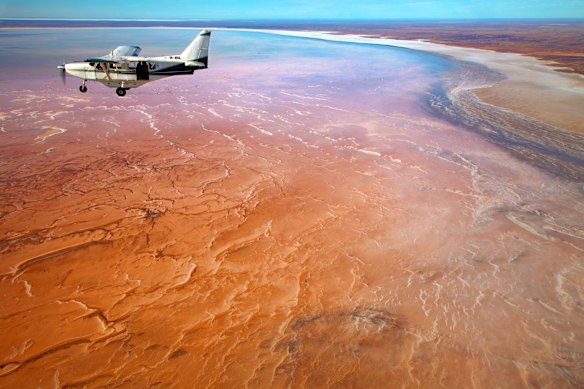
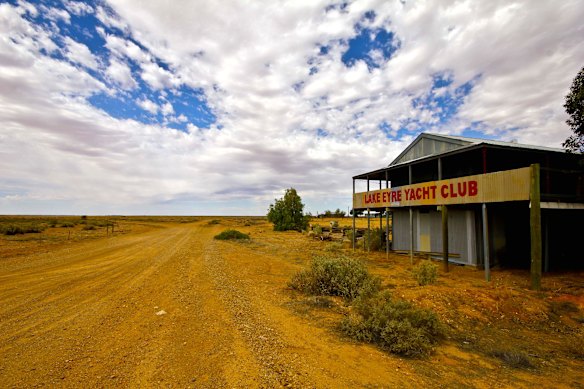
Kati Thanda-Lake Eyre has filled completely just a few times in the past century: a slow, hypnotic process where flood water drains south for months, gently filling the basin. Transformed, the landscape shifts from barren desert to an aquatic wonderland: attracting birdlife, predators, tourists – and surprisingly, yachties. Today, the small town of Maree in South Australia is home to the official Lake Eyre Yacht Club. Established in 2000, the yacht club has its own clubhouse, and despite being seen as a novelty, it is actually a brilliant resource for sailors keen to BYOB (bring your own boat) and set sail.
Make it happen There are no boat ramps, no charters, and there can be a lot of mud, but the Lake Eyre Yacht Club website is filled with excellent information on how to navigate the lake. It is faithfully updated with a map showing which parts of the 9500-square-kilometre lake are dry, filling with water, or potentially navigable. See lakeeyreyc.com
Northern hemisphere: See the lights
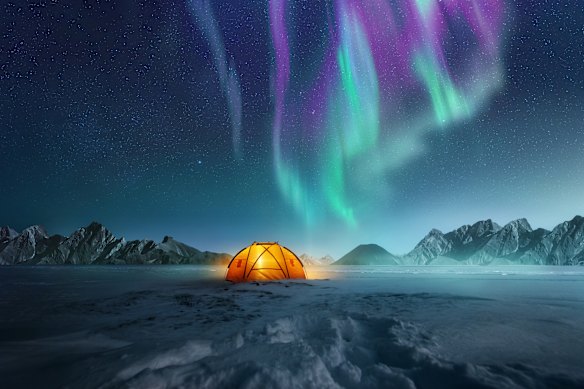
The Aurora Borealis perfectly captures the gamble of travel: people often see nothing at all, yet each winter they still keep packing their bags to come stare at the night sky for a glimpse of the northern lights. Those who do are rewarded with nature’s greatest fireworks show: the sky drenched with blue, green and red light, a swirling mass of dancing colour, a performance that can last from minutes to hours. However, keep in mind what you see is dependent upon the severity of the solar storm that triggered the display, your location, moonlight, the mood of the gods and, frustratingly, cloud cover.
Make it happen Head north into the high-latitude areas of Scandinavia, Alaska and Canada during the cold winter nights. Hurtigruten offers northern lights cruises along the Norwegian Coast. See hurtigruten.com
Queensland: Wild nights on the reef
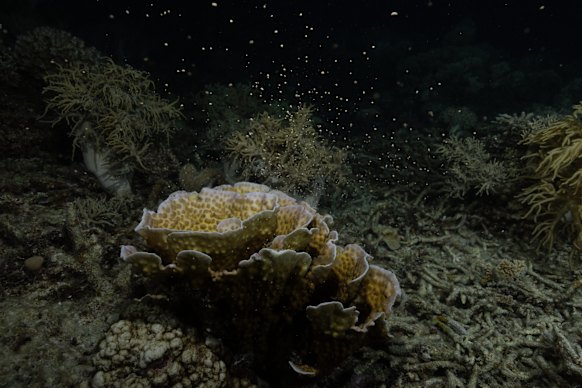
Let’s face it: the moment you hear about sex on the reef, you can’t stop thinking about it. The Great Barrier Reef’s annual coral spawning event has to be seen to be believed – an after-dark, invite-only underwater snowstorm that, for participants and voyeurs, is a heady mix of chemistry and mystery. Typically, it occurs at different times along the reef, is influenced by water temperature and the lunar cycle, occurring just after the full moon in October, November or December. During the event, coral polyps release egg and sperm bundles into the water, which float around the reef for days and weeks until the larvae settle, forming new coral.
Make it happen Many dive operators run specialist night dives and trips out to the reef during coral spawning events, with some offering special live-aboard boat options or using their moored dive platforms as a base. See tropicalnorthqueensland.org.au
Japan: View a volcanic thunderstorm
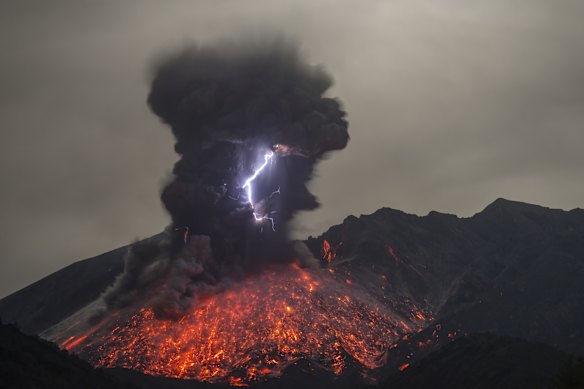
Seeing a volcanic eruption is an incredible privilege. Witnessing a volcanic thunderstorm – when an erupting volcano creates its own lightning around the crater – is a next-level experience. The phenomenon occurs when particles of volcanic ash, rock, gases and ice fragment and collide with force, generating static electricity within the plume of ash. It’s beautiful, terrifying, dangerous – and incredibly rare.
Make it happen Today, one of the better-known places for viewing a volcanic thunderstorm is Mount Sakurajima in Japan. One of the world’s most active volcanoes, Sakurajima’s last recorded eruption was in April 2026; volcanic lightning was last recorded in January this year. Viking visits Sakurajima on its Far Eastern Horizons cruise. See vikingcruises.com.au
US: Capture the firefall
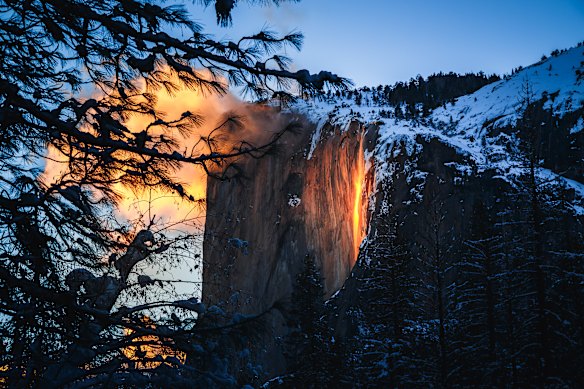
For just a few days in mid- to late-February, Yosemite National Park is inundated with visitors who brave the brisk weather and gather for sunset at the base of El Capitan and along Cathedral Beach, eager to see one of nature’s great optical illusions: the firefall. For just a few minutes, beams of golden light from the setting sun illuminate the seasonal Horsetail Falls, appearing like the waterfall is a cascade of molten fire. The phenomenon has been observed for decades; in the 70s it became popular with photographers, and thanks to social media, the Firefall has become extremely popular. Today, seeing it in person comes down to a combination of timing, weather and whether there is enough snowmelt draining from the mountain top.
Make it happen Expect rock concert-like crowds, parking chaos and gridlock driving out once the sun sets. Photographers tend to camp out from early morning for the best spots: expect to commit a full day here to be able to see it. See yosemite.com
Northern Territory: Watch Uluru’s waterfalls
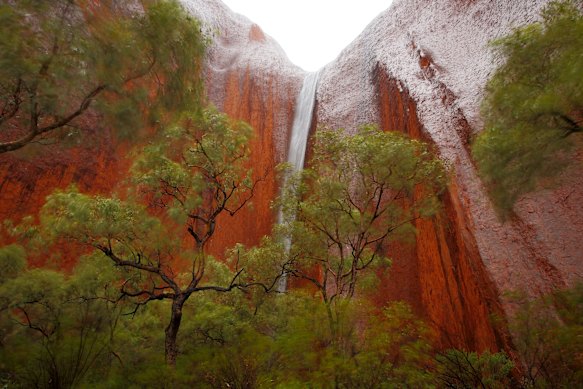
Most people who’ve been, will tell you that seeing Uluru is a deeply moving experience. Seeing it when the rains come, however, is almost otherworldly. Silver strands slip down the sides of the magnificent rock, and fed by the storm, waterfalls thunder down its burgundy crevasses: alive, moving, magnetic, awe-inspiring. The rain shifts the desert landscape: birds bathe, nocturnal animals emerge, dormant species are awoken, and all the while, nomadic two-legged ones scurry for sanctuary back to their tour.
Make it happen The best chance during the wet season from November to April. If there is rain forecast, or if it’s been wet in the previous days, Mutitjulu Waterhole – one of Uluru’s only permanent waterholes – is where you’ll most likely catch a waterfall. See uluru.gov.au
Africa: Witness the Great Migration
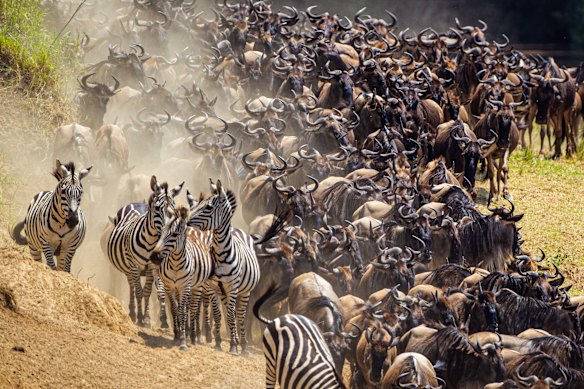
Seeing the Great Migration is an attack on the senses. Beyond the visual feast of seeing a million wildebeest, zebras and gazelles moving along the plain, you’ll be covered in the dust, engulfed by the sound, and potentially overwhelmed by the smell of life and death on the Serengeti. The challenge? Timing: knowing where the herd will be, and when they’ll get there.
Make it happen The herd moves in a clockwise pattern between Kenya’s Maasai Mara and the Serengeti in Tanzania. Many safari operations run mobile camps that move position throughout the year, including &Beyond’s Serengeti Under Canvas mobile camp andbeyond.com.
Central Asia: Spot a snow leopard
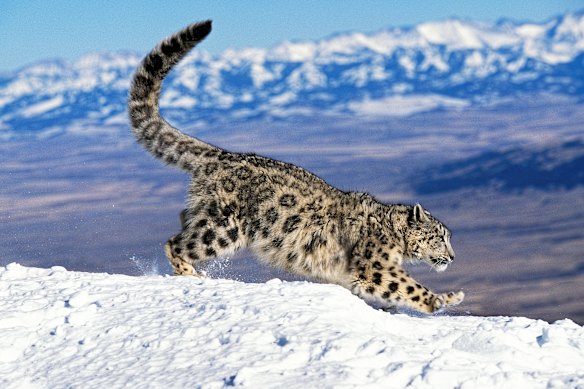
They call them the ghost cats. Solitary predators, the snow leopards of Central Asia are one of the hardest and most stunning animals to glimpse in the wild. The reason? The best time to try to see them is winter, when their primary prey – sheep and ibex – abandon the high-altitude regions for lower pastures, with the big cats following them. Many travellers spend a week in the mountains and don’t see them at all, but those who do say the risk is worth the reward.
Make it happen Pack your winter woollens and be prepared to be patient. World Expeditions runs a 14-day Wild Ladakh: Ancient cultures & the elusive snow leopard tour, which includes five nights in the Ulley corridor, where leopards are frequently seen with specialist trackers. See worldexpeditions.com
Five unexpected travel moments that matter
Meeting “the one”
There’s a reason why those B-grade Netflix travel rom coms are popular – everyone wants to meet the love of their life on the road. There’s no magic wand you can wave to make a meet-cute happen, but you can travel with an open heart.
The hot tip
Everyone has an opinion about where you should go and what you should do when you’re on holiday. But the best people to ask? The locals. Their insights can transform a trip.
A stranger’s welcome
Going behind closed doors can be the highlight of any trip, but a personal invitation into someone’s home, whether it’s for a cup of chai, coffee brewed fresh over the campfire or the opportunity to sleep in someone’s home, is a special privilege.
A welcome stranger
From someone to lean on when you’ve been injured or a shoulder to cry on when your heart’s been broken, being the recipient of the kindness of strangers can be profoundly humbling and instructive.
Getting lost
When travel plans don’t work out, or you don’t end up where you’re meant to be, embrace serendipity and be happily lost. Sometimes, it really is for the best.
Have you experienced any of the magic moments in our list? Is there something we missed? Share your thoughts in the comments below.

















































