3 months ago
18
3 months ago
18
Selinger-Morris: One thing I really wanted to ask you about, which I think a lot of Australians would have been thinking about in particular over the last few days, is the wildly different weather we’re seeing at the same time. So you’ve got bushfires in one part of the country ... then you’ve got floods and cyclones in Queensland. Meanwhile, I’m recording in Sydney and within about 24 hours just the other day, we went from searing temperatures over 40 degrees to then quickly needing jumpers. Why is this happening?
Loading
Bowman: We’re seeing this extraordinarily unstable climate ... [what] we’re learning as we’re going is that the Earth system and the climate system is really very complicated.
When you start putting more energy into the atmosphere … the energy expresses itself in extraordinary ways. So we have, as we know, these extraordinary downpours and flooding events, we have these periods of just amazing rain.
We’re seeing this as well in California. So you get these very wet periods, you get flooding. You can get an interaction of the flooding with burnt areas. And then before you know it, you can switch back to drought ... and then, to add insult to injury, we’ve been getting these incredible windstorms, and windstorms go with wind-driven fires, and wind-driven fires are just the worst because they move so quickly.
Bowman: The growth rate is so high. Extremely difficult to fight, very difficult to use aircraft because the atmosphere is… you’ve got a windstorm, and then you also have... what we’ve seen in Victoria, which is just mind-bending, is these fire thunderstorms where you get such incredible intense fires that they generate their own weather systems, and they are, again, horrible things to contemplate, very difficult things to fight.
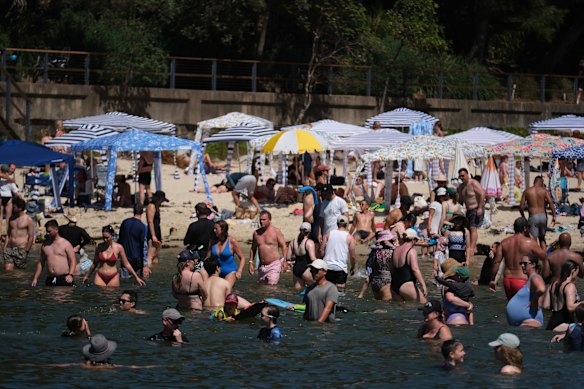
A packed Sydney beach on Saturday, when Victoria battled bushfires and Queensland endured floods.Credit: Oscar Colman
Loading
So what we’re really describing is what’s being called in fire science “hydroclimatic whiplash”, this climate whiplash where we’re … going from wet to dry, wet to dry. So we’ve got this flickering between these states.
Then, within our fire seasons, we’re seeing extreme heat waves, extreme wind events, and then you get the conjunction of an extreme heat wave and extreme wind event. We’ve just seen what happens. It’s just absolutely horrendous.
Selinger-Morris: I wanted to ask you about what you’ve just mentioned there, which was climate whiplash or hydroclimate whiplash. How is climate change causing or driving this? You know, fires in one part of the country, floods in another. What’s happening here?
Loading
Bowman: What’s happening is basically that the old weather patterns are breaking down ... one of the reasons it’s going to become increasingly difficult to forecast weather is because we’re getting all of these complex interactions between sea surface temperatures.
Wind fields are changing because the high-pressure systems are moving further south. We’re getting all sorts of complicated interactions at a planetary scale, and then that plays out at local scales. I mean, often I’ve been looking at synoptic charts and just puzzled at the complexity of them because new emergent weather patterns are becoming created.
And that is a really important point ... it’s not a criticism that this terrible fire season wasn’t adequately forecast ... what we know from the past isn’t necessarily scaling well into the future.
We do know about what are called inter-annual climate modes ... we have names for them, like the Indian Ocean Dipole and the La Niña, El Niño phenomenon. But when you heat up the planet, those things start expressing themselves in new ways.
Bowman: We’re seeing different sorts of weather systems emerging. So for instance, the west coast of Tasmania was classically a very, very wet place. And it’s undergoing a drying trend just in the same way that the ocean currents are changing. So this makes it very, very difficult to reliably predict or forecast what’s going on.
We’re absolutely certain that the climate is going to change because of increased greenhouse gas pollution. But exactly how that will play out this summer or next summer becomes more and more difficult ... that’s where we’re really involved as a learning as we go. And that’s why research and development and really good monitoring is so important because ... we’re almost rediscovering, or discovering, a new climate as it’s evolving and emerging.
Loading
And this is where building community capacity is going to be so important. Communities have to be on this awareness that, as we’ve seen, situations can escalate extremely quickly because the climate is not playing by the old rules. It’s a different beastie.
To hear more about how communities and governments can prepare for the increasingly devastating impacts of climate change, and what pyrogeography even is, listen to the podcast episode in the player above or click here.
Hear the story behind the headlines on The Morning Edition podcast, every weekday from 5am on Apple, Spotify or your favourite podcast platform.
Most Viewed in Environment
Loading