3 months ago
4
3 months ago
4
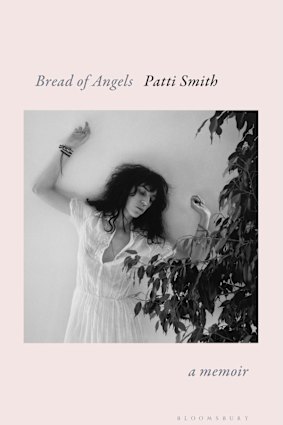
MEMOIR
Bread of Angels
Patti Smith
Bloomsbury, $34.99
The crumb trail begins at once. “The pen scratches across the page rebel hump rebel hump rebel hump. What do those words mean, asks the pen. I don’t know, says the wrist.” That’s the bread of angels: the mundane summoning the mystical. Patti Smith is the go-between, setting the vibration to language, trusting meaning will come.
It’s a spark poets and songwriters know well: sound as the seed of a world more felt than understood. In this latest in her series of gloriously transporting memoirs, Smith follows that scratch into the awkwardness and beauty of childhood, the place where “the kingdom of the infinite imagination” first opened beneath her feet.
Her earliest memories shimmer as if through a looking glass in the back of a wardrobe: the doll rescued from a cliff; the maple bureau whose knobs are dials to infinity; the rat-infested underworld she patrols with the neighbourhood children; old Aggie across the hall with her dark green book of Irish fairytales.
“Mine was a Proustian childhood, one of intermittent quarantine and convalescence,” she writes. A dose of Asian flu intensifies her insistence on divine structure. Her mother’s emptied tip jar and the Puccini box set on the dresser are “a marriage of art and sacrifice” that literally saves her nine-year-old life.
The outer world she describes as her struggling family bounces between Philadelphia apartments is no less heightened. “I was happy there observing the last vestiges of the 1940s, soon to succumb to modern times,” she writes. “There were horse-drawn wagons, the iceman, a ragman, and an organ grinder with a monkey with a little red cap.”
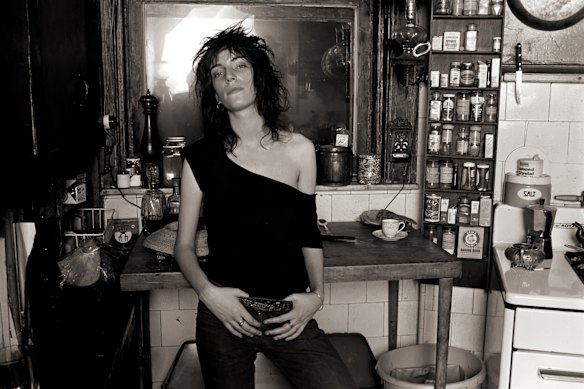
Patti Smith in 1969.Credit: Norman Seeff
She’ll return to the loss of that paradise later, but her spirit world never falters, even as she trades up her mother’s devotion to the Jehovah’s Witnesses for Picasso, Modigliani and Sargent at the Philadelphia Museum of Art. “I believed in the Creator, the many tongues of nature, the moral lessons of fairytales, the language of trees, and the clay of the earth … God, the infinite realm, Jesus, the human bridge, the artist, the material mouthpiece,” she writes. Breadcrumbs are everywhere: animals, constellations, fragments of ancient alphabets.
A teenage pregnancy and a broken family nest hurl her towards New York, and the part of her story fans will know. Mapplethorpe, Shepard and the Chelsea Hotel; Dylan and Burroughs and Lenny Kaye, terrain that crisscrosses her earlier books from fresh angles. “Claiming the right to create without apology from a stance beyond gender or social definition” is one of her cascading manifestos.
The middle chapters chart her arrival in an arc of exhilaration, disappointment and exhaustion. The triumph and solidarity of her band dissolve under pressure, surrendering to the divine light of her soulmate Fred “Sonic” Smith. “I did it for love. I did it for art. But moreover, I did it for myself,” she writes. “Walking away was my second declaration of existence.”
Here, in apartments strewn with Coltrane records and Pollock prints and finally an ivy-covered stone cottage on Lake St Clair, she reveals the hidden bliss and angst of her “retired” years, devoted to her husband and to children arriving as if borne by the weather. She scratches with ink and quill by candlelight, as “the desire for illumination eclipsed that of ambition”.
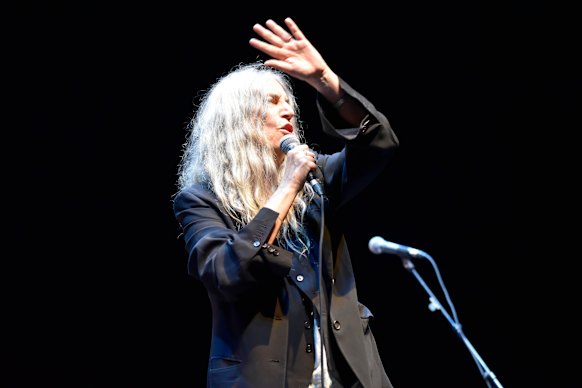
Smith performing in Paris in 2019.Credit: Daniel Pier/NurPhoto
In later chapters, death sweeps through her world like a proverbial scythe. The rarefied circle around her – Stipe cold-calling to be her valentine, Springsteen taking her son Jack on his first motorcycle ride, Ginsberg urging her to “replace grief with generosity and serve the public” – does little to protect her.
Bread of Angels is not the reflective adjunct or coda to a life that memoir often entails. No less than her classic albums Horses and Easter, this is Patti Smith’s work, crafted with the same deep faith, poetic precision and visionary charge, not reduced but amplified by the urgency of age.
Loading
The years unearth secrets, too. One Drop of Blood unpacks a family mystery that unsettles everything before it. “We who no longer believe” becomes the writer’s troubled mantra. At last, the Vagabondia chapter finds her wandering, “a convalescing would-be traveller with a book upon my lap”, unsure where to send her words.
“Perhaps to another time when we will all be gone. My generation, that is, my ludicrous kind … I dip my pen into a glass ink pot and scrawl these words. ‘I am memory’.”
If she were just that, it would be hard to fault her legacy. The revelation here is that she’s still so ardently at work, still gathering whatever strange, often cruel nourishment the world offers and transmuting it into art.
The Booklist is a weekly newsletter for book lovers from Jason Steger. Get it delivered every Friday.
Most Viewed in Culture
Loading