3 months ago
23
3 months ago
23
On Wednesday, West Coast are expected to use one of their top two picks to select young ruckman Cooper Duff-Tytler in the national draft.
AFL draft guru Kevin Sheehan’s description of the 18-year-old could double as a prototype for the modern ruckman: “A gifted athlete, Duff-Tytler covers the ground extremely well and becomes an extra midfielder after taking the ruck contest”.
The reason: A raft of rule changes for 2026 will impact ruckmen more than any player on the ground and bring players with Duff-Tytler’s attributes to the fore (it’s why the Tassie Devils can hardly hide their excitement about under-16 prospect Axel Walsh being available to them).
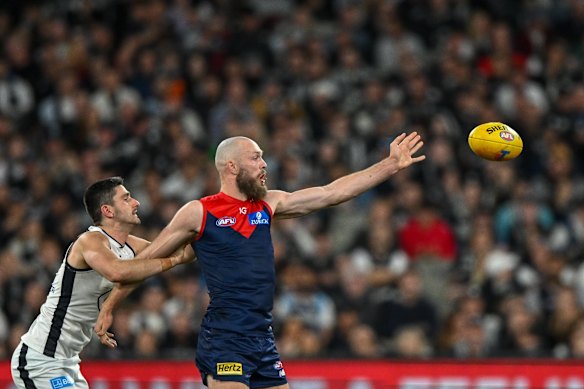
Melbourne’s Max Gawn is one of the greatest, most adaptable ruckman the game has seen. Credit: The Age
The rules should suit Duff-Tytler, who stands at the relatively short (for a ruckman) height of 201 centimetres because he can leap and he can run. It’s also put another draft prospect, Louis Emmett, in the frame at just 199cm, particularly after he finished the two kilometre time trial at the combine in 6:07.
But that pair represents the not too distant future.
The more immediate question for many in footy, particularly those who are taller than two-metre Peters, is how will the rule changes affect the current ruckmen, such as Max Gawn, Sam Draper, Darcy Cameron, Brodie Grundy, Tom De Koning, Lloyd Meek, Reilly O’Brien, Tim English, Luke Jackson, Jarrod Witts, Tristan Xerri or Toby Nankervis?
Could it, in time, spell the death of the ruck as the game moves quicker than a weekend? Who will have their careers revived and who will be extinguished?
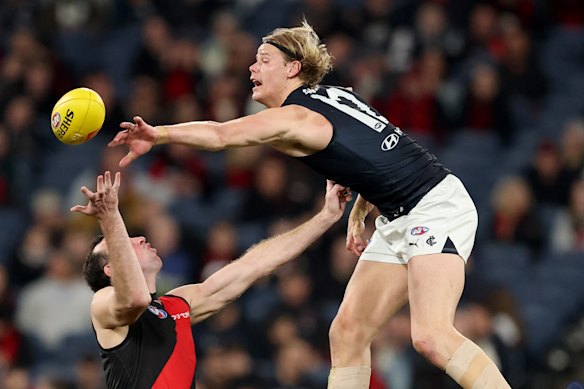
New rules should suit former Blue, now Saint Tom DeKoningCredit: Getty Images
We asked six recruiters, ruck coaches and assistant coaches from across the competition, who wanted to speak anonymously so they could speak freely about the potential impact of the rule changes on ruckman.
What are the rule changes?
The most obvious shift is the death of the centre bounce, meaning the ball will be thrown up every time in the centre or around the ground.
That change along with the fact “the competing ruck cannot cross the centre circle line and engage with the opposition ruck, prior to contesting the football” will make the centre contest look as different in 2026 as a man who has just shaved his moustache off.
Three other new rules will speed the game up, making it more difficult for big men to get to ruck contests or get behind the ball to mark as the ball will stay in play and in transition more often than it did in 2025.
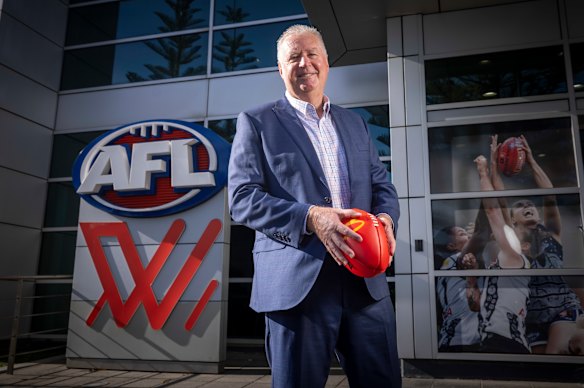
New AFL football performance boss Greg Swann has not mucked around in making decisions about rules. Credit: Wayne Taylor
Those rule changes include the introduction of a free kick for the last disposal out of bounds between the 50-metre arcs. Umpires will restart play around the ground or from a boundary throw in without a nominated ruck being present. Ruckmen will even be rushed to kick when they take a mark or gain a free kick. Perhaps on the plus side, there is no sub now, with five players now on the bench.
Where will the focus be?
There is unanimous agreement that each rule change suits St Kilda recruit De Koning.
He is an athletic tall with an outstanding leap at centre bounces. By no means the finished product, he will, however, be able to play football like a jockey rides the best horse in a race.
Melbourne champion Gawn had already predicted De Koning would be the next ruck star on the horizon and his ascension to that mantle should be celebrated as the AFL encourages a return to the spectacular leap after fearing its extinction.
The league’s research found that “only 21 per cent of centre bounce ruck contests had at least one ruck jumping in the 2025 season. In 2023, just two years ago, that number was at 63 per cent.”
That would, on the face of it, appear to threaten the futures of those with concrete in their boots. However, the experts say the nature of the threat will become clearer once they know how umpires will interpret the new rules.
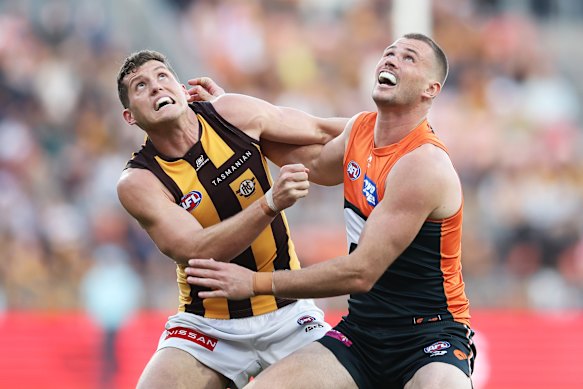
Lloyd Meek’s ability to wrestle with ruck opponents will be somewhat nullified by the change to the centre-square ball-up rule.Credit: AFL Photos
“It all comes down to adjudication,” a ruck coach said. “You can still find ways to block or disrupt your opponent’s jump at the centre bounce but you need to see how the umpires pay free kicks.”
Last year was considered a free-for-all and the umpire’s whistle unpredictable. The centre ball-up will lead to more certainty and set-ups will reflect that, but there is still expected to be variation in how high certain umpires toss the ball in the air.
It’s why there is less unanimity among the experts as to what the changes mean for the grappling ruckman such as the Dockers’ Sean Darcy, Sydney’s Grundy and Hawthorn’s Meek. Some supporters had Meek’s obituary written suspecting the rule changes would favour his teammate Ned Reeves.
Not so fast, say the experts. Being smart enough to adapt is more important now than rucking with a defined characteristic.
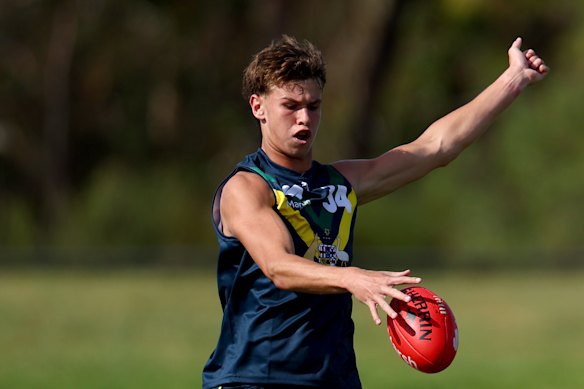
Cooper Duff-Tytler remains one of the brightest prospects in this year’s draft class.Credit: via Getty Images
“The centre bounces will be fascinating. The rules mean smart ruckmen will be able to adjust. The smart ruckmen, such as Grundy, know how to manipulate the rules and their positioning to counter their opponent’s advantage and maximise their own,” an assistant coach said.
Some will adjust. Some won’t. The need to adapt potentially explains partly why the Hawks were so keen to get retired Lions’ premiership ruckman Oscar McInerney, universally recognised as a team first person, on their coaching panel this season.
“With the 6-6-6, the centre bounces have become so critical, so there will be an enormous amount of work put in to get it right,” an official said.
As the game gets faster, will the ruckmen keep pace?
Not only will the ruckman need to jump or stifle their opponent’s elevation at centre bounces, they will need to cover the ground like a midfielder to stay as involved in the game. Umpires will throw the ball up immediately around the ground rather than waiting for nominations like a waiter arriving at a table with three different parmas.
That reality has one football manager concerned that everyone will soon be looking for Mark Blicavs clones, 198cm players who can compete at stoppages then charge around the ground in between, potentially diluting the notion the game is one for all shapes and sizes. “Do we want that? I am not so sure” he said.
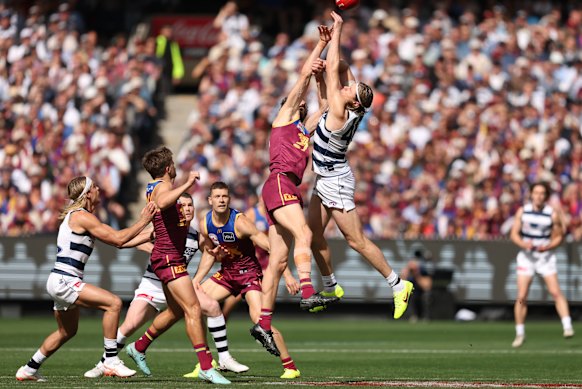
Mark Blicavs helped the Cats to the grand final, but the Lions dominated in the ruck in the decider. Credit: via Getty Images
With three fewer boundary throw-ins per game predicted and the umpires in fast-forward at stoppages, ruckmen may position themselves behind the ball to mark and leave smaller players to take the ruck job when nearest a stoppage. It might mean welcoming back the Shaun Grigg-type ruckman.
All six experts agree the tall players’ ability to mark will always be valuable meaning players such as Gawn, Cameron and Nankervis will remain relevant.
The challenge will be getting into position behind the ball, particularly with last touch. Those teams who have used their ruckman to bolster their defence can’t also expect that player to always be at stoppages. It’s why, one assistant said, the Western Bulldogs with Tim English, Sam Darcy and Rory Lobb in all parts of the ground could gain an advantage via the new rules. It may explain why St Kilda retained Rowan Marshall, despite his trade request.
The game is becoming so fast that a tired, lumbering ruckman will be hard-pressed to execute their skills if pushed too hard, said one coach. So two ruckmen or one ruckman with a different role will be the way forward.
No one has Blicavs’ physical attributes, but one recruiter thought Collingwood should try their skipper Darcy Moore in the ruck, replicating his dad Peter’s feats on the football field. Geelong’s Sam De Koning has been tried before, as has the Hawks’ Mabior Chol.
It was time to think outside the square, the recruiter said, with wrestling in the AFL’s crosshairs, and determine who might play the role best going forward rather than assuming it will be the same old names.
That’s why Duff-Tytler’s run has been well-timed, entering the competition with a set of rules to suit. He will still take time to develop but the chances of him succeeding have, if anything, increased.
There will be casualties. But for every disappearance there will be an emergence of another player. No one sees the rules signalling the death of the ruckman.
“I’m really looking forward to watching how the smart players adapt,” an assistant coach said.
“There is something in the rules for everyone.”
Most Viewed in Sport
Loading