3 months ago
28
3 months ago
28
When Andrew Christodoulou saw a block of land available for purchase four doors down from his house in Clarinda, he snapped it up.
The 37-year-old panel beater and painter – who, along with wife Georgia, grew up in adjacent Oakleigh South – has lived in the middle ring, south-eastern Melbourne suburb for seven years and cannot imagine a better location.
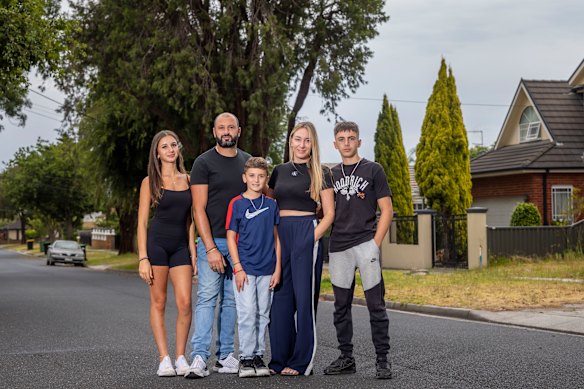
Andrew and Georgia Christodoulou, with their three children Mia, 14, Michael, 11 and Dimitri, 15 love living in Clarinda, the most tightly held suburb in Melbourne. Credit: Wayne Taylor
“We’re so central to everything – five minutes down the road we’re in Oakleigh, 10 minutes we’re at Chadstone, 10 minutes we’re at Southland if we need it. We’ve got Dingley Bypass nearby – it’s great,” he said.
Christodoulou is not alone in his love of Clarinda. Figures from property data firm Cotality show it is Melbourne’s most tightly held suburb, somewhere homeowners hold on to their properties for a median 28 years – 3.5 years longer than the second-most-held suburb, Balnarring Beach (24.5 years).
It’s nearly triple Melbourne’s overall median hold period of 9.9 years, data for the 12 months to December shows, and, with a median house value of $1,082,753, slightly above Melbourne’s overall median house value of $981,165.
At his address, Christodoulou has built three townhouses: one for his mother-in-law, one for his family of five and the third for sale. He plans to build two more townhouses on the new land, to sell or leave to his children.
“The kids love it. I’ve offered them [the choice] of moving to another suburb, but they don’t want to move, so I ended up buying the place four doors down to give them a bit more space,” Christodoulou said.
His friend, who already owns three houses two doors from him, has recently bought another across the street and is keen to move back from Oakleigh South and live in Clarinda again.
“Everyone wants to be there,” Christodoulou said.
Cotality research director Tim Lawless said many of Melbourne’s tightly held suburbs were heavily owner-occupied, with higher median home values than Melbourne overall.
“They’re not all your ultra-high-end suburbs, but they’re not your starter suburbs, either,” he said.
“These suburbs are mostly going to be quite dominated by owner-occupiers rather than investors, so they’ll have a smaller portion of renters – they’re the sort of areas that are generally pretty well serviced by an amenity.”
Lysterfield South in Melbourne’s south-east came in third, with a median hold period of 23.7 years.
This was followed by Yallambie (22.4) and Attwood (21.8). Their median values were $1,131,790 and $900,199, respectively.
Lawless noted that Clarinda’s turnover rate of 2.4 per cent was “pretty extreme”, especially compared with Melbourne’s overall average of 4.7 per cent.
“Not many people are putting their property up for sale here,” he said.
In contrast, greenfield areas in Melbourne’s outer west and north pockets such as Mount Cottrell, Mickleham, Wyndham, Tullamarine, Broadmeadows and Melton tend to experience high turnover, sometimes within three years.
Loading
“They tend to be newly developed … but also probably a little bit more dominated by investors, who tend to have much shorter timeframes for the period of time they’re going to hold their property,” Lawless said.
“These might be classic first home buyer areas where they look to upgrade into markets that might be closer to the city.”
McGrath Estate Agents senior sales executive Peter Laspas, who has helped Christodoulou buy and sell, said Clarinda had a lot to offer every demographic.
“It’s great for families – there are three local schools, numerous parks, good infrastructure with regard to buses, and close to shopping centres,” he said.
“A lot of people aren’t wanting to move because they’ve been there since the get-go … [they’re saying] well, if I downsize, where am I going to go? I’m not going to find locations which still have all these things to offer.”
Loading
Melbourne demographer and director of the Demographics Group Simon Kuestenmacher said Clarinda was “the standard Australian suburbia of yesteryear that is now well established”.
“It’s a highly car-dependent part of the city … that is relatively established, but not too established,” he said, adding its status as former outer fringe-turned-middle ring suburb meant people had not yet had the chance to retire, downsize and move out.
“So it has been developed a couple of decades ago, and people are not yet at the stage of the life cycle. The previous first home owners will still live there, to a degree, but they aren’t old enough at scale.”
The area looked like it would be popular with tradies, who had less need to live in more expensive, inner-city suburbs with less space, Kuestenmacher said.
Clarinda and the other top 20 suburbs tend to attract buyers who are relatively wealthy and seeking their forever home.
“It’s all single-family homes, separate homes … there’s no area where you could squeeze in an 18-storey tower if you’re a developer,” he said.
Most Viewed in Property
Loading