3 months ago
31
3 months ago
31
By Friday afternoon, the smell of simmering dashi fills a small flat in Chatswood, a multicultural pocket of Sydney where Chinese, Japanese and Korean are heard more often than English. Inside, the kitchen hums with quiet purpose. On the dining table, the ingredients for temaki – make-your-own sushi – are laid out with meticulous precision: salmon and avocado, pickled ginger, snapper, cucumber and tamagoyaki, a sweet Japanese omelette.
The host, 86-year-old Teri Teramoto, moves a plate half an inch to the left, adjusts a bowl, checks the steam rising from her savoury egg custard. Every Friday night for more than two decades, she has gathered up to 10 guests around this table.
“It started when I was looking after friends’ children,” she says. “They grew up, but the dinners stayed. We just get together and chat – that’s very important for us.” Politics and gossip mingle freely over tea and sake. “It keeps my brain active,” Teramoto adds with a laugh.
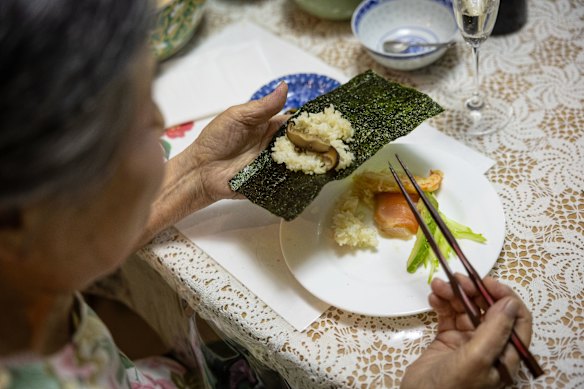
Temaki or make-your-own sushi.Credit: Wolter Peeters
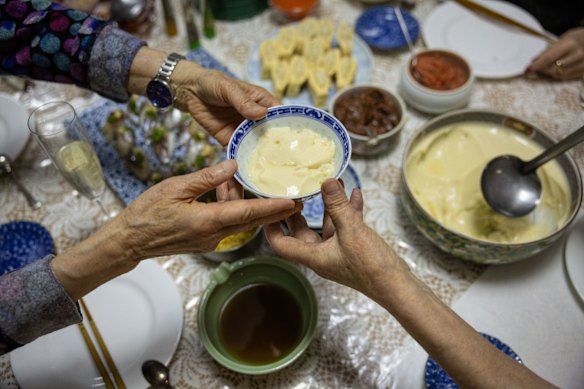
Silky egg custard like mother makes.Credit: Wolter Peeters
For her guests, the evenings are nourishment in more ways than one. “She never takes the easy route,” says Keiko Montil, a former UN staffer and long-time regular. Her silky egg custard with shaved bonito – is something no restaurant can match, Montil says. “It’s like our mothers’ cooking. She makes me feel at home.”
What happens around Teramoto’s table, though, is more than hospitality. It’s a continuation of a lifetime spent connecting cultures – only the setting has changed.
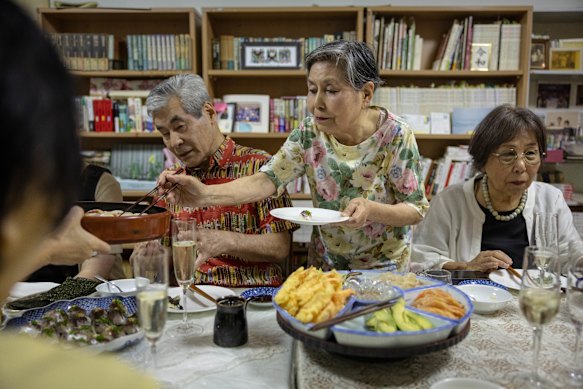
Teramoto’s dinners have been a Friday night institution.Credit: Wolter Peeters
From Hiroshima to the skies
Teramoto was six when she saw the sky above Hiroshima erupt in blinding light. On August 6, 1945, she and her family were on a train near the city when the atomic bomb fell. In the days that followed, she walked for miles with her mother, four-year-old brother and two-year-old sister through a wasteland of ash and bodies. Her father had already been killed in the war.
“We just had to keep walking, trying to find the next train – through the radiation, with the dead lying everywhere,” she recalls quietly.
For more than a month, they went unwashed, sleeping outdoors. When they were finally able to bathe, she says, “it felt like paradise – like normal life”. But that normality didn’t last: her younger sister died months later from radiation sickness.
“There are two ways – some people try to forget,” she says. “I didn’t talk about it until I turned 60. But I never really forgot.” Now, she speaks about it with calm pride. “I’m proud to be a survivor.”
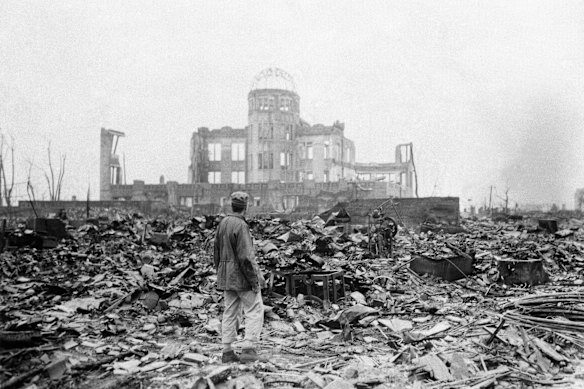
Hiroshima after the atomic bomb hit in 1945.Credit: AP/Stanley Troutman
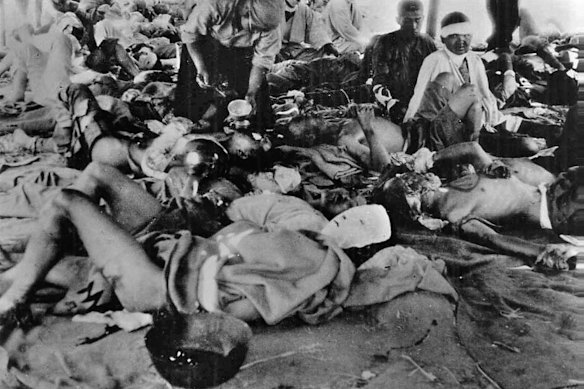
Survivors in the aftermath of the bomb.Credit: AP
Between two worlds
After the war, Japan’s rigid hierarchies left little room for a war widow’s daughter. “I couldn’t apply for jobs because of that,” she says. Instead, she joined an American firm as a secretary – her first step into an international world.
In 1964, a telegram arrived from Qantas. The Australian airline was recruiting Japanese flight attendants for its new Sydney-Tokyo route. During her interview, she was asked if she knew Australia’s capital. “No, sir,” she answered honestly. “I only know it’s not Sydney and not Melbourne.”
She got the job anyway. Dressed in kimono, serving in first class, she became one of only 12 Japanese women flying for Qantas in the 1960s. To Japanese passengers, she was a reassuring presence; to Australians, she embodied the grace of a new cultural exchange.
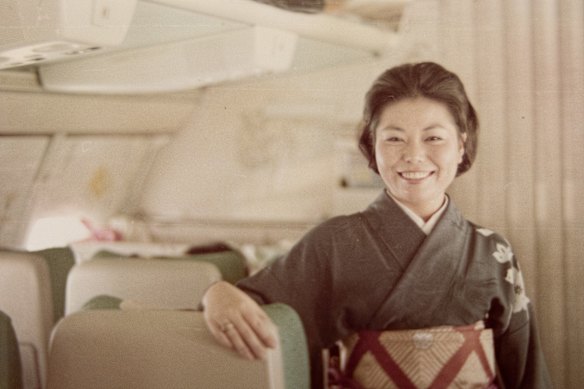
Teramoto brought Japanese culture to Qantas passengers.Credit: Wolter Peeters
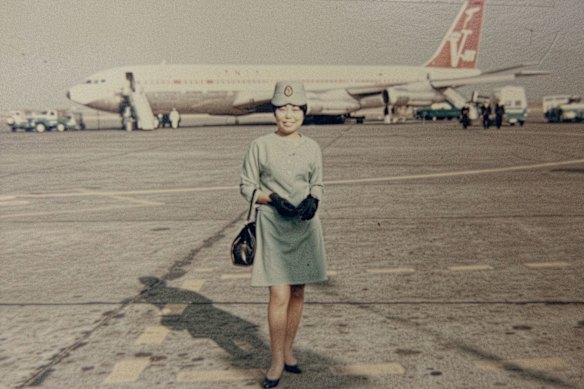
Teramoto on the tarmac.Credit: Wolter Peeters
Marketing happiness
By 1980, Teramoto had moved into marketing, tasked with luring Japanese honeymooners to Australia. She met with wedding planners, studied the Shinto calendar and persuaded Qantas to schedule Monday evening flights – just after weekend weddings on “lucky days”.
“I thought: same distance, seven and a half hours to Hawaii, seven and a half to the Gold Coast – why not Australia?” she says.
It worked. “From zero honeymooners to half a million in three years,” she recalls. At one point, a quarter of Qantas’s revenue came from the Japanese market. In 1989, she moved permanently to Sydney and became active in the Australia-Japan Society. Whether in business or in private life, she was always a cultural bridge – linking languages, lifestyles and outlooks.
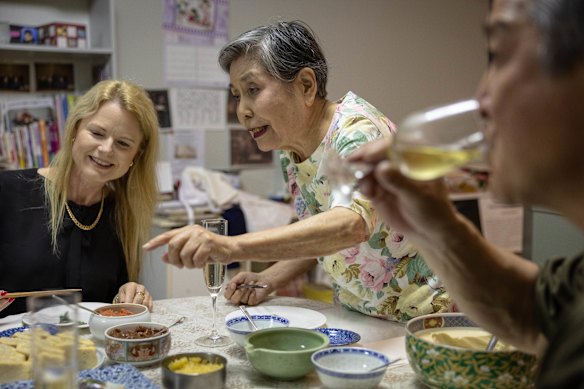
Dinner guests come from many backgrounds.Credit: Wolter Peeters
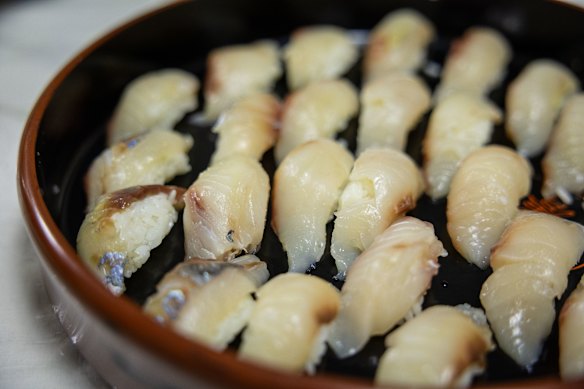
A glistening fish dish.Credit: Wolter Peeters
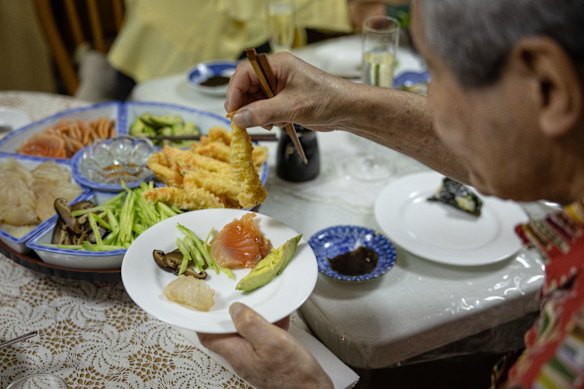
Guests help themselves.Credit: Wolter Peeters
A life of learning and resilience
In 1994, doctors diagnosed Teramoto with oesophageal cancer. Retirement followed – but so did more diagnoses: bladder, stomach, breast and throat cancer. “Whatever cancer you name, I’ve survived it,” she says matter-of-factly. Her explanation is simple: regular check-ups. Doctors suspect her illnesses may trace back to Hiroshima’s radiation.
She now divides her time between cooking and a decade-old reading group devoted to The Tale of Genji, the 11th-century Japanese epic. “We’ve been studying for more than 10 years – lifelong learning,” she says. “It keeps my brain active.” She’s also an avid fan of the all-female Takarazuka theatre, where women play men’s roles – another small bridge between worlds.

Cooking is one of the interests that keep Teramoto active despite health challenges.Credit: Wolter Peeters
Bridging worlds, one meal at a time
On this Friday evening in Chatswood, nine guests gather: a Qantas flight attendant, a chef, a former UN official, an occasional actor and a German journalist. They share sushi and egg custard and talk about politics and celebrity gossip.
“She looks after us,” one says simply. In truth, what Teramoto does now isn’t so different from what she once did at 30,000 feet. She brings people together, giving those far from home a sense of belonging. Only now, the bridges she builds are made not of steel or skyways – but of dashi broth, homemade sushi, conversation and the timeless pages of Genji.
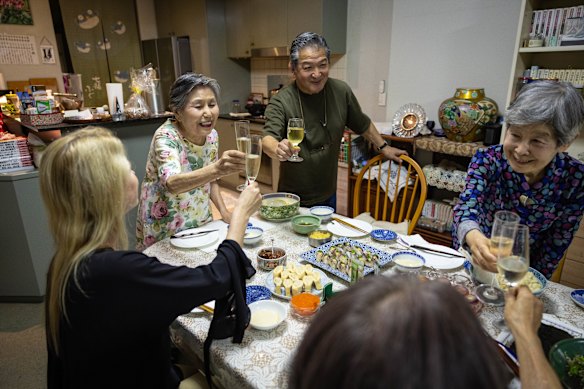
‘She looks after us’: Teramoto and her guests toast another successful meal.Credit: Wolter Peeters
Start the day with a summary of the day’s most important and interesting stories, analysis and insights. Sign up for our Morning Edition newsletter.