3 months ago
26
3 months ago
26
When Sting decided to put his name to a musical he could have made it easy on himself. Let’s imagine he created a show called Roxanne, the tale of a kind-hearted sex worker and the man who loves her. It would be so packed with hits from his solo albums and his days with The Police, no one would notice the paper-thin storyline.
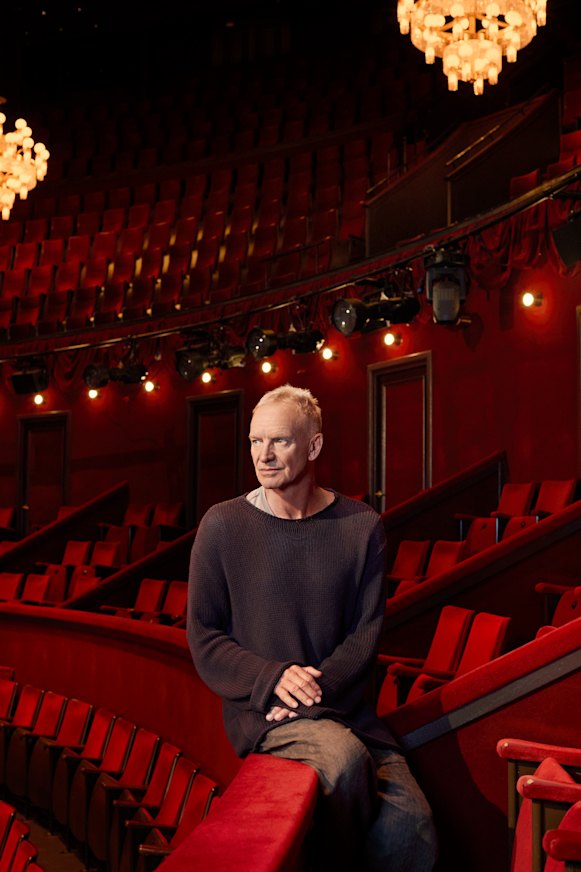
“Queen has We Will Rock You, ABBA has Mamma Mia!″ I say to the man at the other end of the sofa who is in fact Sting. “A juke box musical based on your songbook would be a surefire hit.”
“Maybe I’ll do that next,” says the 74-year-old English pop icon in a way that suggests he absolutely won’t be doing that anytime soon. “You know, I don’t think there’s any point falling off the lowest rung of a ladder. I like difficult things; I like puzzles. And this is the most difficult thing you can do: turning an original story into a musical.”
He’s talking about The Last Ship, his stage show about a town in North East England facing the closure of the shipyards that have sustained the local community for decades. Based on his 2013 concept album of the same name, it contains a few familiar tunes, most notably Island of Souls, a standout track from his 1991 album The Soul Cages. However, the bulk of the songs, a stylistic grab bag ranging from Celtic folk to sea shanties and waltzes, were written entirely in support of the story.
The Last Ship had its premiere in Chicago in June 2014. The $US5 million ($7.1 million) production transferred to Broadway the same year, but closed within four months having sustained losses estimated at $US75,000 a week. Producers declared themselves “bewildered and saddened”; others questioned the decision to open a show about de-industrialisation in the UK on Broadway, a place with a distinct preference for lighthearted entertainments based on popular movies and books.
Sting insists he had few illusions about the size of the challenge he faced. “Normally, a musical is based on a fairytale or a Disney movie. I wasn’t blithe about any of this and I’d seen the bleached corpses either side of the trail. It is difficult. But I can honestly say that 14 years of this has been the most exciting adventure I’ve had creatively.”
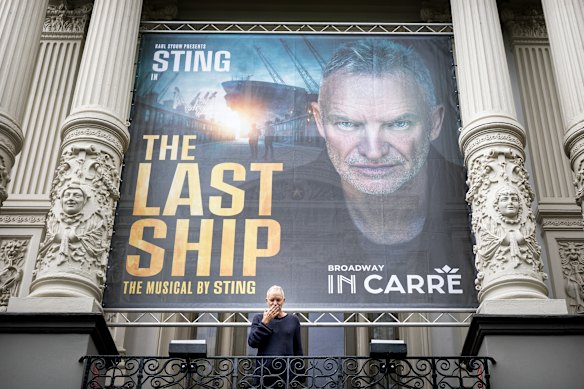
The truncated Broadway run didn’t deter him and, in fairness, most reviews praised his songs (the show received a Tony Award nomination for Best Original Score in 2015), but took issue with the way the story was told. “It’s so expensive to stage a play on Broadway that the line between success and failure is a couple of rows at the back of the theatre,” he reasons.
He relaunched the show in 2018 with a new book that ditched some of the original characters, notably a Catholic priest who encouraged the community to build one final vessel. This production – let’s call it The Last Ship 2.0 – toured the UK to overwhelmingly positive reviews. Now, he’s back for a third bite at the cherry. There’s another new book and a new cast that includes … himself. Having enjoyed his three-week stint playing shipyard foreman Jackie White on Broadway (a role he only accepted after producers begged him to step in to boost flagging ticket sales) and reprising the role for a North American tour in 2019, Sting has signed on again as a full-time member of the cast.
The latest incarnation of The Last Ship will travel to Amsterdam and Paris before dropping anchor in the new Glasshouse Theatre at Brisbane’s QPAC. In June, it sails to New York’s Metropolitan Opera House.
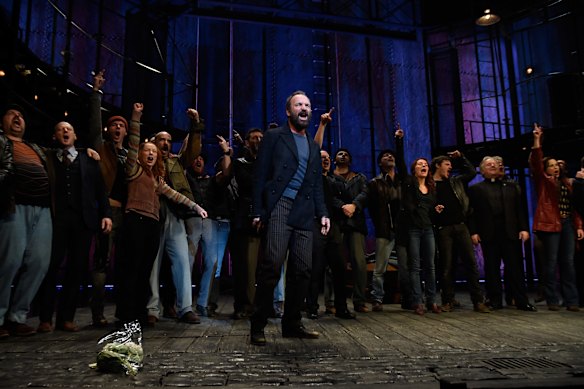
I ask him how he prevents his fame from capsizing the ship. When he appeared on stage in New York, for example, he had to ignore screams of excitement from the audience each time he made an entrance. “I think I managed to suppress Sting,” he says with a shrug.
It probably helps that Jackie White is not the true focus of the story. The real protagonist is Gideon Fletcher, a character loosely based on Sting, who returns to his hometown after 17 years at sea to pursue the girl he left behind. “There is some history that is parallel to mine,” he concedes. “I didn’t go back for the girl, but I could have done. And I didn’t go to sea; I got in a van and went on tour. I’m not sure which is more romantic.”
Integrating himself into The Last Ship company is another challenge. After all, he wrote the songs everyone else is singing and it’s safe to assume he’s the only member of the cast with 17 Grammy Awards and homes in New York, Los Angeles, Tuscany and England. He’s fully aware of the “frisson” his fame can cause, but takes steps to negate it. The day we met at a rehearsal studio in West London he’d come straight from a “Dignity in the Workplace” seminar with the show’s cast and crew. Some of his colleagues were surprised to see him, but he made a conscious choice to sit in the front row. “I arrive at 10am every day and do the physical and vocal workouts with the cast,” he says. “My role as Jackie is as a kind of ‘father of the community’ and I feel I can do something similar [off stage]. I hope I’m doing a good job. I have my own dressing room which is nice, but apart from that I’m a company member.”
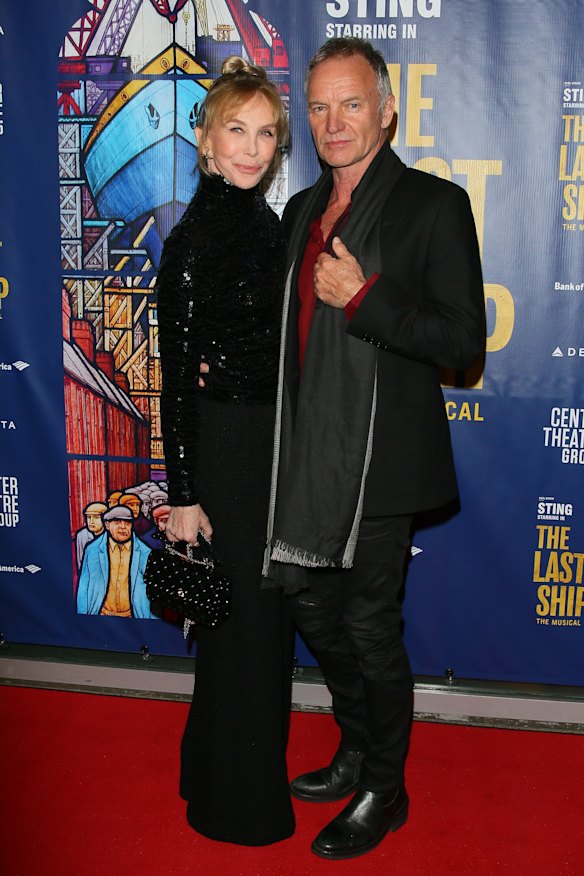
Today, he’s wearing an oat-coloured rollneck and black jeans. A woollen flat cap that’s part of his stage costume is perched on his lap and his head is clean shaven, emphasising the aquiline nose and piercing eyes. His Geordie accent is more pronounced than I anticipated and his charisma, a blend of unshakeable self-confidence and latent mischief, remains potent. He still does yoga, swims every day and eats well. “I’m pretty vain, so I keep myself together,” he says with a shrug. “I don’t feel 74.”
His work ethic certainly belies his age. When he isn’t performing in The Last Ship, he’ll rejoin his band to play a string of dates on the Sting 3.0 World Tour. “All of my contemporaries have retired. I’m the only f---er still working,” he laughs. “Of course I enjoy it, but it’s exhausting because I’m working with the musicians in one room and the actors in another. There’s a lot to do, but it’s fascinating.”
One of the reasons he has persisted with the musical is that it is an intensely personal project. The artist formerly known as Gordon Sumner grew up in Wallsend on the banks of the River Tyne. His house was above a dairy (his father, Ernest, was a milkman) and next to the Swan Hunter shipyard. When receivers arrived in 1993 and began laying off hundreds of highly skilled workers, it was the beginning of the end for a tradition, a way of life, that once sustained more than 14,000 workers.
“My dad and I would deliver milk to the shipyard,” he recalls. “It was a very powerful symbolic presence in my life. I’d see thousands of men walking down there every day. It was a f-–-ing hideous place: noisy, scary and dangerous. But we were immensely proud of the work that was done there.”
He was eight or nine when Queen Elizabeth the Queen Mother was driven down his street in a limousine on her way to launch a ship. “We were all waving our little Union Jacks,” he says. “I caught her eye and she waved to me. I thought ‘I’ve been seen by an alien creature from another planet’.” Instantly, he realised there was a bigger world beyond Wallsend and resolved to live in it.
Phase one of his escape plan was passing the exam that got him a place at grammar school. His father, a former army engineer, was strongly opposed to the idea of a selective school. He wanted his son to go to a technical school. “There was a big row in our house,” says Sting. “Dad said ‘what do you want to learn Latin for? Are you going to become a priest?’ I couldn’t articulate why grammar school was important to me, but it was. Luckily, my mum, Audrey, sided with me.”

He did learn Latin and loved it, apparently. But grammar school came at a cost. “Only four boys in my class passed the11-plus [entrance exam]. I had to wear a uniform and get the train to Newcastle every day. I was quickly ostracised by my friends who were left behind. I’d see them outside the shipyard and they’d ignore me. It was traumatic, a wound.”
I like difficult things; I like puzzles. And this is the most difficult thing you can do: turning an original story into a musical.
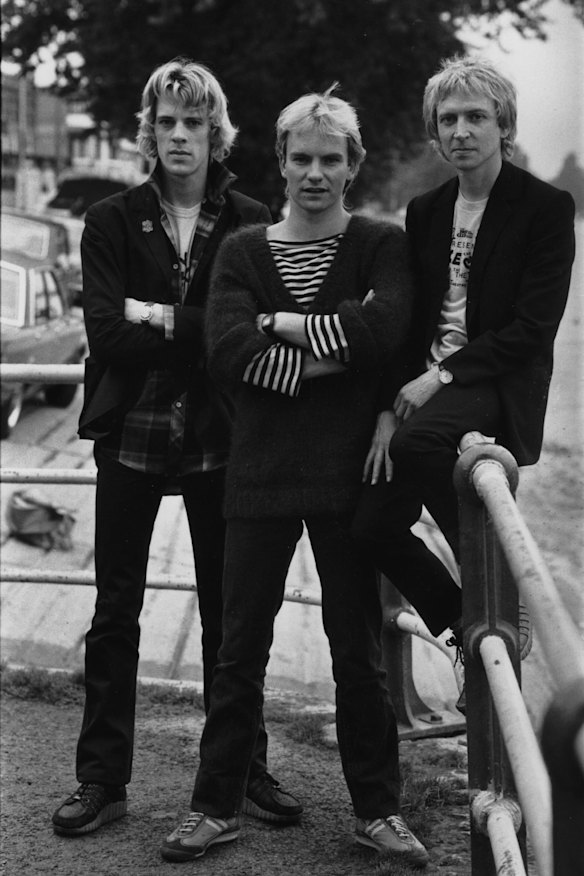
He found solace in music. Sting was bequeathed an old Spanish guitar by a relative and spent hours mastering it. Later, he switched to bass and paid his dues in local jazz bands. It all came together in 1977 when he moved to London, joined a fledgling pop trio called The Police and … well, you know the rest.
Like many people who flee their hometown, he has had a sometimes complicated relationship with Wallsend. His brother and sister still live there as do a handful of mates from school. He goes back from time to time, but finds it “a bit of a ghost town”. “Because I’d escaped I had survivor’s guilt,” he says. “At some point I realised there’s a debt to pay.”
His parents died within months of each other in 1989. Indeed, it was the loss of his father, a man with whom he’d had a difficult relationship, that engendered The Soul Cages, a deeply personal work that draws heavily on his childhood and memories of Ernest. “It’s a very potent record for me,” he says. “It’s my least understood record, my least successful record. But people write to me and say, ‘Soul Cages really helped me after my dad died’. I like the idea that songs have a function in society, that they provide emotional touchstones for people’s lives.”
The Soul Cages can also be seen as ground zero for his work on The Last Ship. “I was going through a kind of self-therapy at the time,” he explains. “I’d had a lot of success and I was thinking ‘who am I … what do I do next? I wasn’t sure what to write about so I thought ‘let’s go home’.”
He runs his fingers along the brim of the cap he’s holding. “My dad didn’t really understand what I was doing with my life. But I did have a wonderful moment with him when he was dying. I held his hand and said ‘Dad, we have the same hands’. And he said, ‘Aye son, but you used your hands better than me.’ His eyes begin to glisten as he remembers the moment. “I’d never had a compliment from him prior to that,” he says. “It was devastating, but we were reconciled.”
Sting performs in The Last Ship at the Queensland Performing Arts Centre, Brisbane, from April 9 to May 3.