3 months ago
5
3 months ago
5
Opinion
November 21, 2025 — 5.00am
November 21, 2025 — 5.00am
Few things infuriate Anthony Albanese more than suggesting he and his government lack political ambition.
Raise the topic and the prime minister will instantly reel off a long list of legislation and other policies implemented by his government in the past 4½ years: changes to the stage 3 tax cuts, more money for Medicare, more ambitious climate targets than the previous government, urgent care clinics, major housing programs, an expansion of paid parental leave, the right to disconnect and so on.
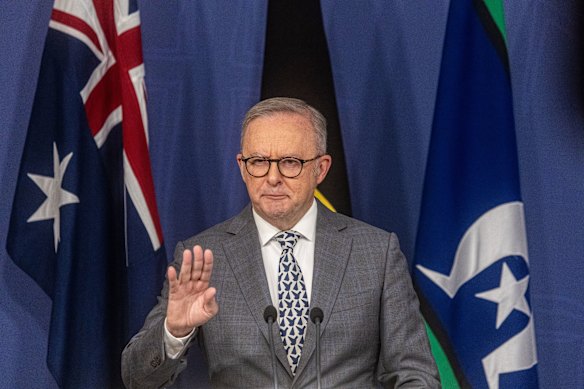
Not so fast … Prime Minister Anthony Albanese faces critics close to his own camp.Credit: Sam Mooy
But that doesn’t mean the criticism is not correct, despite what Albanese claims.
Labor governments are elected to do things – more so than conservative governments. And this week, while Sussan Ley attempted to resurrect her leadership, five separate critiques again questioned Albanese’s ambition.
The first was the release of Sean Kelly’s Quarterly Essay, The Good Fight: What Does Labor Stand For? As a former staffer to prime ministers Kevin Rudd and Julia Gillard turned author and columnist for this masthead, Kelly writes perceptively about the purpose of Labor in government and whether the party is overcompensating for the disorderliness of the Rudd-Gillard years, and in so doing, failing the people who need the party most.
Loading
His conclusion, more in sorrow than in anger, will dismay progressive types: by seeking to be the “natural party of government”, Albanese and his team have become “essentially conservative” by seeking to represent the “vast majority of interests”, many of which do not wish for the status quo to change.
The second critique was Shane Wright and Millie Muroi’s essays in this masthead on Australia’s dysfunctional federation. The pair take a different starting point, interviewing state premiers and economic boffins, examining what this country’s citizens get for the $1 trillion in taxes charged across the federation. They rip into some of the more absurd rules and regulations that gum up the wheels of the federation.
And they arrive at essentially the same conclusion as Kelly: while the Albanese government has made changes to remove duplication and waste, a heck of a lot more needs doing to deliver value for money.
The third critique was from a powerful left-wing union, the CPSU, claiming the scale of job losses at the CSIRO – 800 so far, and as many as 350 more announced this week – meant more jobs had been lost at the agency under Albanese’s government than under conservative bogeyman prime minister Tony Abbott. Let that sink in for a moment.
Loading
Fourth, the International Monetary Fund called for major tax changes in Australia – hardly the first time – including raising the rate of the GST and re-introducing a resource revenue tax. The chances of that happening under this government are vanishingly small.
Fifth and finally, from former attorney-general Mark Dreyfus, came a call for Labor to hold a referendum on fixed four-year terms for the federal parliament and to restart a campaign for Australia to become a republic.
(Australia’s decision on Thursday to back out of the race to host the COP31 climate summit next year could also be added to the list, but given COP’s reputation as a massively expensive, overly long talkfest and Albanese’s waning enthusiasm for the event, it’s unlikely he will regret the event not coming to Australia.)
The common question that unites all five of these critiques is the same: Is the Albanese government ambitious enough?
Loading
The prime minister secured a stunning victory in this year’s election and Albanese’s reputation as a political strategist and leader has been elevated to rare heights. As 2025 ends, it’s fair to say – for now – he has mastered his domestic political opponents, nailed his brief on the world stage and that he is the unquestioned leader of the Australian Labor Party.
And again, to give the government its due, when you look at its achievements in just the past couple of months, they’re not inconsiderable. Aged care funding reforms and a tripling of the bulk-billing incentive for GPs began on November 1; Australia and Indonesia negotiated a landmark agreement on defence; Australia recognised Palestine; in a pact with Papua New Guinea, it signed the nation’s first formal alliance since ANZUS in 1951; major changes to Indigenous employment programs have commenced; and real wages increased for an eighth consecutive quarter.
Seven months on from Albanese’s victory, this second term has had the same feel-good start as that of his first term, but for all the achievements, the whole seems less than the sum of its parts.
In his essay, Kelly quotes Labor legend Paul Keating, years ago, describing his view of politics: “I’m not in the consensus business ... f--- consensus. I’m in the conflict business.” And later: “Why would we take second-quality decisions? Why wouldn’t we do better?”
Those Keating quotes best explain why this government falls short of the sum. After 4½ years in power, it’s still unclear sometimes what it will fight for and how much it is willing to risk of its political capital to be a reforming Labor government.
Albanese, for example, supports fixed four-year terms and he supports an Australian republic. But both require a referendum, and after the failure of the Voice, and his experience working for federal minister Tom Uren in 1988, when Bob Hawke proposed fixed four-year terms and bipartisanship collapsed, Albanese has no intention of proceeding with either.
It’s a fair bet that most of the Labor caucus would support winding back negative gearing tax breaks, too, but after an untimely leak, that idea was killed off and is unlikely to be examined again under Albanese.
His determination to reset politics after a revolving door of prime ministers is understandable. He has successfully portrayed himself as a reliable, trustworthy leader in the minds of voters. After all, 94 seats do not lie.
Loading
But his incrementalist approach to change leaves him open to the charge of being too cautious or not ambitious enough, as we see with these critiques from people and organisations as diverse as the IMF, the CPSU and his own former attorney-general. None of these are sworn ideological enemies.
If he wants to secure a legacy as a great reforming prime minister, and not just a two-time election winner, Albanese will need to take more risks and spend more of his capital than he has to date.
James Massola is chief political commentator for The Sydney Morning Herald and The Age.
Most Viewed in Politics
Loading