3 months ago
39
3 months ago
39
″Ethan tells this story now,” says director Richard Linklater, who started talking to his old friend Ethan Hawke about 12 years ago about playing songwriter Lorenz Hart in his latest film, Blue Moon. The story goes that Linklater told Hawke: “You’re not ready to make this. You have to wait to be old and unattractive.”
Ten years later, he called Hawke. “I said: ‘Well, I’ve got good news and bad news. Let’s make the movie. No one wants to hit on you now. You’re ready to play Hart’.” He lets slip a little smile. “I exaggerated a bit.”
Hawke would be the first to say it paid to wait. Blue Moon is a small film, shot on a single set in Dublin in just 16 days, but it packs a punch; Hawke, 55, was nominated for a Golden Globe for his ragged, anguished performance.
Robert Kaplow’s script is set in 1943. Hart, at the end of a prolific career, is a washed-up drunk, while his former writing partner, Richard Rodgers, has formed a new partnership with Oscar Hammerstein.
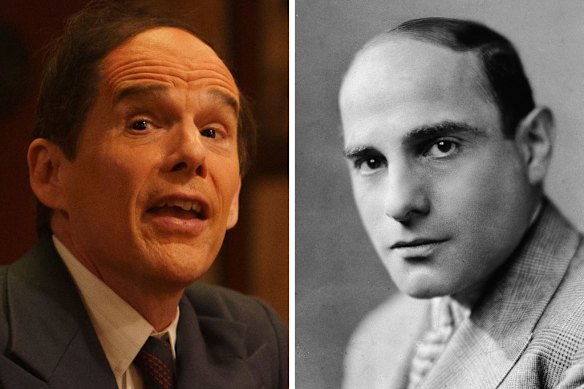
Rodgers and Hart wrote more than 500 songs including Isn’t it Romantic, My Funny Valentine and The Lady is a Tramp. Hart was very short, with an ugly comb-over; his compensation was a rapid-fire wit that could fixate a room. Hawke, a foot taller than Hart, told The Guardian that the role felt dangerous and difficult. “I felt like I was hitting the wall of my talent.”
The film takes place on the opening night of Rodgers and Hammerstein’s first musical, Oklahoma!, with an after-party due to be held at famous Broadway restaurant Sardi’s. Hart is lying in wait at the bar, sinking Scotch, bantering with the barman (Bobby Cannavale) and parading his fixation on Elizabeth Weiland (Margaret Qualley), a much younger, much taller woman with whom he has set up a flirtatious correspondence despite being – as everyone in the room knows – exclusively homosexual. The booze has put him beyond shame.
Linklater and Hawke had already made eight films together, including the enchanting Before trilogy and Boyhood, which they shot over 12 years. Why cast him as Hart, given the poor physical match?
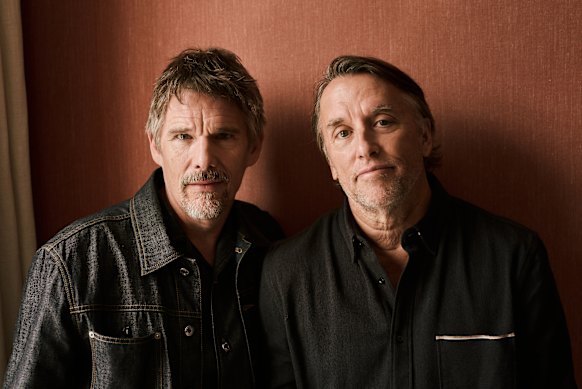
“Because of his own obsession with it,” says Linklater. “I think I let him read it, not thinking he could do it. And he was like ‘yeah, I get it’.” They experimented with camera angles and different floor levels – the kinds of tricks that were available in 1943 – to make Hawke seem short; it was important, says Linklater, because anyone who knew anything about Lorenz Hart knew it was a burden to him.
“I wanted to show we made the effort. Every movie has some little element that’s being a total pain in the arse and making the film more complicated than it should be. That was it on this film. You know, Larry’s been dealt quite a hand. You’re gay. You’re not quite five feet tall. You’re addicted. You’re the child of Jewish immigrants. Your sexuality is against the law. In that time and place, that sucked. On the other hand, he was a brilliant lyricist at a time when there was gainful employment doing that. The times almost conjured him.”
Both Linklater and Hawke were passionately attached to those songs. “I’m so weird that way,” says Linklater, 65. “I had the punk rock ’80s, you know, but next to my Dead Kennedys albums I had Ella Fitzgerald singing Rodgers and Hart, because I was always like a theatre, show-tune, big-band guy.” Not that he was able to see those big New York shows. “I never left Texas growing up; I couldn’t have been more provincial. But my mom had this grandiose love of musicals. The living room was full of them, mostly Rodgers and Hammerstein.”
Andrew Scott plays Rodgers, whose hit collaborations with Hammerstein included The King and I, South Pacific and The Sound of Music. Scott’s portrayal of a man torn between pity and self-preservation won him the Best Supporting Actor award at the Berlin Film Festival, where the film had its premiere.
“I feel Rodgers has enormous love for Hart,” Scott says. “But with so many people you have that experience: you are exasperated by them, but you love them. He’s trying to set up boundaries with this person who is reckless but also completely brilliant. I think that’s the stuff that makes it interesting because then people go oh, I have that in my life. And that’s what we’re here for.”
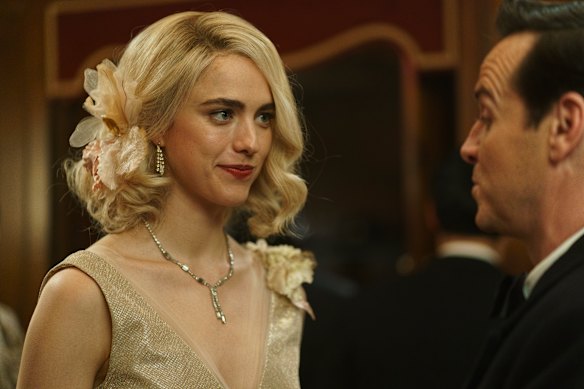
Elizabeth Weiland, the vibrant Yale student played by Margaret Qualley, is a fictionalised version of an unknown young woman whose frank, racy letters to Hart were preserved and became one of Kaplow’s inspirations. She joins him at the bar and lets him buy her drinks.
“I think she feels for him,” says Qualley. “But she’s also at a time in her life when she’s putting her own needs first. Probably the reason their relationship was thriving at that point was that he could hide himself in it, only sharing what he wanted to share with someone more naive, whereas his real friend could see the whole picture.”
Hart didn’t have a sober day after that opening night; he died a few weeks later. Linklater compares him to an open wound, but doesn’t blame Rodgers for jilting him. “I told Andrew Scott that I’m Rodgers,” he says. “I’ve had to cut loose long-time collaborators, people with alcohol problems, who just were f---ing up. You get put in the position as the leader where OK, we can ruin this production to not hurt this person’s feelings – although I don’t know if they care or not – or we can get someone else.”
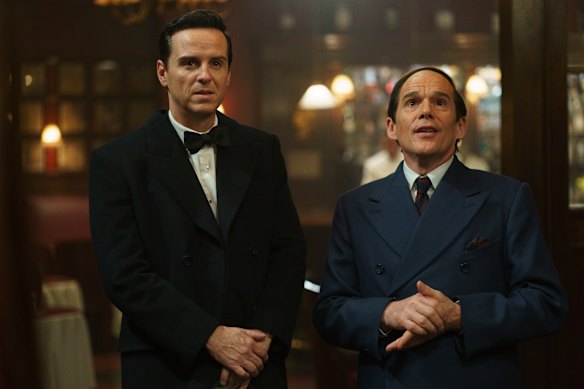
It’s always painful. He recalls watching a 1974 TV interview with Rodgers where he is asked about Hart. “Immediately, you can see the mix of feelings on his face, a little anger and a little love. It’s all still there ... 30 years later.”
Rodgers wrote a different kind of show tune – “soaring and aspirational” – with Hammerstein; Hart’s lyrics were full of longing. By 1943, Hart must have known that he was yesterday’s man; a country at war was looking for frothier, more heightened entertainment. As someone who makes human dramas for the big screen, Linklater has experienced that sinking feeling of irrelevance, even making a short film for the Pompidou Centre in which he wandered the streets, wondering whether he was just an extinction event in a Marvel Universe. “I was just at this dark moment of thinking: is it over?”
With two films out this summer, however – the other being the splendid Nouvelle Vague, about the French director Jean-Luc Godard making his first film – he has recovered his sense of optimism. “I think that’s every generation. It becomes your time to worry about such stuff,” he says. “But I’m taking a longer view, I guess.”
Last year, he found himself in various cinemas where he was surrounded by young people. “It’s like they’re discovering vinyl. ‘Hey, you can go to a movie and then go and get a drink after and talk, which is kind of cool!’” And people are still singing Blue Moon, so who knows what will endure? “I might be deluding myself, but it gives me some hope.” I’ll drink to that.
Blue Moon opens on January 29.
Must-see movies, interviews and all the latest from the world of film delivered to your inbox. Sign up for our Screening Room newsletter.