3 months ago
22
3 months ago
22
England won a game of cricket at the MCG on Saturday. Technically, it was an Ashes Test match, but by most other measures this game was quite a bit less than that.
Occupying just 142 total overs and about 12 hours, play lasted for about the same amount of time as a typical two-day club game.
The last time two or more Ashes Tests were decided inside two days in the same series was in England in 1888. The three games at Lord’s, the Oval and Old Trafford all ended in two days, as the home side won 2-1 under the captaincy of W.G. Grace.
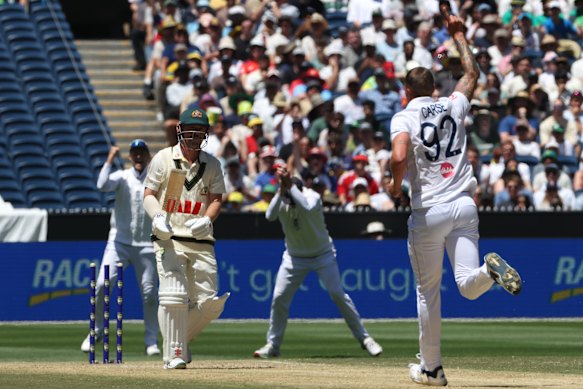
Travis Head is bowled by Brydon Carse.Credit: AP
But those games were scheduled to be played over just three days, on uncovered pitches, in an era well before radio, television and cricket’s overt commercialisation. Suffice to say the loss of those days of play cost relatively little in the way of money.
This time around, the hectic rush of wickets on an over-juiced pitch did not just cost numerous batsmen a little bit of their reputations.
Cricket Australia will be measuring the cost in millions – upwards of $10 million in revenue for two days of lost content – while circa 90,000 spectators planning to come here on day three will be dolefully making other plans. One senior CA figure had a flight scheduled to Sydney for Saturday night. They had not factored in seeing the game’s final ball.
Loading
Among those left hanging are numerous UK-based cricket followers who were due to get into Melbourne in time for days three, four and five before flying up to Sydney for the last game of the series. They will be happy about a victory, the first by England in a Test in Australia since 2010-11, but there will also be a sense of disappointment.
While Brisbane and Adelaide both had a richness to their play, lasting four and five days respectively, Perth and now Melbourne have come and gone in an unsatisfying blink. In both cases, the pitches presented challenges that were beyond the capability of many batsmen to outlast them, until something of a redress in the final innings.
Perth has always come with a bit of wildness, however. Melbourne, by contrast, is supposed to be the showpiece of the cricket year, where the nation sits down either in their usual MCG seats or on the couch in front of the TV to take in the ebb and flow.
This game was all flow and precious little ebb. It started, apparently, with curator Matt Page’s decision not to shave back the 10 millimetres of thick, thatchy grass on top of the pitch. Page was seen deep in conversation with Australia’s coach Andrew McDonald and stand-in captain Steve Smith more than once in the build-up.
How those conversations went, only they know. But there was no indication Australia were unhappy with the carpet of grass for their seam attack, only that they thought it pointless to pick a spin bowler.
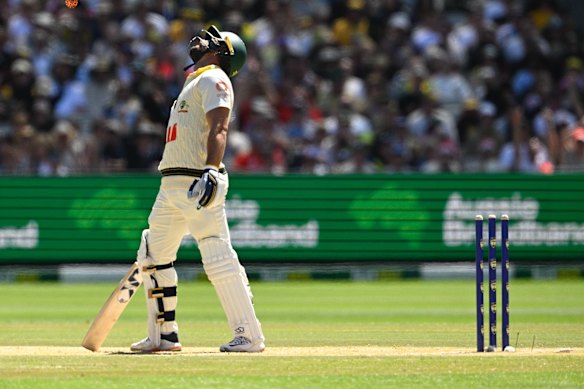
Jake Weatherald is bowled.Credit: Christopher Hopkins
Ben Stokes won the toss and chose to bowl for the first time in the series. His seamers rewarded him by rolling Australia for 152, before the hosts responded by razing England for 110. At that stage, with Scott Boland snicking a boundary from Boxing Day’s last ball, the Australians were dominant. As for the pitch, there was optimism in the home camp that it would settle down for batting. Not so.
Not a bit of it, in fact. Tracking data on day two showed a pitch that had quickened up while also offering more seam movement than on day one. The indentations created in the first innings of the game had hardened, creating the opportunity for balls to jump. After Boland and Jake Weatherald fell early, it was the sight of Stokes hitting Marnus Labuschagne twice on the gloves in successive balls that got tongues wagging in the broadcast suite.
At the other end it was England’s Tongue, Josh, who wagged for the second day in a row, defeating Labuschagne and Usman Khawaja when the latter shaped to duck a sharp bouncer then waved his bat at it too late for any control. When the top edge settled in sub-fielder Ollie Pope’s hand at fine leg, England started to look like favourites.
Brydon Carse, far too short for most of the series, belatedly threatened the top of the stumps. The away movement he found to bowl Travis Head (top scorer in the match with 46) was so expansive as to draw a rueful smile from Australia’s vice-captain.
Smith and Cameron Green threatened briefly to build a partnership, only for the young all-rounder to hang his bat out at Stokes – one dismissal that had very little to do with the pitch and all to do with the match situation.
That the Ashes are already decided can be neatly measured by the collapsibility of the Australian tail. Stokes and Carse swept up Australia’s last four wickets for 13, after England had collected the same quartet for nine on day one.
Notionally, Australia still had a big chance, with the pitch still doing plenty and the bowlers fresh. But England had, as Head did in Perth, the advantage of attacking the target in white-ball fashion, which they did well enough to prevail.
Curiously, Smith did not hand the ball to Boland until after 10 overs had elapsed and 70 runs scored. Ben Duckett (34) made his most impactful contribution of the series, Zak Crawley chipped his way to 37 and Pope’s replacement Jacob Bethell carved a sensible 40.
These were the scores of club cricket, not Tests. In a two-day affair, they were enough to win England their first Ashes match on Australian soil in 15 years. But this match and this pitch cannot be representative of Test cricket; if it is, then cricket’s grandest and oldest form will be in trouble.
News, results and expert analysis from the weekend of sport are sent every Monday. Sign up for our Sport newsletter.
Most Viewed in Sport
Loading