3 months ago
27
3 months ago
27
With a cover drive to the fence and a clenched fist of celebration in the middle of the SCG, Alex Carey brought the 2025-26 Ashes series to a close with a 4-1 margin for Australia over England.
Carey was a fitting man to administer the coup de grâce, for he deserves to share top billing alongside Mitchell Starc and Travis Head as the players of the series.
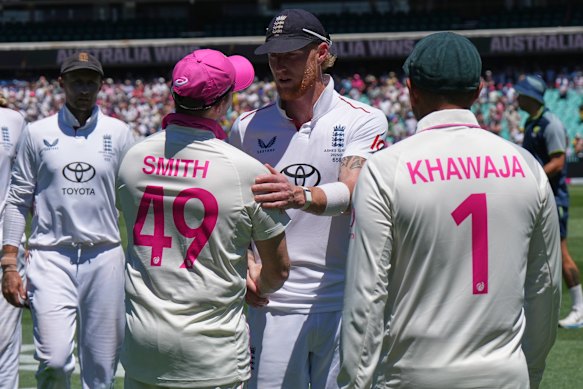
England captain Ben Stokes (centre) congratulates Steve Smith and Usman Khawaja after the final day of the 2025-26 Ashes series.Credit: AP
Starc’s Compton-Miller Medal is his second such award in successive Ashes series, but Head’s three breakneck centuries and Carey’s combination of sublime glove work and confident batting were the difference in turning 2023’s 2-2 draw into a contest decided in just 11 days this time.
It was a dizzying series in many ways, comprising some moments of champagne cricket but many more of poor stuff that spoke to England’s ramshackle preparation for the task and Australia’s numerous vulnerabilities.
Still, this was a fair margin for an Australian side that overcame considerable odds in terms of injuries and fluctuations to deliver the same outcome as 2002-03, the series where they were led at home by Steve Waugh, who presented the trophy to Steve Smith, Pat Cummins and company.
Loading
Like so many recent series in Australia, the opening round of the bout proved to be definitive. At lunch on day two in Perth, England appeared to be set fair for an opening victory that would at least give them a chance, like India last summer, of making this series a contest until its final match.
But so awful was the subsequent batting collapse, and so outrageous Travis Head’s fourth-innings chase after making the impromptu decision to open the innings, that England contrived to lose that first Test within four hours of sitting pretty. For Smith, there would have been confidence even if Perth was lost.
“Even had we lost that game, we’d take confidence out of what we did against India,” Smith said. “We lost that first Test, which we’re not accustomed to in Australia, and we came back. That was always in the back of our mind – if things didn’t go to plan, we’d continue playing our way.”
Ben Stokes, so often a bellwether of his team's fortunes and mindset, had looked genuinely winded by that result. From the vantage point of Sydney, it was fair to say that neither the touring side nor the series itself ever recovered from that first stunning collision.
“It’s been so far below the level this team can operate at,” Stokes lamented. “We’ve had periods where we’ve wrestled some momentum back, and then we’ve just let it all go again.”
That will be a source of major frustration for Stokes because Australia had looked shaky. Without Cummins for all but one Test, Nathan Lyon for two and Josh Hazlewood missing entirely, Australian depth was tested to a considerable degree.
At the same time Usman Khawaja’s final series saw a dimming of his gifts, Marnus Labuschagne flattered to deceive, and none of Jake Weatherald, Cameron Green or Josh Inglis enhanced their reputations.
Loading
Smith deserves particular credit as captain in four out of five Tests, making his share of key runs and also catching wondrously: 14 chances came his way over the five Tests, and he snaffled every last one of them.
It was left to the likes of Scott Boland, Michael Neser and Beau Webster (belatedly chosen for the final Test) to provide the firmest support for the captain and his star contributors.
Together, they offered a staunch argument for the strength of the Sheffield Shield with its six hardened teams and 10 keenly contested rounds of cricket. Should England ever wish to genuinely compete on these shores, it may well be necessary to similarly rationalise their domestic competition, find ways for more England players to play regular cricket on Australian pitches, or both.
Sydney’s pitch turned out to be arguably the best of the lot. It offered some bounce and seam for the quicks, shot-making opportunities for players willing to apply themselves, and from day three onwards provided sharp spin for the slow bowlers.
That Smith was bowled beautifully through the gate by Will Jacks in Australia’s somewhat nervy, but ultimately comfortable, chase was a poetic irony for a home side that is growing increasingly leery of picking spin bowlers.
Two-day matches in Perth and Melbourne disfigured the series to a significant extent, not least by stopping it from becoming the best-attended Ashes contest ever. This game’s final attendance of 211,032 was the best-ever at SCG, while the total series roll-up of 859,580 was still the third highest behind 1936-37 and 2017-18. An average daily crowd of 47,754 would’ve seen the million mark broken had the MCG, in particular, been less febrile.
Watched by those spectators who flooded onto the field of play, Australia’s celebrations were hearty enough but had just enough hints of weariness to suggest all will enjoy a break. Now that Khawaja has retired, there’s a strong chance that almost all of the remaining group will present themselves for selection in England in 2027, a location that, in recent years, has seen by far the better contests for the urn.
For the likes of Smith, Cummins, Starc and even Lyon, that tour now looms as a chance to finally claim the win on English soil that has been elusive since Waugh's men did the trick in 2001. For Stokes and England, that series will be an opportunity to make good on the many mistakes of this tour.
There will be some optimism amongst the tourists because they were able to unfurl the best breakthrough performance of the series, a coruscating hundred by 22-year-old Bajan Jacob Bethell that was equal parts David Gower and Brian Lara. Then again, England ended the 2023 series genuinely thinking they would have Australia’s measure next time around: how wrong that turned out to be.
News, results and expert analysis from the weekend of sport sent every Monday. Sign up for our Sport newsletter.
Most Viewed in Sport
Loading