3 months ago
25
3 months ago
25
Did you know that the mathematically correct term for the shape of an Australian rules football is “prolate spheroid”? Or that flour can kill you because, like gunpowder, it’s based on carbon so it’s potentially flammable? Or that the bread-bag clip was invented on a plane by Floyd G. Paxton, who put his penknife and an old credit card to creative use so that he could reseal his complimentary bag of peanuts?
These are just some of the nuggets of information that certified National Living Treasure Dr Karl Kruszelnicki sprinkles through the second season of his entertaining and illuminating series Dr Karl’s How Things Work.
The irrepressible and apparently indefatigable septuagenarian has been a trusted presence on Australian TV and radio for decades, particularly at the ABC, where he’s been on the airwaves since the early 1980s. But this latest series is some of his best work yet.
It’s an ideal showcase of his enduring talent for bringing understanding and appreciation of science to a mainstream audience. Which is no mean feat, and is especially useful for ABC TV, which has had a vexed relationship with that discipline in recent decades.
Essentially, as with children’s and religious programming, it’s an area that falls within the organisation’s official remit. Even if those areas typically appeal to niche audiences rather than the wider ones the broadcaster is chasing.
The ABC has recently tried all sorts of ways of making a supposedly “dry” subject more enticing. Many of these efforts have been lamentable and forgettable. Sometimes it’s the tried-and-true, but not necessarily rewarding, tactic of parachuting in a comedian to liven things up (WTFAQ, Crime Night!). Sometimes it’s confecting a competition (Australia’s Favourite Tree and the frankly wacko The Great Australian Bee Challenge). Sometimes it’s inserting a popular personality who might have no relevant expertise, but whose presence allows for a promotable angle (Myf Warhurst, Sammy J and Matt Okine in Secret Science).
At the same time these more popular shows were made, Quantum, the science show on which Dr Karl was an original presenter in 1985 – which was renamed Catalyst in 2001 – was downgraded from a weekly staple to a more sporadic proposition of sometimes-dubious quality.
A 2013 Catalyst episode on cholesterol and statin medication, in which presenter Dr Maryanne Demasi claimed that the medication was over-prescribed and that the link between cholesterol and heart disease was weak, was found by an ABC investigation to have breached editorial standards on impartiality. A 2016 report, also by Demasi, on the alleged health risks of Wi-Fi, also led to an investigation and her subsequent suspension.
ABC TV’s coverage of science over the past couple of decades has been patchy and marked by a lack of confidence, both in producers’ capacity to tackle topics in an engaging manner and their management’s underlying assumption that people won’t be interested in the subject unless it’s tricked up.
Happily, Dr Karl’s show doesn’t invite or require such gimmickry, as it presents enlightening information in a lively and accessible manner. As a bonus, it’s ideal family viewing as it examines the production of a range of everyday items, such as bread, chocolate, boots and books.
Donning a white lab coat or overalls and sometimes a mask and hairnet, the good doctor hits the factory floors, often arriving with a delighted “Oh my heavens!” as he surveys spaces humming with activity, from loaded conveyor belts to robotic machinery and skilled workers intently going about their business. Frequently marvelling at the union of science, technology and creativity, he’s excited by a vacuum sucking device that lifts bags of skim milk used to make ice-cream. Then there’s that vibratory conveyor pushing chips uphill to flavouring stations and preventing them from stacking on top of each other. Everywhere he goes, he fills us in on the smells, sounds and tastes he encounters, and asks lots of questions.
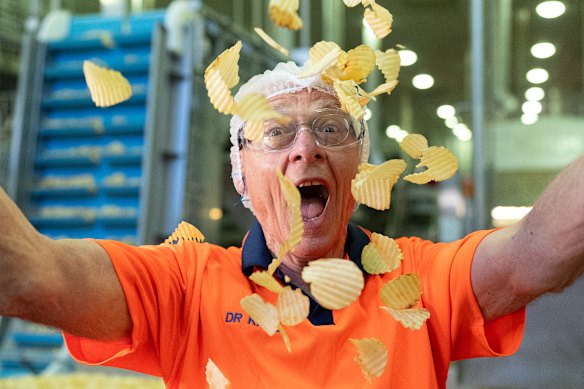
Each episode provides a capsule history of the item being discussed and often detours to the farms or factories that supply the ingredients: potatoes for chips, vanilla for ice-cream, leather for the boots, salt for chips. Along the way, you can also find out about fat bloom and the danger of it in making chocolate, how and why potatoes are subject to a witch-trial test in assessing their suitability for chips, and why there’s a polyester-cotton lining inside footballs. The series is a veritable showcase for Aussie icons: Sherrin’s prolate spheroid footballs, R.M. Williams boots, Golden Gaytime ice-creams, Smith’s chips, Mrs Mac’s pies.
Dr Karl’s descriptions are eloquent, evocative and brimming with his infectious enthusiasm. Ice-cream, he marvels, is “solid, liquid and gas, all at the same time!” Those footballs are not only objects “shaped by love and tradition”, but also the result of “complex material science, balances of pressures and stitched geometries that would make a mathematician sweat”. In each slice of bread, he explains, “You have a mixture of agriculture, biology and community. It’s a simple snapshot of our entire civilisation.”
Throughout, the tone is upbeat and admiring, and the series is like a warm light shining on people who take pride in what they’re producing.
Dr Karl’s qualifications for this gig, as well as his inimitable style, are probably unique and impossible to emulate. A Master of Biomedical Engineering with a degree in medicine, he’s also a radio host, podcaster, blogger and author of dozens of books, including the 2025 memoir A Periodic Tale.
He co-presented the TV science show Sleek Geeks (2008-10) with Adam Spencer. He was awarded Sceptic of the Year in 2006 and TikTok High Quality Content Creator in 2024. And he’s done a research project on belly button fluff.
Every endeavour positively sings with his desire to communicate and educate. He’s a once-in-a-generation talent, or perhaps even rarer than that, and he’s going to be a hard act to follow. While he retains a childlike wonder about the world, he is 77.
So here’s hoping some bright spark will emerge, pick up a white coat or a wildly colourful shirt, and perform the invaluable role Dr Karl has for future generations. Or do something entirely different to the same end. In the meantime, though, we can enjoy seeing the world through his eyes.
Dr Karl’s How Things Made is now streaming on ABC iview.
Find out the next TV, streaming series and movies to add to your must-sees. Get The Watchlist delivered every Thursday.