2 months ago
14
2 months ago
14
Opinion
December 20, 2025 — 5.00am
December 20, 2025 — 5.00am
On the morning after, the walk down to Bondi became a solemn procession. Locals who usually head to the beach with towels slung casually over their shoulders cradled flowers in their arms. The flags at Icebergs already were at half-mast.
After the gunshots, screams and sirens of Sunday’s murderous mayhem, a quietude descended. A soulful silence. Knowing glances replaced words. Bereaved families were locked in tearful group hugs. An expanding carpet of floral tributes outside the shut gates of Bondi Pavilion became a measure of community and national sorrow. On the shoreline of Australia’s most charismatic crescent of surf and sand came wave after wave of grief.
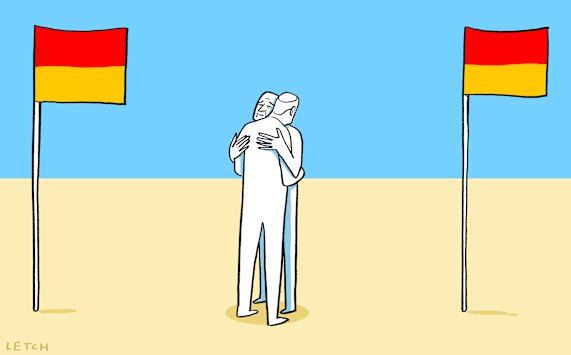
Illustration by Simon Letch Credit:
Too many times on too many continents have I covered the aftermath of mass shootings and terrorist massacres, but never before in a setting cherished by so many as a happy place. A sanctuary from the pressures of everyday life. A safe haven from the troubles of the world. No wonder we are all so shell-shocked. No wonder emotions are so raw.
This, at the risk of sounding platitudinous, was an attack on a cherished idea in Australia: that the centuries-old conflicts of distant lands should not be fought on this soil. This was also an attack on the Australian way of life. Just as the Twin Towers were totems of American might, so Bondi has always been an emblem of the Australian mindset. Laid-back. Egalitarian. Fun. Grateful. That fabled democracy of the beach.
Today I write not so much as a columnist but as a community member. Bondi is our home. We live alongside Jewish neighbours whose houses at this time of year are adorned with Hanukkah decorations. Were we listening attentively enough to their fears? Did we as a nation do enough to safeguard Australian Jews? The answer, clearly and collectively, is no.
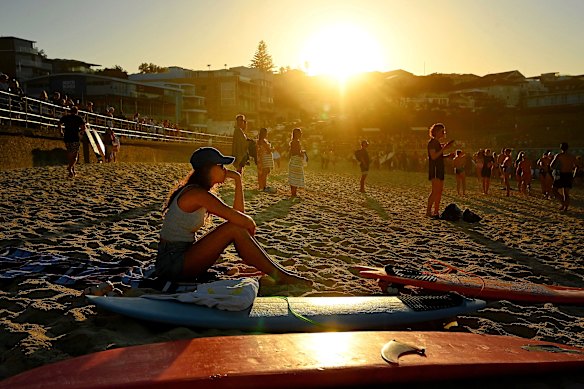
A woman sits on Bondi Beach before a “paddle out” to pay tribute to the victims. Credit: Kate Geraghty
As we reflect on the enormity of Sunday’s atrocity, and vest it with broader meaning, never should we lose sight of the prime targets: above all, this was an attack on Australian Jews. Bondi, a suburb that in postwar years provided a haven for so many Holocaust survivors seeking to put as much geographic distance as possible between themselves and the horrors of the gas chambers, became a killing field. A Holocaust survivor, 87-year-old Alexander Kleytman, was among the first named victims.
Understandably, words of incomprehension have come to all our lips. Unthinkable. Unimaginable. Unbelievable. Unfathomable. But the reaction in the Jewish community has been quite different. “I have to say that I’ve been holding my breath, fearing that something like this would happen because it hasn’t come without warning,” said Jillian Segal, the antisemitism envoy appointed by Anthony Albanese. “The writing was on the wall,” said Alex Ryvchin, from the Executive Council of Australian Jewry.
That writing came, daubed large, in antisemitic graffiti scrawled on walls and cars in the eastern suburbs. The suspected arson attack on the Adass Israel synagogue in the Melbourne suburb of Ripponlea. The attack on the office in Melbourne of the Jewish Labor MP Josh Burns. The anti-Jewish chants at that pro-Palestinian protest on October 9, 2023 on the forecourt of the Sydney Opera House. The brandishing of a portrait of Iran’s Supreme leader Ayatollah Khamenei, a spewer of antisemitism, near the front of the March for Humanity on Sydney Harbour Bridge in August this year – a gathering, it should also be noted, of overwhelmingly well-intentioned people.
The announcement from the government in late August that the Iranian regime was behind arson attacks at a synagogue in Melbourne and a kosher deli in Sydney contributed to the downplaying of the home-grown threat. The allegation of foreign interference was both alarming and allaying. It shifted the blame. Perhaps we took succour from thinking the poison of antisemitism had been imported, and was a non-native venom.
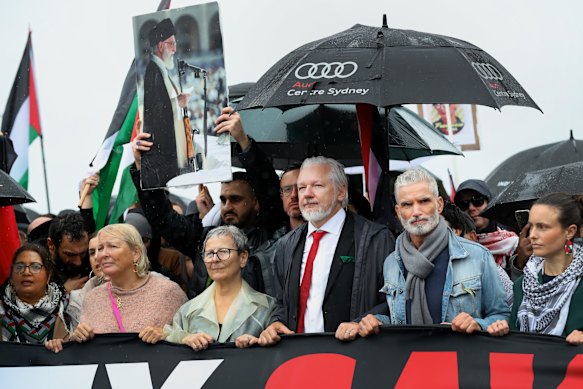
Julian Assange and Craig Foster (front) in the pro-Palestinian rally across the Sydney Harbour Bridge on August 3. In the background, a protester carries a picture of Iran’s supreme leader, Ayatollah Ali Khamenei.Credit: Getty Images
Certainly, the self-congratulatory story we have told ourselves since the gun laws enacted after Port Arthur also lulled us into an unjustified sense of security. After the Westfield Bondi Junction attack – which many initially thought bore hallmarks of an antisemitic attack – how many of us expressed a measure of almost smug relief that the murderer was carrying a knife and not a semi-automatic rifle. I know I did.
Maybe we have become complacently isolationist, thinking that our geographic detachment offers us inalienable protections – a trait magnified by benefiting for the past 30 years from a near recession-proof economy and by shuttering the portcullis of Fortress Australia during COVID.
We relocated as a family to Bondi … partly to escape the scourge of American gun violence.
The two years between the October 7 atrocities committed by Hamas and the Bondi massacre of December 14 have also demonstrated how binary is our thinking, and how angrily tribal has become our political, media and online culture. Have those who not unreasonably condemned the excesses of the Netanyahu government’s brutal war in Gaza done enough to condemn antisemitism here at home? Have those naturally horrified by Hamas’ terrorism on October 7 shown sufficient empathy for the tens of thousands of innocent Palestinians killed in the Israeli government’s response?
Have we become so captive to the algorithms of animosity that we have lost the capacity for nuance, balanced thinking and empathy? I fear we have. Dopamine-driven division runs the risk of turning us into a continent-sized Tower of Babel.
Loading
We relocated as a family to Bondi four years ago partly to escape the scourge of American gun violence. Our kids had reached the age when they realised school lockdown drills were not in preparation for hurricanes but rather a hail of bullets. Yet another reason we left was to get away from the polarisation of the misnamed United States: a country now defined by mutual loathing.
American disunion has deep historical roots, but it was accelerated and aggravated at the start of the 21st century because the country squandered the chance of national unity offered by its own darkest day, September 11. After a fleeting coming together, the “war on terror” became politicised and polarised. Judging by the heated rhetoric of the past few days, Australia is racing through those gears quicker than America did after 9/11.
The partisan point-scoring and personalised finger-pointing, in a polity that has become so relentlessly oppositional and nasty, comes as little surprise. It shows how much the political culture has changed for the worse since Port Arthur, when John Howard, who was so fiercely critical of the present-day prime minister this week, benefited from patriotic bipartisanship. In such an emotionally charged moment, politicians – such as Pauline Hanson, who was applauded when she visited the floral memorial at Bondi this week – might eye vote-winning opportunities. The tabloids, staying true to their business model, will stoke division. “It’s time to stop all this bullshit about harmony” was the headline in the Melbourne Herald Sun the morning after.
But do we really want to fall into the trap of further ripping the social fabric, especially when the widespread revulsion at what happened at Bondi presents an opportunity to repair it? I covered America in the aftermath of 9/11. I watched the US tear itself apart. Bipartisanship broke down. Voices of moderation were drowned and driven out. Politics not only became oppositional but nihilistically destructive. Again, I write as a permanent resident in the process of becoming an Australian citizen: don’t let that happen here.
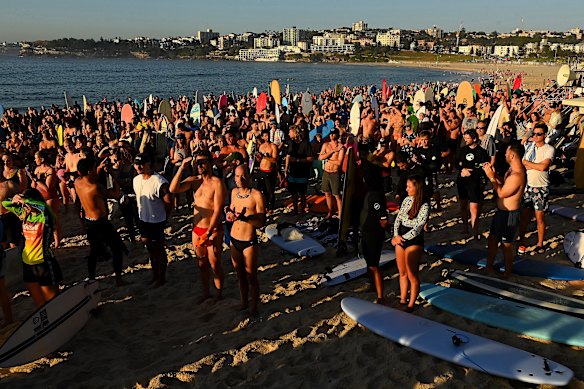
Surfers gathering to paddle out at Bondi Beach to pay tribute to the victims. Credit: Kate Geraghty
Since the first time I came to live here almost 20 years ago, I have seen enough of this country to know the decent-minded and community-spirited make up the overwhelming majority: Australia’s reasonable people. We saw that this week. In the tens of thousands who donated blood. In the admiring response to the heroism of Ahmed al Ahmed, who was only granted Australian citizenship in 2022. In the measured words of the antisemitism envoy Jillian Segal, and other Jewish figures. In the impressive leadership of local politicians such as state member and opposition leader Kellie Sloane, NSW Premier Chris Minns and federal MP Allegra Spender. I have not used their political affiliations for a reason. They did not matter. State and local politicians, in collaboration with faith and community groups, will probably be more constructive over the coming months than federal politicians. Practical rather than performative, they conduct politics at a lower temperature.
Ultimately, it is for us to decide. We all have agency. Do we want this atrocity to become a bloody milestone along the path of further polarisation, or the moment where we chose comity over mutual hate?
Bondi has always had convening power. Multi-ethnic, multi-faith, multi-generational, multilingual, it is a place where modern Australia gathers en masse. It is still a place that can draw us together. I saw that for myself on that hushed morning after, when I took the short walk to the beach.
Nick Bryant, a regular columnist, is a former BBC correspondent and author of The Rise and Fall of Australia: How a Great Nation Lost its Way.
Get a weekly wrap of views that will challenge, champion and inform your own. Sign up for our Opinion newsletter.
Most Viewed in National
Loading