3 months ago
23
3 months ago
23
Nasty people doing jobs you don’t understand: that’s the core business of Industry, the slow-growth, utterly compelling hit series about cutthroat young people competing for success in the world of fintech. Industry is back for a fourth season and, this time, it’s political. Pierpoint, the Goldman-adjacent shark tank where we first met Harper (Myha’la), Yasmin (Marisa Abela) and their competitors, is no more. It’s reset and reload.
Yasmin is now up to her swan-like neck in Britain’s right-wing political fringe; Harper is running a fund elsewhere and tangling with a new, nascent bank called Tender, headed up by the spectacularly Machiavellian Whitney Halberstram (Max Minghella). In Cardiff, where the show is shot at the evocatively named Bad Wolf studios, this has meant new sets and a search for new locations in nearby stately homes. There is also a storyline set in Ghana and shot in South Africa: an expensive offshore venture reflecting the series’ ascendancy.
Loading
When Industry started in 2020, co-creator Konrad Kay recently told GQ, it was the second-least watched HBO show of all time. It was renewed for its second season solely because, as a co-production with the BBC, it was shot in Wales and was much cheaper than its rivals. Then its hyperactive brew of sex, drugs, money and cruelty caught on. Kay and his co-writer Mickey Down, now firmly in control of their IP, have signed a multimillion-dollar deal to keep Industry barrelling along until 2027.
A few journalists have been invited on to one of the new sets to see one of Yasmin’s political dinner parties take place in a meticulously reproduced French salon. She has married the drug-raddled Lord Henry Muck (Kit Harington) and, backed by her family’s tabloid newspapers, is busy leveraging his career. The scene is full of daringly long, desperately tense pauses. “Family! Tradition! Proud nations!” says neo-Fascist Sebastian Stefanowicz (Edward Holcroft), the man they’re assembled to see, as he raises his glass. Harper sits quietly, cool but out of place.
Two bouncy men in black T-shirts I had assumed were very enthusiastic runners turn out to be Down and Kay; they are directing four episodes themselves this season. They bound over to say hello in between lighting adjustments. Like the cast, we are perched on spindly Louis XIV chairs among gilt and marble tables cluttered with bottles of fine wine, but we are in an anteroom behind the camera; our clearest view is through the fake window, looking at some elaborately espalier-ed trees threaded through iron railings.
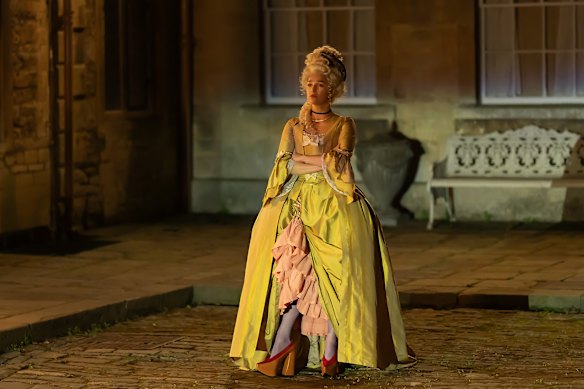
Marisa Abela in Industry season four.Credit: HBO Max
“Everyone walks in and says it’s very French; I’m very happy with it,” says production designer Simon Rogers over a morning coffee. There are three standing sets – the opulent Tender office, based on a real financial institution in London’s Canary Wharf; an airy hotel room where discredited Pierpoint alum Eric sets up a new business with Harper; and another office that is a redressed version of the hotel room.
Otherwise, they are on location, which has its challenges. One: they are running out of plush restaurants for the characters to frequent in working-class Cardiff. Two: all locations, plush or not, require negotiation. “Parking,” says location manager Tim Faulkner, “is the number one thing that upsets people anywhere in the world. And there are some especially tricky places, like multiple occupancy buildings, where there are 30 flats, and you have to get all of them on side.”
All those offices mean there are a lot of desks, beige walls and computer screens. Not picturesque, but Rogers says that was one of the things he enjoyed about it. “There is great pleasure in designing the simplest space; every single environment requires a different approach,” he says. “How you’ll get the lighting to work, what the wall colour is, how the set reflect the characters.” The storyline has taken a turn towards conspiracy drama – accordingly, Alan Pakula’s All the President’s Men was a key design reference.
Loading
For the characters, now in their 30s, their rakish progress means another level of wardrobe. “Every season has some element of branding,” says Laura Smith, the costume designer. “There’s so much hierarchy in the show and people are placed by the brands they are aligned to, so that’s an important thing for each character.” Bags were a topic last season; this time around, it’s shoes.
Harper, a failed student from America who lied her way into Pierpoint, started out by piecing together high-street bargains. When we first see her in season four, she is swathed in a Napoleonic overcoat of dove-grey cashmere over perfectly matched silvery silk, head held at a perpetual boss-lady tilt. “We looked at a lot of silhouettes that work for her, how she physically takes up space and what sort of shadow she casts,” says Smith. “Harper has more money than ever before, attained the things she’s desired, so we’re looking a little bit at what that means.” One spoiler: it doesn’t mean happiness.
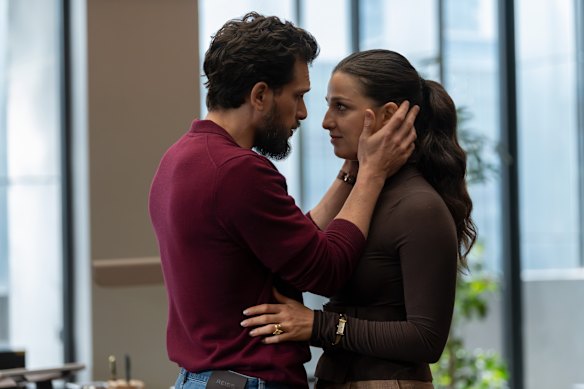
Kit Harington and Marisa Abela in Industry.
The scene we are watching, which will appear in the season’s seventh episode, is a callback to Lord Muck’s 40th birthday party in episode two, which Yasmin conceived as a Versailles knees-up where she starred as Marie Antoinette. “It was supposed to be a fabulous fun thing,” says Smith. “But we’re taking elements of that through to this scene in Paris – images of kings and queens, heredity, the responsibility of money and the way generational wealth carries through. That’s something Mickey and Konrad talk about a lot.”
Mickey Down and Konrad Kay met at Oxford University. Down enrolled in theology, which was easier to get into than his real love, history; Kay read English in a desultory way. Mostly, they went out. This is, apparently, a usual launching pad for a career in flashy finance; despite having no economic smarts, both were offered jobs in places they would eventually fictionalise as Pierpoint.
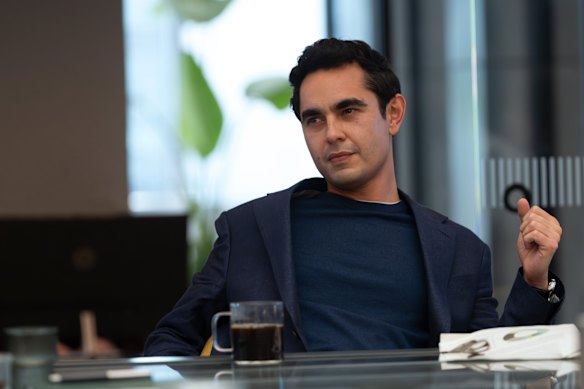
Max Minghella in Industry.
They didn’t last long in their respective banks. A lot of the time they just emailed each other, writing playful accounts of their days in the style of Bret Easton Ellis’s American Psycho – the “guidebook for finance bros”, according to Down. It was awful, but it was fascinating, too; Industry is compelling partly because it is still in thrall to the brutal excitement of this world and the energy of its black-hearted players. Since the show hit serious paydirt, Down and Kay have rejoiced in winning the sorts of rewards their characters crave, posting from yachts and top-end ski fields. “Any product of capitalism has to be, on some level, a celebration of it,” Kay told GQ.
Loading
Early on, Kay compared Industry to a prison drama. “I think we set the bank up to be this place where they go and practise some sort of perverse religion of their own ambition and their pursuit of money,” he told Deadline. Everything, especially their frequent, joyless sexual escapades, is transactional. “It’s interesting to us why someone would be like that,” Down added, finishing Kay’s thought. “Everything they do is despicable, but sometimes it’s explainable.”
In the end, however, perhaps the allure of huge wealth doesn’t bear explanation. When the wigs and corsets come off after Yasmin’s costume party, she and Harper have had one of their acidic spats. Why did she come at all? “You invited me,” Harper replies. “I have business interests here. And you’re lonely.” Yasmin rounds on her. “YOU’RE f---ing lonely!” “Yes!” Harper snaps as she leaves the room. “And so what if I am?” When there are millions to be made, being happy counts for nothing.