3 months ago
28
3 months ago
28
‘Devalues the future of cricket rights’: How two-day Tests may dent next broadcast deal
Two-day Ashes Tests in Melbourne and Perth are seismic events that may put a significant dent in Cricket Australia’s next media rights deals if broadcasters decide they can’t rely on matches running their full length.
That’s the view of media rights expert Colin Smith, as CA, the Melbourne Cricket Club and broadcasters continue to pick up the pieces from a Boxing Day Test that was enormously popular but ended well before the scheduled halfway mark.
“This Ashes is the biggest event of every four years, so losing days from that as a premier property also devalues the future of cricket rights,” Smith told this masthead. “You will project a different view, based on what we’ve seen, for how long a Test match is.
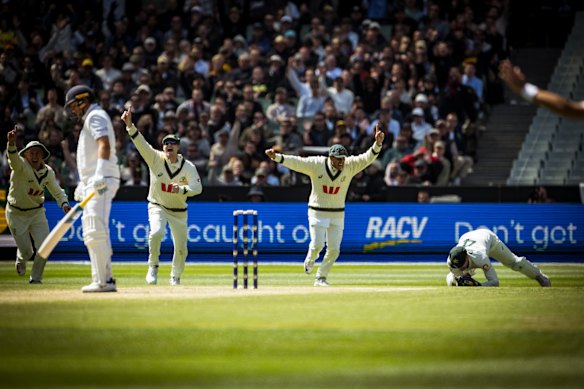
The Australians were overjoyed at snaring Joe Root’s wicket on Boxing Day.Credit: Chris Hopkins
“Because we are a discreet market in terms of Test cricket still being dominant, especially the Ashes and India, if this is going to be less playing time, they’re going to pay less, significantly less.
“When you start doing your maths on this, if you’re reducing your total audience you can sell to premium sponsors, that’s a fairly significant effect, and Test cricket in Australia still dominates the broadcast market, no question of that.”
While Foxtel and Kayo may be hurt by short Test matches in terms of subscriber churn, free-to-air broadcaster Seven is the biggest loser in terms of losing hundreds of valuable advertising slots that must be compensated for.
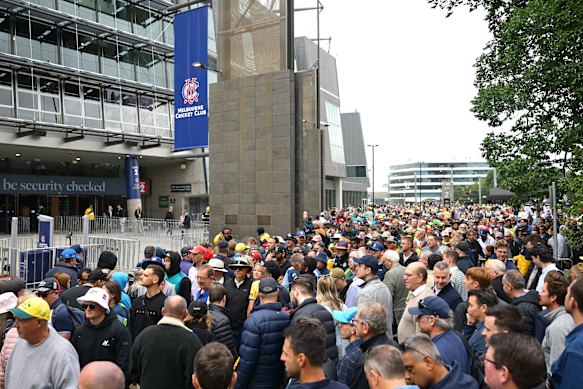
Fans queue up outside the ’G on Boxing Day.Credit: Getty Images
“They’ve got a twofold issue. More than likely, their sponsors would’ve had the usual clauses in their contracts for ‘makegood’, and the makegood of this will be huge,” Smith said. “You’ve got six hours of play lost yesterday and today.
“You’d think between Perth and Melbourne you’d get an average of three days [play] but you haven’t, so the makegood for that will be very significant. Not only do they have to replace the ad, but they’ve got to put it on at an equivalent ratings time slot.
“It will have a lesser effect on Kayo and Foxtel, but they wouldn’t love it either, because it would’ve been a real subscription driver as well. But the major effect is for free-to-air and Seven and Seven Plus.”
Loading
CA chief executive Todd Greenberg has acknowledged the wider commercial and broadcast implications of two-day Test matches.
“Some of these things have a long-term tail if you’re not careful,” Greenberg said. “Broadcasters have an impact; all of the sponsors and partners who invest in cricket. It’s not just about us and ticket sales, it’s about every part of it, including the MCG, who will also lose significant revenue over the next couple of days.
“So there are swings and roundabouts in cricket. The number of people who watched the first two days were way beyond forecast and expectations. My goal is to just have more of it. I can’t think of another sport on the planet that has such a material impact on performance on the field and commercial return off the field through all the variables outside our control on wickets.
“That’s what makes cricket so amazing and unique, but it also creates enormous challenges for us. We’ve got to figure out how we deal with some of these things.”
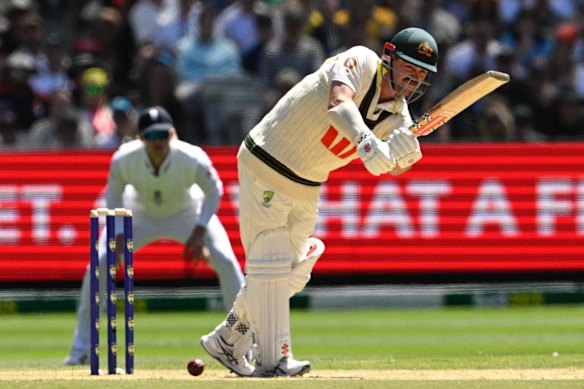
Travis Head battles the conditions on the second day of the Melbourne Test.Credit: Chris Hopkins
The Big Bash League is also affected by the early end of the Test because the Twenty20 league’s biggest audiences have habitually come in the evenings immediately after a day’s play in Melbourne or Sydney.
“BBL games get a big fillip from being played after a Test match. If the Test ends early, that means you lose some of that fillip,” Smith said.
“If this trend continues, it will be very significant. But the cost for Seven even this year will be very significant, and I wouldn’t imagine there will be a sponsor who doesn’t have a makegood clause.
“Cricket is the No.3 sport for Australia in terms of the value of media rights, and it puts pressure on that. CA have done a really good job in driving interest in the BBL, but then they’ve got this, which they need to address. I can see why CA is starting to indicate they may want to have some input into how these wickets are readied to play.”
Loading
Seven has put out a communiqué trumpeting the huge audience figures for the two days of the Melbourne Test, which had a national audience of 1.84 million during the third session on Boxing Day and 1.6 million for the final session on day two.
“Despite Australia already retaining the Ashes and the Test wrapping up far quicker than we would have liked, the record-breaking attendance figures and ratings once again proved cricket remains Australia’s number one summer sport,” Seven’s head of cricket Joel Starcevic said.
Foxtel declined to comment on subscriber figures.
Most Viewed in Sport
Loading