2 months ago
16
2 months ago
16
By James Rothwell
December 14, 2025 — 5.30am
London: It was the rustle of paperwork heard around the world: a 33-page US security plan that upended virtually everything Europe takes for granted about its closest military ally.
In a new national security strategy report (NSS), the Trump administration painted an excoriating picture of a Europe in terminal decline and ruled by weak, corrupt elites.
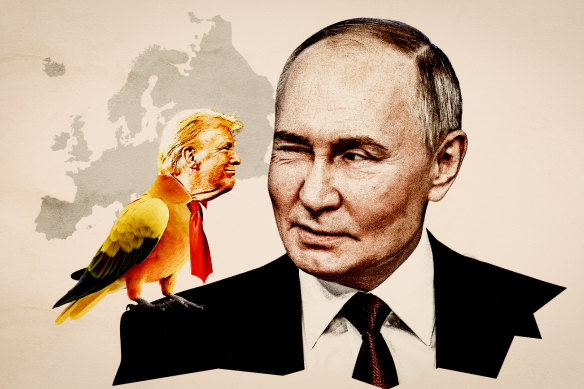
After the release of the US National Security Strategy, Vladimir Putin’s press secretary said the Trump administration’s foreign policy was now “in many ways” aligned with Moscow’s.Credit: Marija Ercegovac
“Civilisational erasure” loomed for the continent, the NSS claimed, blaming centrist governments for their fixation on open borders, political correctness and censorship.
It went on to herald “patriotic” parties, such as Germany’s AfD (Alternative for Germany), as the antidote to a region where “within a few decades at the latest, certain NATO members will become majority non-European”.
One section even blamed European leaders for the lack of a peace deal in Ukraine, citing their “subversion of democratic processes”.
At the same time, the report pointedly avoided describing Russia as a threat and is reminiscent in parts of the pre-Woodrow Wilson America, which viewed war in Europe as someone else’s business.
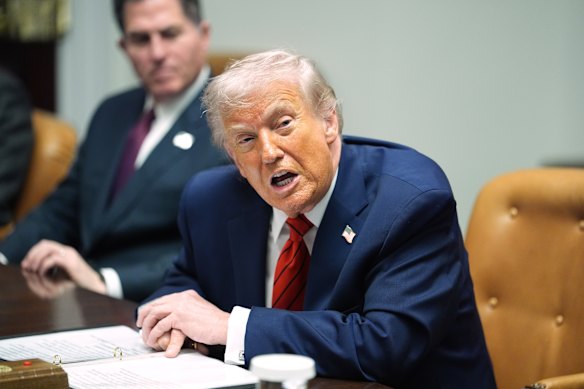
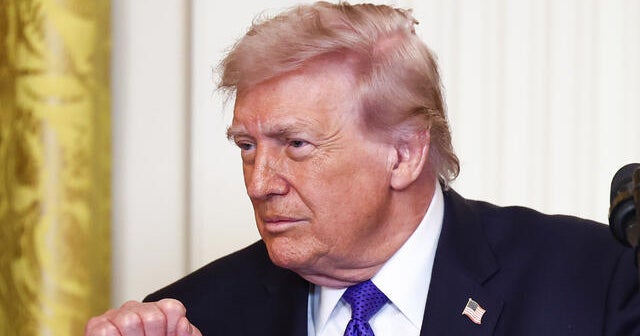
US President Donald Trump’s administration warned of “civilisational erasure” for the continent.Credit: AP
The scathing report has once again shown how the Trump administration can, with the flick of a pen or a lash of the tongue, fundamentally shake up the world order.
It has left European diplomats, politicians and industry figures in a state of shock – or grim resignation – about the transatlantic relationship, though some welcomed the call for Europe to become independent on defence.
“After 80 years of close transatlantic security cooperation, the US no longer stands with Europe’s democracies on questions of war and peace, but instead sides with a belligerent Russia,” Norbert Röttgen, a senior MP in German chancellor Friedrich Merz’s Christian Democrats party, told The Telegraph.
“It even seeks to dismantle the EU, a project Washington once championed after the Second World War. This is nothing less than a second Zeitenwende [turning of the times],” he added, referring to Germany pivoting to a far tougher stance on Russia after the 2022 invasion of Ukraine.
A longer version of the strategy leaked online also revealed how the US wants Italy, Hungary, Poland and Austria to pull out of the European Union.
The Kremlin is certainly celebrating the NSS report: Vladimir Putin’s press secretary has said that the Trump administration’s foreign policy is now “in many ways” aligned with Moscow’s.
It is the clearest sign yet of a sea change in US attitudes towards Russia under Trump, whose views on Ukraine are at times hard to distinguish from those of Putin.
“This is JD Vance on steroids,” former Swedish prime minister Carl Bildt said, referring to the US vice-president’s castigating speech on European politics at the Munich security conference in February.
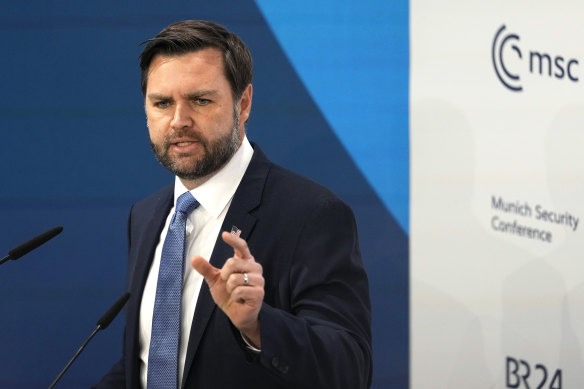
US Vice President JD Vance chastises Europe’s leaders at the Munich Security Conference in February.Credit: AP
One senior source in the German defence industry, which under Merz is rearming Europe against Russia, spoke of fears that Trump is about to “switch teams or leave the playground”.
“The best moment for a Russian dictator to pull the trigger on Europe is during the Trump administration,” the source said.
“What does Putin want? To make NATO fall apart – it’s doable on a short timeline [if] the US decides not to support Europe.”
The senior source spoke of concerns that European leaders are stuck in an increasingly futile game, where they must heap praise on Trump’s security plans, even as he seems to pull ever further away from European security interests.
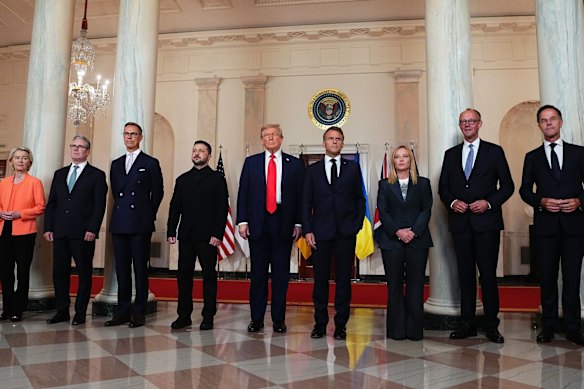
President Donald Trump, centre, with European leaders at the White House in August.Credit: Bloomberg
“That’s the wildest part of it all. Caught between opportunism and diplomatic limits of behaviour, we seem to find no solution and instead keep clinging to hope,” they said.
Former French ambassador to Syria Michel Duclos, a senior adviser at the prestigious Institute Montaigne, said the NSS offered a somewhat disturbing glimpse inside the minds of the administration’s leaders.
“This document shows a neurotic relationship with Europe. They mention Europe 50 times and China only 20. It reveals an obsession,” he told The Telegraph.
“There are things which, once written and published, mean nothing will ever be the same again. The Americans have crossed that line. The contempt, even the hostility, it’s irreversible,” he said.
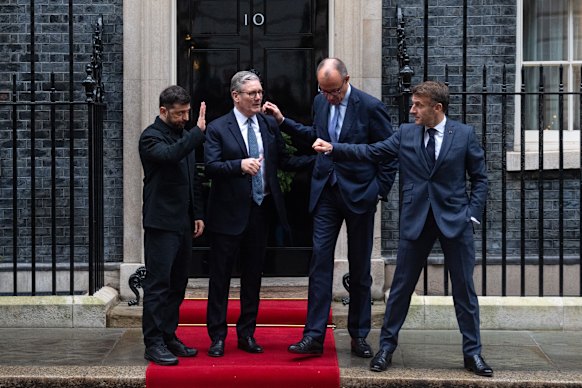
Ukrainian President Volodymyr Zelensky with Keir Starmer, Friedrich Merz and Emmanuel Macron in London this week.Credit: Getty Images
Duclos accused the Trump administration of “projecting” its own fears about the future of America on to Europe, such as the warning that some NATO member states will soon become a “non-European majority”.
“In 20 years, the United States will no longer have a white majority. They are projecting their anxieties on to us,” he said. “Trump’s strategists are fighting in Europe a cultural battle they have already lost at home.”
In Brussels, EU diplomats and NATO sources offered a more stoic response to the NSS, which they pointed out was similar in tone and content to previous remarks about Europe by Trump and his allies.
“It’s been met with a proper Gallic shrug. It’s not like we didn’t know,” one EU diplomat said.
“America has been drifting away from Europe for a while, it’s been a good ride together, but going forward in the not-so-distant future, we need to be able to do it also alone.”
“This is being taken seriously but not dramatically,” a NATO source said. “For our part, there is nothing new, and there are elements to which the Americans are not wrong, such as us needing to take responsibility for our own security.”
Former European Commission vice-president Margaritis Schinas was bullish about the endurance of the EU, which he expects to outlive Trump’s school of MAGA.
“American administrations change, and with them national security strategies, doctrines and political rhetoric. Europe, by contrast, is a long-term political project built on institutions, treaties and shared interests – and that gives us resilience,” he told The Telegraph.
Executive director of MCC Brussels think tank Frank Furedi said: “America writes the script and Europe immediately auditions for a supporting role. If that’s the EU’s idea of leadership, no wonder European voters are losing faith in a failed political elite.”
There was one country which was a tad pleased with some of the NSS contents: Britain, which was singled out as a nation to which the US is “sentimentally attached”.
Sources told The Telegraph that this was justification for Prime Minister Sir Keir Starmer’s attempts to position Britain as a go-between for Washington and continental Europe.
Loading
But overall, European leaders’ reactions to this plan, both public and behind the scenes, have been muted at best, or outright negative.
“Some of the things in there are reasonable; some of it is understandable; some of it is unacceptable for us from a European perspective,” was Merz’s response.
“That the Americans now want to save democracy in Europe, I don’t see any need for that. If it needed saving, we’d get it done ourselves.”
Merz’s sentiments were echoed by European Commission president Ursula von der Leyen, who said “nobody else is supposed to interfere” in European domestic politics.
Germany is particularly exposed to the Trump administration viewing “patriotic” parties as their preferred leaders of government across Europe.
AfD, the hard-Right anti-migrant party, is currently leading the polls and won an unprecedented second place in last February’s federal elections.
AfD leaders were in Washington this week to meet with Republican officials, in a sign of their ties growing ever closer.
They are, unsurprisingly, delighted by the NSS report: “The AfD is fighting alongside its international friends for a conservative renaissance,” AfD foreign policy spokesman Markus Frohnmaier said.
The same goes for Italy’s defence minister from prime minister Giorgia Meloni’s populist Brothers of Italy party.
Loading
Guido Crosetto told Avvenire, a newspaper run by the Catholic Church, that the West is “old and tired”, and “weakened by profound selfishness” in remarks that certainly chime with the NSS.
The divide is clear: Europe’s ruling centrist parties fear that Washington has decided it should have a say in who governs their countries, while the populists see in Trump a leader who finally speaks their language.
As for Russia, Kremlin spokesman Dmitry Peskov has heaped praise on the NSS, saying that it “corresponds in many ways to our vision”, while foreign ministry spokesman Maria Zakharova said Russia hoped the document would have a sobering effect on the European “parties of war”.
Russian political scientist Maria Lipman told The Telegraph that, internally, Moscow will treat the strategy with some caution owing to Trump’s unpredictability.
Even so, she pointed out, the current leadership of the US and Russia seem more aligned than ever. “Putin holds European countries and, of course, Ukraine in such low esteem,” she said – comments that one could easily attribute, in this new era, to the leader of the free world.
The Telegraph, London
Get a note directly from our foreign correspondents on what’s making headlines around the world. Sign up for our weekly What in the World newsletter.
Most Viewed in World
Loading