2 months ago
23
2 months ago
23
A plan to burn 600,000 tonnes of Sydney’s waste in NSW’s central west has attracted fierce opposition from farmers, families and traditional owners, who say the proposed $1.5 billion incinerator threatens their health and endangers their livelihoods.
With Sydney projected to run out of landfill space by 2030, the state government last year awarded a tender to a private consortium to build and operate a waste-to-energy facility near Parkes – famed for its Elvis festival, astronomical observatory and the film about its role in the 1969 moon landing.

Third generation farmer Graeme Somers, 66, on his farm bordering the proposed waste-to-energy facility.Credit: Kate Geraghty
The proposed plant will burn non-recyclable waste at 1000 degrees to create steam, driving turbines to generate electricity.
Emissions from the process pass through a filtration system to remove toxic particles.
The company, Parkes Energy Recovery, has told the community all emissions would be within safe and legal limits, but residents are uneasy about household waste being burned within kilometres of homes, schools and prime agricultural land.
“If it goes ahead, [and] we get our produce contaminated ... where do we go?” said Graeme Somers, whose farm borders the proposed incinerator site.
The third-generation farmer said he had delayed necessary improvements to his home and farm due to the uncertainty about the project.
The state government has the right to acquire Somers’ land as part of the Parkes “special activation precinct”, a business hub that would draw power from the waste-to-energy plant. The 66-year-old said he would have the option to lease back the land, but he would not stay in the area if the incinerator went ahead.
“I’m at retirement age now, I’ve got three sons and none of them are that interested [in farming this land], so I’ll be off,” he said.
The NSW government in 2022 legislated a ban on all energy-from-waste facilities except in four locations: Lithgow, Goulburn-Mulwaree, the Richmond Valley and Parkes.
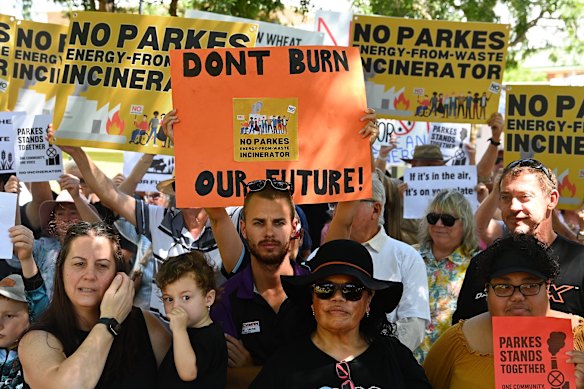
Wiradjuri people and their supporters gather in Cooke Park, Parkes, to protest against the planned incinerator.Credit: Kate Geraghty
The proposal promises to create 50 permanent jobs, fund projects in the community and generate enough electricity to power 100,000 homes annually.
More than 200 locals marched through Parkes on Saturday to support a push from local Wiradjuri groups to stop the project.
“I’d put this in Point Piper, I’d put it in Penrith, I’d put it in Parkes ... the emissions will be safe.”
Parkes Energy Recovery director Edward NicholasA 2019 cultural heritage assessment of the precinct identified scar trees, cultural artefacts and a quarry, but concluded no Aboriginal objects or intact archaeological features would be harmed by the project.
Aunty Frances Robinson, a traditional owner from Peak Hill, said the potential impact on the health of her community and their lands was not worth the economic benefits of the project.
“If one person gets sick from the fallout … that is one too many,” Robinson said. “I’ve got grandchildren to take care of tomorrow, to take care of Country … we don’t need it.”

Aunty Frances Robinson at the site of the proposed incinerator with a photo of her Wiradjuri ancestors, which she carries everywhere she goes. Credit: Kate Geraghty
A 2020 systematic review found modern incinerators were associated with fewer negative health effects than older technologies, but warned many had not been operating long enough to gather strong evidence for or against construction.
Parkes Energy Recovery director Edward Nicholas said the state government had chosen the site, but he was confident the technology was safe regardless of its location.
Loading
“I’d put this in Point Piper, I’d put it in Penrith, I’d put it in Parkes,” he said. “We’re not saying this is zero emissions. What we’re saying is that the emissions will be safe and will be within licence limits.”
The $1.5 billion project is backed by a consortium including investors in Abu Dhabi and Swiss company Kanadevia Inova, a pioneer in energy-from-waste technology.
Nicholas said dozens of energy-from-waste facilities were operating around the globe, including 63 in the United Kingdom and three in central Paris.
Australia’s first, the $700 million Kwinana Energy Recovery facility south of Perth, was opened by Western Australian Premier Roger Cook last month.
Construction on the Parkes incinerator is slated to begin in 2027 and it is scheduled to open by 2030.
An Environment Protection Agency spokesperson said the company had not yet submitted a development application. Any such proposal would need to be supported by community feedback and rigorous environmental assessments considering air quality, health, agricultural risk, traffic noise, water issues and social impact.
“Emission limits in NSW are among the most stringent in the world,” the spokesperson said. “[The proposal] will need to meet strict regulatory settings that align with global best practice.”
A NSW parliamentary inquiry into proposed energy-from-waste facilities in Parkes and Tarago, south of Goulburn, received more than 1400 submissions.
Later this month, the inquiry will begin investigating the technologies proposed at the two sites and their impacts on human health and agriculture, as well as alternatives to reduce and manage waste in greater Sydney.
Start the day with a summary of the day’s most important and interesting stories, analysis and insights. Sign up for our Morning Edition newsletter.
Most Viewed in National
Loading