3 months ago
23
3 months ago
23
A previously unreleased briefing on global warming to the Howard government issued a stark climate change warning two decades ago, but even this frank advice failed to anticipate the extreme heat and catastrophic bushfire conditions that swept the eastern seaboard during the week.
Newly released cabinet papers, prepared by the federal public service and experts at the Bureau of Meteorology, were largely ignored by the Howard government, despite telling ministers that the global average temperature rise was “unprecedented in human history”.
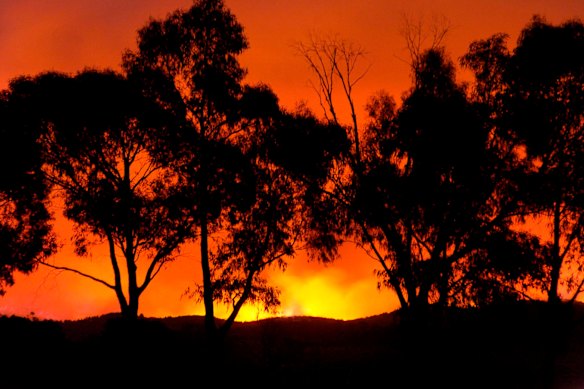
A previously confidential briefing to the Howard government in 2005 warned of climate change, but did not anticipate the scale and severity of the impacts now playing out. Credit: Rob Carew
Australian National University professor of climate science Sarah Perkins-Kirkpatrick commended the briefing for incorporating contemporary scientific advice from the Bureau of Meteorology, but said even this undercooked the alarming rise of Australian heatwaves in the past 20 years.
The briefing said global warming would spur increasing heatwaves, droughts, fires and sea-level rise, which was a result of rising levels of greenhouse gases in the atmosphere that were “in part attributable to human activities”.
Loading
“There is a very close link between increasing global temperature, the increasing regional temperature and the rise in the intensity, frequency, and duration of heat waves,” Perkins-Kirkpatrick said.
“It’s happened at a faster speed than what climate scientists would have thought originally. Each decade has been significantly warmer than the decade prior.”
The bulk of the briefing was prepared by government departments, but included a seven-page primer on climate change science by the Bureau of Meteorology. This said that the global average temperature had risen 0.6 degrees compared to that of the period 1900-1920, but since 2005, warming has accelerated and the global average temperature rise now sits at about 1.2 degrees, a rate of change not anticipated by the briefing.
“We’ve seen changes in heat waves here in Australia and globally that I never thought we would see so quickly,” Perkins-Kirkpatrick said.
The briefing said more intense and frequent bushfires were projected for Australia due to climate change, but noted that “gaps remain in the knowledge” of the timing, location and magnitude of such impacts.
The CSIRO has found that extreme fire weather days have increased in Australia by 56 per cent over the past four decades.
Emeritus Professor Mark Howden of the Australian National University said the briefing underestimated some impacts of global warming and the rate of greenhouse gas pollution.
“Greenhouse gas emissions have actually gone up faster than that projection indicated. So has sea-level rise, melting sea ice, temperatures and other changes [such as heatwaves],” said Howden, who serves as a vice chair of the United Nations’ chief climate body, the Intergovernmental Panel on Climate Change.
Australia signed the Kyoto Protocol in 1998 but ultimately chose not to ratify it under the coalition government led by John Howard, citing potential economic disadvantage compared with major emitters such as the United States and China. It was ratified on December 3, 2007, the day the Rudd government was sworn in to succeed Howard.
Cabinet received the briefing as Australia was in the midst of the Millennium Drought, which ran from 1996 to 2010.
Howden said the Howard government was sufficiently informed on the science of climate change at the time.
“The science was sufficiently robust to make good decisions on climate change in 2005,” Howden said. “It was clearly in Australia’s interest to foster global action on climate change.”
Loading
The State of the Climate report by the CSIRO in 2024 found that Australia’s warmest year on record was 2019, and eight of the nine warmest years on record have occurred since 2013.
University of NSW climate scientist Professor Matthew England was critical of the Howard government’s lack of response to the briefing, with no new policies put in place to drive down greenhouse emissions.
“As something of an omen to the catastrophic bushfires of 2009 and 2019 -2020, the cabinet papers flagged the risk of more frequent and intense bushfires, yet the Howard government pushed those risks aside and chose not to act on climate change,” England said.
The briefing was issued a decade before 195 nations signed up to the 2015 Paris Agreement on climate change. It noted that the United States and developing nations were “unwilling to commit” to emissions reduction targets.
Former chief climate diplomat Professor Howard Bamsey, who led Australia’s negotiations over a global emissions reduction treaty for two years in the lead-up to the Paris deal, said the briefing identified the key sticking point that was ultimately subverted by multilateral co-operation.
“The Americans thought they were stopping everything,” he said. “But it had the opposite effect really, because it caused countries to think about the issues in a way that wasn’t confrontational, through this long-term dialogue.”
Bamsey said that in international climate talks, in the years leading up to the Paris Agreement, Australia began proposing that nations would propose their own emissions goals, rather than a blanket global target, which was ultimately “the key tool to allowing the Paris Agreement”.
Start the day with a summary of the day’s most important and interesting stories, analysis and insights. Sign up for our Morning Edition newsletter.
Most Viewed in Politics
Loading