3 months ago
27
3 months ago
27
When the renos are done, the black cockies come home to roost and reproduce. A longitudinal study of Carnaby’s cockatoos has found that female birds will inspect the real estate, move in and raise a fledgling family if the hollows in old trees are repaired.
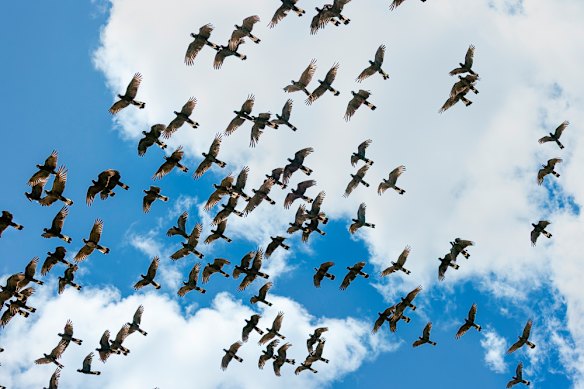
Flocks of white-tailed cockatoos take to the air.Credit: Rick Dawson
The detailed study of Western Australia’s white-tailed black cockatoos has revealed that repairing natural tree hollows - like covering holes in the trunk and installing nesting floors where they have rotted out – is a way of securing their survival.
This threatened species prefers hollows that can take 120 years to form - knock down a single tree, and you must wait a century or more before nature creates a metre-deep hollow suitable for the bird tenant to occupy.
“We’ve nicknamed it Cockatoo Club Med – you build it right and they will come,” says Rick Dawson, a retired senior wildlife officer who carries out repairs at a rural nesting site at Coomallo Creek, two and a half hours’ drive north of Perth.
Apart from routinely fixing up around 90 natural hollows, Dawson has installed 80 artificial nest homes with a resulting high occupancy rate.
“Carnaby’s will move readily from natural hollows to artificial ones, just like they’ll move from eating banksia to eating pine cones. They’re adaptable,” he said.
The cockatoos are the subject of Australia’s longest-running bird research led by the same individual, Dr Denis Saunders.
A former CSIRO senior scientist, Saunders began meticulously recording Carnaby’s cockatoos on his first visit to Coomallo Creek in 1969; he continues to visit every year, accompanied by Dawson and Dr Peter Mawson, former head of research at Perth Zoo, to check for signs of nesting and to measure and band new fledglings.
The companionable trio have jointly written 25 papers on the cockatoos’ life cycle and habits.
Saunders says maintaining nesting hollows is crucially important for the survival of the bird species, whose declining numbers are caused by mass tree removal, feral cats and climate change affecting food availability.
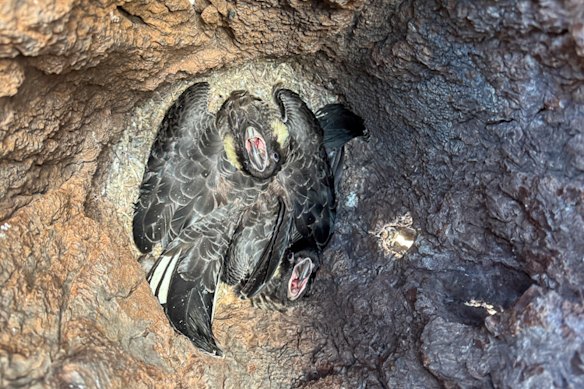
Maintaining nesting hollows is crucially important for the survival of the bird species.Credit: Rick Dawson
“We think females have site fidelity – where they’ve fledged is where they will return to lay their eggs, in some cases to within a few hundred metres of where they fledged,” he says. “The results over the last five years have been exceptional – by repairing old hollows and installing more artificial hollows, we get a good healthy population.”
In the most recent survey last November they recorded 131 breeding attempts at Coomallo, higher than 82 attempts in the previous year.
“It’s an exceptional response especially after a couple of drought years, and the condition of the nestlings was good,” says Saunders.
Dawson says he was thrilled to see so many young adult birds returning to Coomallo.
“It’s a case of ‘build it and they will come’,” he said.
“ repaired one of the original hollows from Denis’s survey and this year it had twins in it. Another hollow hasn’t been used for years, then I repaired it and bang, it had a fledgling in it.”
The survey team has a particular favourite, Bird Number 111, who has just moved back into a repaired hollow and produced offspring for the thirteenth year.
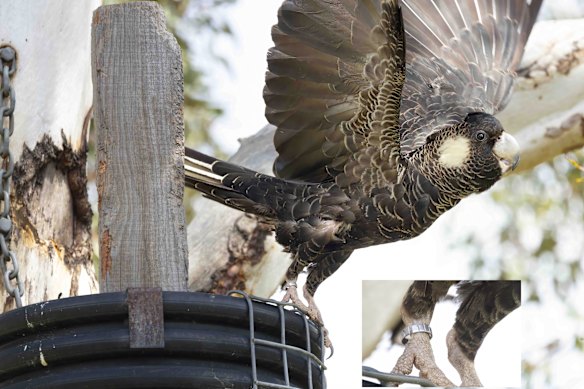
The survey team has a particular favourite, Bird Number 111.Credit: Rick Dawson
“I was elated to see 111, our girl that we’ve photographed every year,” said Dawson.
“She’s seen me thirteen times in a row, but she still gives me a filthy look when I approach to check the hollow, kind of ‘oh really?’ Then she flies to the next tree and waits until I’ve climbed up. I’ve got the most beautiful photos of her.”
Carnaby’s cockatoos once flew across Perth’s skies in flocks of many hundreds, but now a dozen birds is a welcome sight. At Coomallo Creek, the men were rewarded by the spectacle of 92 birds flying overhead.
Saunders says the historic survey work at Coomallo, a farming region with a nine kilometre long corridor of mature trees, has produced dozens of useful scientific observations.
Providing viable nesting sites is a key to successfully raising young, he says, but so is removing feral cats.
“Cat predation is devastating, not just when you see dead fledglings but dead breeding females,” Saunders said.
“Last year we lost seven out of 100 breeding pairs, a terrible loss when you realise the females don’t start breeding until around aged three or four. I’ve seen a cat preying on a cockatoo in a nest ten metres off the ground.”
Local farmers have started shooting or trapping feral cats, removing 17 cats in an 18 month period alone.
“We’re very grateful to them, and we’ve lost fewer birds this year,” said Saunders.
The trio’s findings are being shared nationwide with other conservation experts, including groups focused on vulnerable species like Regent Parrots, Great Barn Owls and Yellow Tailed Black Cockatoos.
“We wanted them to know that artificial hollows can work well for them,” Dawson said.
“There’s great science to show that if you install an artificial hollow within two kilometres of a known breeding area, they’ll take them up readily. But if you put them up outside of that, they may never use them or it’ll take them several years to find.”
Dawson will head back to Coomallo Creek in March to repair more hollows.
“Female black cockatoos, like all good women, check out the real estate no matter what time of year it is,” he said.
“They’re always looking, they prospect. There must be water and food within a reasonable distance of the nest, but if they find the right hollow – natural or artificial – they’ll move in.”