3 months ago
12
3 months ago
12
By Nick Kaldas
November 25, 2025 — 10.00am
Clive Thomas Small (1946-2025)
While Clive Small will be rightly remembered for leading the investigation of the backpacker murders – an innovative, groundbreaking operation that put a stop to one of the most evil serial killers in Australia’s history — there was much more to his achievements. Few outside the police force would be aware that his legacy lies in revolutionising major crime investigations.
And he did all that with an egalitarian streak introducing investigative structures and protocols and ensuring that accountability stopped with police bosses rather than junior officers. “I’m sick of constables wearing the blame,” he told me.
During his police tenure he received many commendations and awards and helped shape the operations of the NSW Police Force.
Small joined the NSW Police Force on October 28, 1963 as a cadet and sworn in as probationary constable on August 5, 1965. He came first in his class, setting himself a high standard that saw him rise through the ranks to assistant commissioner. He retired in 2003 and was appointed head of operations of the NSW ICAC in 2004, a position he held for five years.
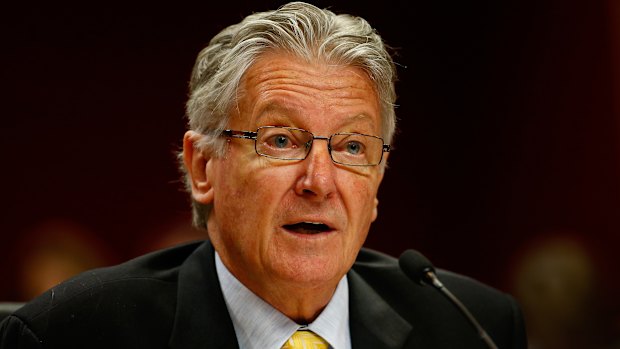
Former NSW assistant police commissioner Clive Small gives evidence at a hearing at NSW Parliament in 2015.Credit: Daniel Munoz
He worked in criminal investigation, commanding patrols and districts and was the inaugural commander of the revamped Criminal Investigation Command (then called Crime Agencies). But it was in major crime investigations where his impact was considerable.
As a young detective he worked in the Special Breaking Squad, dealing with escapees, extortion and major breaking offences. He was an investigator in the Stewart Royal Commission into Drug Trafficking in the early 1980s and also in the 1983-1985 inquiry into the infamous Nugan Hand Bank, a torturous investigation into drug trafficking and corruption on a global scale by a minor bank.
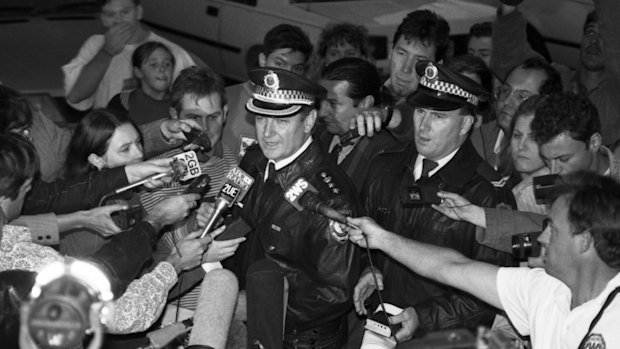
Chief superintendent and commander of Taskforce Air, Clive Small at a press conference after the arrest of Ivan Milat in 1994.Credit: Dean Sewell
Small will be rightly remembered for leading the investigation into the “backpacker” murders by Ivan Milat. In 1994, he was appointed to head a 20-strong team, Taskforce Air, to investigate the murders of young backpackers reported missing between 1989 and 1992 after their bodies started turning up in shallow graves in the Belanglo State Forest. There was no suspect but seven months later, Small arrested Milat, who was found guilty after a 15-week trial and jailed for seven consecutive life sentences. He died in prison in 2019.
It was an innovative, ground-breaking effort, solving seven murders and putting a stop to one of the most evil serial murderers in Australia’s history. But there was much more to his achievements including establishing a framework for successful investigative operations.
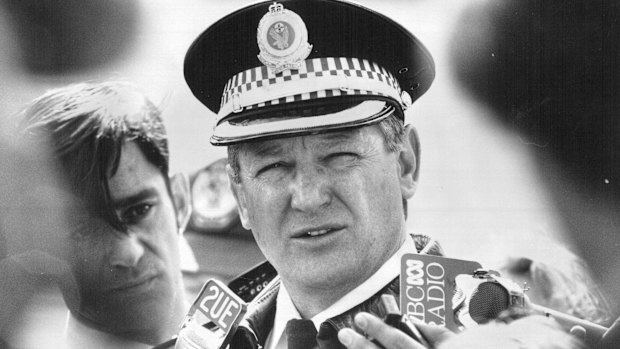
Briefing the media on the backpacker investigation.Credit: Simon Alekna/Fairfax Media
The Wood Royal Commission into corruption in NSW Police was a long, drawn-out inquiry from 1995 to 1997. Many officers felt procedural fairness was ignored with the inquiry’s harshest criticism for detectives. The Criminal Investigation Branch (CIB) was disbanded and there was even a bizarre suggestion that all detectives should wear uniforms. After the inquiry the oversight apparatus for police, both internally and externally, was out of control.
Small was instrumental in moving the organisation past the angst, arguing that no matter how the inquiry was conducted, the corruption problems were real and we must learn and ensure that it never happens again. Amid the doom and gloom, Small had a vision for criminal investigation to be seen as a great and noble cause again; an aspirational post for police.
Some thought he was unrealistic, even a bit mad, declaring that he wanted to re-establish a CIB – in the midst of the royal commission – with checks and balances and innovative leaders who would ensure integrity and act fearlessly in the face of malice. He did it, and the framework he established will now long outlive him. Crime squads with professional, successful operations became the norm, and pride was re-established. Other jurisdictions began to look to NSW and copy the model of accountability coupled with strong support from leadership.
Small had called a meeting of crime squad commanders and laid out his vision for accountability in major crime investigations with initial terms of reference, progress reports and post-operational assessments. He said, “let us all agree here and now that if there is another corruption inquiry, it won’t be because of detectives. It will be a hard regime, but it is necessary and will restore CI work. Anyone who disagrees can leave”. No one left and we succeeded against all expectations.
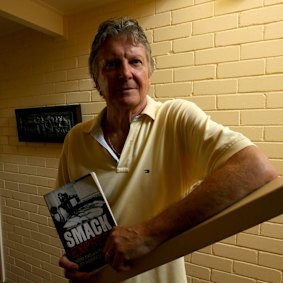
Small in 2009 with one of his books on organised crime, Smack. Credit: Steven Siewert
Small’s view was that when things went wrong, accountability tended to fall on the lowest of the ranks and senior police walked away unscathed. Tasking me with an internal investigation, he once said to me, “I’m sick of constables wearing the blame”. His point was that leaders had to accept responsibility, rather than blaming junior staff who often could not defend themselves.
Small could be easily riled though. There was an incident when one of his deputies stopped to get a sandwich in a less-than-salubrious part of town. A group of kids broke into his car and stole his mobile phone. All the crime squad commanders, Small and I were in this officer’s phone contacts as favourites. The young thieves took great delight in ringing us with Small, being the first on the list, getting the most calls: “Hey Clive, waddyadoing you p---k”. He was annoyed and cleverly retorted: “Listen I know where you are and you will be arrested any minute now”. Good comeback, but his reaction just egged them on, much to the merriment of his staff and the annoyance of Small.
Small never saw the media as an enemy. He built many lifelong friendships with journalists and commentators who he engaged with on a deep intellectual level and called on them to support police when needed. He co-authored six books, mainly on organised crime, displaying a depth of knowledge and understanding of the nature of crime and criminal groups that was unmatched by those who often criticised him.
Small could be very task-focused and was great at many things but not at remembering people including his own staff. During the Sydney Olympics he and I attended a diplomatic function and I introduced him to a line of dignitaries from the United States, the FBI and other agencies. A young sergeant who worked for us was at the end of the line. “Clive Small from Crime Agencies”, he said, as if they had never met. There was an awkward silence as the sergeant said, “Sir, I work for you”. A giggle went through the group, as a red-faced Small moved on.
There were some around Small who had no operational credibility, and whose ambitions were never matched by their ability. They saw him as a threat and did their best to nobble him at every turn; for his leadership of the Milat murder inquiries, he only received a deputy commissioner’s commendation, an inadequate recognition for what was an internationally renowned investigation. The tall poppy syndrome at its worst.
By any measure, his vision was revolutionary, historic and had a huge impact on policing. Had he been appointed commissioner, there is no doubt his tenure would have been visionary.
He exemplified Don Bradman’s adage that those who played the game had a sacred duty to leave the game in better shape than when they found it. The people of NSW owe Clive Small a great debt. May he rest in peace.
Small is survived by his wife Alison and children Amber and Joshua.
Nick Kaldas is a former deputy commissioner of NSW Police from 2007 to 2016.
Get a weekly wrap of views that will challenge, champion and inform your own. Sign up for our Opinion newsletter.
Most Viewed in National
Loading