3 months ago
24
3 months ago
24
Children as young as 14 could be jailed for life for violent crimes under justice reforms set to be introduced by the Victorian government in response to rising crime rates.
The state government has adopted a Queensland flavoured “adult time for violent crime” slogan to sell a tougher juvenile justice regime for serious young offenders, with the proposed changes approved by cabinet on Tuesday.
“We want the courts to treat these violent children like adults, so jail is more likely and sentences are longer,” Premier Jacinta Allan said after a lengthy cabinet meeting, which also endorsed new protest laws.
“Adult time for violent crime will mean more violent youth offenders going to jail, facing serious consequences.”
Loading
The new regime will see children charged with aggravated home invasion, intentionally or recklessly causing injury in circumstances of gross violence, carjacking and serious and repeat aggravated burglary and armed robbery tried and sentenced by adult courts.
Currently, the maximum jail sentence that can be imposed in the Children’s Court is three years for any single offence, while adult courts can impose sentences of up to 20 years for intentionally causing serious injury through gross violence and up to 25 years for aggravated home invasion. Under the proposed changes, the penalty for aggravated home invasions and carjackings will increase from 25 years to life imprisonment.
The proposed legislation will also compel the Children’s Court to take into greater consideration the impact of youth crime on its victims, and remove the stipulation that jail should be a last resort for children convicted of serious crimes.
Under existing laws, one third of teenagers convicted in the Children’s Court for carjacking and aggravated home invasion are given custodial sentences. People sentenced for the same crimes by adult courts are jailed in nearly all instances.
Adult courts place greater emphasis on community safety and impact on victims, whereas rehabilitation is the primary objective of the Children’s Court.
The proposed changes, which will be introduced to parliament this week with a view to push them through before the end of the year, are likely to dismay youth-justice advocates who argue that tougher sentencing, rather than addressing the causes of youth crime, will turn children into career criminals.
“There are no easy solutions to youth crime and the best approach is always to stop crime before it starts,” Attorney-General Sonya Kilkenny said. “But we absolutely need serious consequences for violent youth crime to protect the community now.”
The changes echo those promised by Queensland Premier David Crisafulli in his “adult crime, adult time” election pitch, which saw the LNP returned to government at the end of last year and comes after the Victorian government faced sustained criticism over its handling of youth crime.
The legislation will require amendments to the Crimes Act, the Children, Youth and Families Act and the Youth Justice Act.
The latest Crime Statistics Agency data shows criminal offences across Victoria are at record highs. Recorded offences rose by more than 15 per cent in the year ending June 30, an increase of 86,587.
Youth crime has also surged, with 25,206 alleged incidents involving children aged 10–17 years in the same time period. This is up from 22,172 incidents the year prior, 19,340 in 2023 and 15,964 in 2022.
Four of the five fastest-growing crimes are theft: stealing from cars, theft of cars, shoplifting and broader robbery offences.
Loading
The issue has become a political headache for the Allan government and a key weapon for Opposition Leader Brad Battin, who has repeatedly accused Labor of being weak on crime.
Following the stabbing attacks that left 12-year-old Chol Achiek and 15-year-old Dau Akeung dead in September, Battin used question time in state parliament to ask: “Premier, how has it come to this under your government?”
This week’s announcement follows the Allan government’s backdown on increasing the age of criminal responsibility, tightening bail laws to make it easier for children to be remanded and banning the sale and possession of machetes.
Allan also confirmed her government would not pursue a blanket ban on masks at protests, as revealed by The Age, after receiving advice it would be vulnerable to constitutional challenges.
Under the proposed changes, to be introduced to parliament on Wednesday, police will be able to request someone remove a face mask if they reasonably suspect a protester is committing or about to commit a criminal offence.
Penalties of more than $1000 will apply for those who refuse a direction, though exemptions can apply for medical, cultural and religious reasons.
Police already have the power to direct anyone wearing a face mask for any reason where they have declared a designated area.
Public display of symbols of proscribed terrorist groups will also be banned under state law, as will the use of attachment devices such as rope or chains if it endangers the public or first responders.
Loading
While the government backed down on a proposed blanket ban on protests at places of worship, new penalties punishable by up to three months’ jail will be introduced for assault at religious assemblies and for intimidating, harassing or obstructing attendees.
Jeremy Leibler, president of the Zionist Federation of Australia and member of an anti-hate taskforce, said the new laws would not be effective.
“We’re deeply disappointed by the Victorian government’s announcement about the proposed mask ban,” he said.
“After the Adass Synagogue terrorist attack, the premier committed to banning the use of masks at protests because they were being used to conceal the identities of those engaging in violence and vilification.
“We don’t understand why a protester should be allowed to wear a mask if police believe they’re about to break the law.
“This is a much narrower proposal than what was promised, and unfortunately, we think it’s unlikely to achieve the purpose this legislation was meant to serve.”
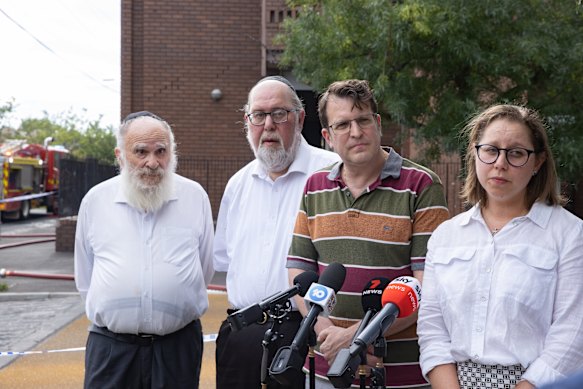
The Jewish Community Council of Victoria’s Naomi Levin (right) with Benjamin Klein (left), Yossi Aron, and Daniel Aghion, KC, in the aftermath of the Adass Israel Synagogue attack.Credit: Simon Schluter
Jewish Community Council of Victoria chief executive Naomi Levin said the government needed to send a stronger message to disruptive protesters who use masks to conceal their identities.
“Victorians, including Jewish Victorians, are sick and tired of protesters taking over our city, causing mayhem and disruption,” Levin said.
Loading
“These laws need to clearly tell protesters that they cannot hide behind masks. The JCCV will continue to work with the government, opposition and the crossbench to make sure all Victorians feel safe.”
Nerita Waight, chief executive of the Victorian Aboriginal Legal Service, said face masks were an important way to keep Indigenous communities safer while engaging in political action.
“Banning face masks will also deter those experiencing family violence from participating in peaceful protest, for fear of being identifiable. A blanket ban on face coverings will only lead to discriminatory policing against Aboriginal people,” Waight said.
Start the day with a summary of the day’s most important and interesting stories, analysis and insights. Sign up for our Morning Edition newsletter.
Most Viewed in National
Loading