2 months ago
19
2 months ago
19
At the heart of Chus Martínez’s first Australian exhibition is a radical idea – that art can teach us to disagree. “Because really, even if it’s a pain to be together with people who radically disagree with us, we must do it,” she says, laughing. “Goodness is a muscle; you need to train it.”
She argues that we have dismantled culture, and our education systems, to such a degree that the ability to debate, once taught (and prized) in university classics departments, in schools of philosophy and history, has been lost. “And now you are left with bullies. And they don’t disagree, they insult, and there is the problem of overprotecting against disagreement, this cancel culture. We need training camps on how to disagree again.”
The exhibition she has curated, A velvet ant, a flower and a bird, explores the vital role museums and galleries play in creating spaces for debate, reflection and free thought. “It’s a super simple premise,” Martínez says. “Everyone knows what an ant, a flower or a bird is, but each has a remarkable life of its own.”
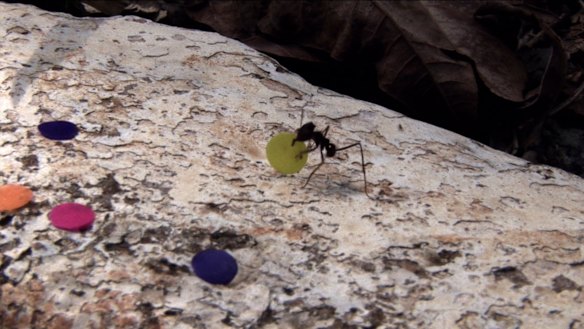
The velvet ant, whose light-absorbing ability is being studied for its potential applications in solar technology, represents radical adaptation. The flower symbolises perpetual renewal, and the bird, through its flocking behaviour, shows the power of collective intelligence. Together, they create a starting point for comprehending the world in new ways, from different perspectives, to take us outside ourselves.
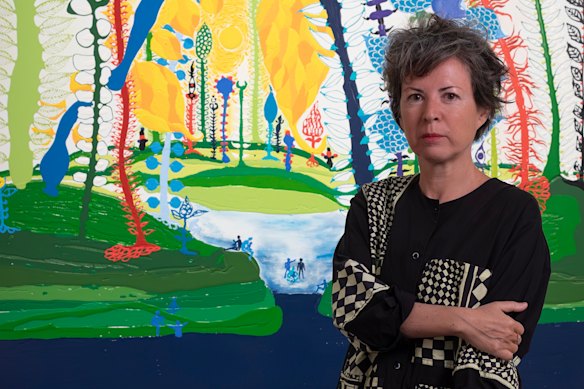
Martínez is a Spanish curator, currently based in the Swiss city of Basel, where she leads the Institute Art Gender Nature at FHNW Academy of Arts and Design. It’s early morning in mid-winter when we speak. Basel is covered in thick snow and Martínez jokes she’s hibernating. In conversation, she is spirited, passionate and brilliant.
The exhibition began as a conversation between Martínez and Charlotte Day, director of museums at the University of Melbourne, about bringing works from the university’s classics, biology and art collections together in a new way.
“I asked myself; how can we mix materials differently to create some kind of new comprehension?” Martínez says. “Because right now, we’re really in need of comprehension. This is a skill people have lost, the ability to ask questions and understand. And if you don’t understand, if you don’t ask questions, it is impossible to make decisions and position yourself in the world.”
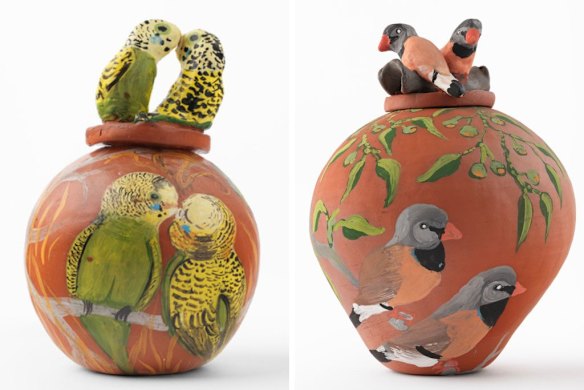
The exhibition’s works span botanical drawings, ceramics, sculpture, blown glass, painting, photography and digital works from more than 60 artists including Australians Kate Daw, Heather B. Swann, Rosslynd Piggott and Judith Inkamala, along with Canadian Tamara Henderson and Swiss photographer Anouk Tschanz. Rather than dwelling on the stories behind individual works, Martínez says she thought she “would try to make a case that these things belong together, and they help us to understand the future. It’s a kind of epistemological stew. The [works] don’t exactly have any trait in common, but they are complementary.”
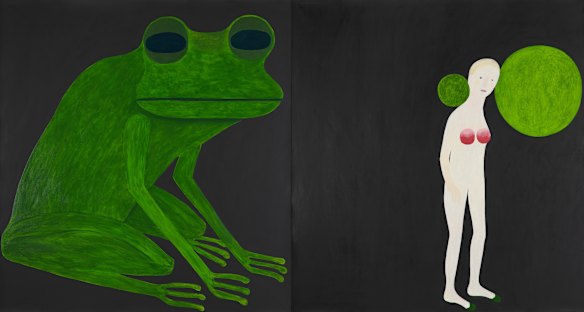
Among them is Destino, an animation of Salvador Dali’s work by Walt Disney. As a student from Barcelona, Martínez once hated Dali – “such a cliche” – but she later came to appreciate the surrealist’s “incredible genius”. He produced, she says, “a language of exoticism and exuberance that takes you out of your mind because he explores dreams”.
“His work is powerful because you don’t need to be an expert [to understand it], you just need to start relating in a free way. You need to empty your body and your mind out of prejudices and start moving in space with the objects.”
Another central work is Derek Tumala’s Kayama nan ng pilipinas (Treasure of the Philippines), a single-channel video in which his digital recreations of plants from the Sierra Madre mountains of northern Luzon move and respond via sophisticated software to real-world weather conditions – temperature, humidity, wind patterns and shifting atmospheric pressure. Tumala is fascinated by novel ways to “connect art with technology to create a forest in the city”.
The plants draw from a catalogue created by Filipino botanist Dr Leonard Co, who was killed by soldiers during remote fieldwork in 2010. The work pays tribute to Co while bringing attention to a critical ecosystem under threat from extensive mining and illegal logging.
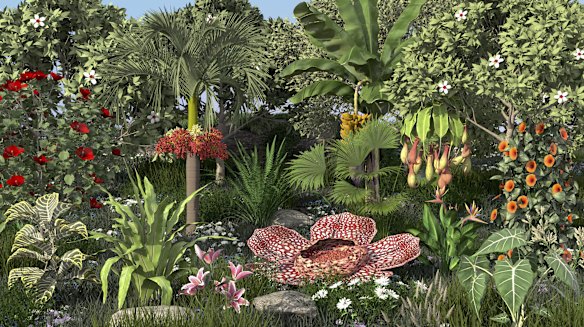
“Sierra Madre means ‘Mother Mountain’,” Tumala says. “Scientists argue this mountain range is crucial for our weather system because it weakens typhoons. The work is about creating a more visceral way to connect with nature by processing real-world data into a visual image.”
One of the exhibition’s most compelling pieces is a self-portrait by Naomi Hobson, a Southern Kaantju/Umpila artist, that depicts her sitting by a riverside embracing a magnificent Barking Owl. Martinez describes it as “foundational image. I see it and I think of the president of the cosmos, there is something you can trust. Who would stop the madness in the cosmos? You trust Naomi.”
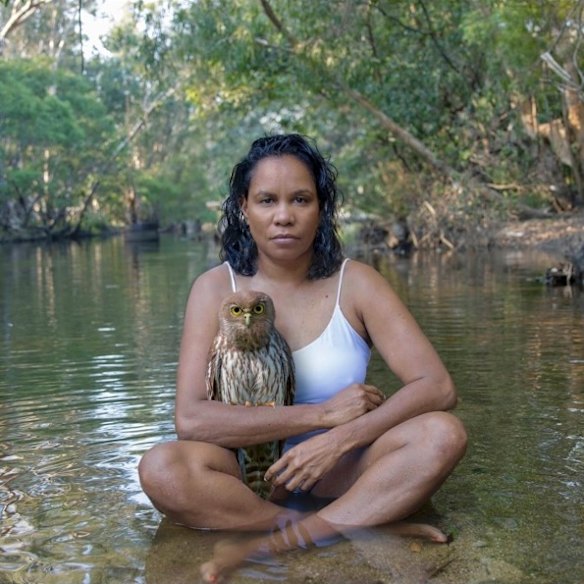
For Hobson, the photo captures a morning on her Country, a story about the way she lives. “It was one of those rare moments. That day I was at the river with my family, and we saw the owl on the ground. I think it had fallen from the tree, it looked a bit disoriented, so I sat with the owl quietly while it regained its bearings and then it flew off again.
“I didn’t wake up in the morning thinking today I will take a photo of me with an owl,” she says, laughing. “I live 60 metres from the river, and the owl has always lived in a hollowed-out tree next to the water. I see this owl, I hear it at night, every day.”
Hobson says her work “is about empowerment, about being honest and real about the life we live in the bush. My work is about creating space for real conversation, for grounding people. There are so many distractions today in the world, we’ve forgotten how to live in the present and how important it is to go back to where you’re from, back to your roots and appreciate what’s around you.”
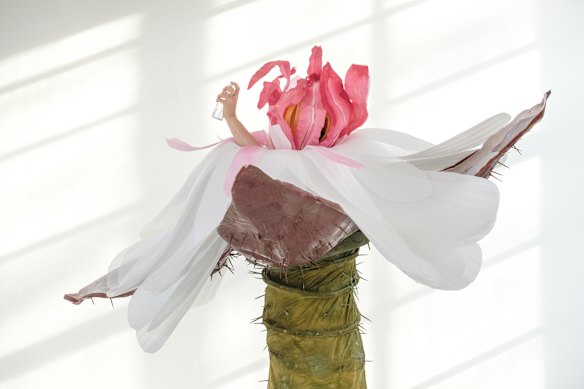
While the spectre of climate change touches lightly on Martínez’s thinking, her exhibition is about “the immense power of many orders, the order of art, the order of literature, of poetry. The order of how important it is to give yourself a time to reflect on culture, how culture is political.” She says art is always being criticised for being elitist, but it’s not, and “if we don’t appreciate it, we’re going to face far bigger dangers”.
Martínez delights in the idea of the exhibition being on a university campus. “I’m aiming towards a threshold, to open a door to young people who are studying politics, engineering or science. To know that everything we study has many paths. There is no clean path, not in politics, not in epistemology, not in science. They are always overlapping.”
She argues the regeneration of democracy and the regeneration of the planet “go hand in hand”. But the purpose of art, she says, is not to indoctrinate people but to bring them together on common ground.
“When I was a student at university, we debated difficult ideas all the time, and afterwards we went to get a drink together. But now this is lost. Right now, I would love to be in a room with people from the far right, to debate in public. I would say, ‘Spain has only had democracy since 1978. You want to dismantle it already? Who is going to profit? Not even you.’ But now nobody wants to debate because you get cancelled, and this is new.” She likens debate to “a homeopathic boost to our immune system, that when it’s broken seems to go in easy paths towards the far right”.
Which brings us back to centre, with the ant, the flower and the bird – three beautiful but complex life forms that create a common ground between us, a space to explore different ways of thinking. “I am a positive person, and I think complexity is easy,” Martínez says. “We move in worlds that are usually familiar to us, but when we move in worlds we don’t know, we feel confronted. But this is not a bad thing, it’s a good thing, a way to see things differently.”
A velvet ant, a flower and a bird is at The Potter Museum of Art, Parkville, February 19-June 6.
Get the day’s breaking news, entertainment ideas and a long read to enjoy. Sign up to receive our Evening Edition newsletter.