3 months ago
21
3 months ago
21
Among Eng’s patients are judges, academics, business leaders, lawyers, politicians, a former Department of Health secretary and the late former Labor leader Simon Crean.
Loading
One former mining chief executive, who did not want to be identified for privacy reasons, has been receiving treatment from Eng for a rare gastrointestinal cancer since 2020, along with conventional treatments from an oncologist at the Epworth.
Eng’s prescribed treatment for the former executive has involved twice-weekly infusions of substances including curcumin (a derivative of turmeric) and taking a long list of supplements and medications including ivermectin, an anti-parasite medication used to treat worms in animals.
He claimed the treatment he had received from his oncologist and Eng had slowed the progression of his stage 4 cancer, and that this had been regularly confirmed by PET scan results.
“I’m feeling wonderful,” the patient said. “Eng is remarkable. I am very fortunate. I have had the best treatment.”
This masthead interviewed 11 other patients of Eng’s, who all provided glowing references shared with AHPRA, and claimed he had extended their lives and allowed them to live without pain.
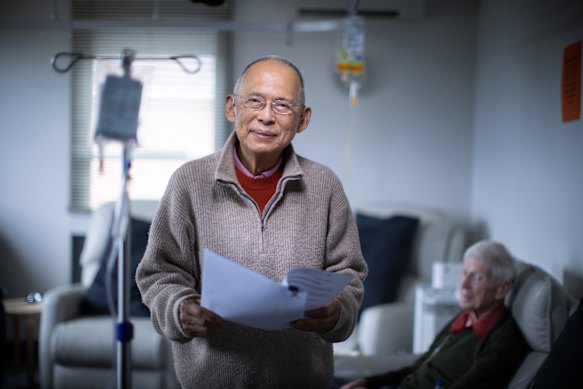
Eng and a patient receiving a curcumin infusion.Credit: Simon Schluter
“It is so unfair,” said Christine Richards, a patient of Eng’s, a former Law Reform Commissioner and the previous mayor of Frankston.
“The Medical Board is taking away patients’ choice and slam-dunking Peter because he doesn’t fit into the normal way GPs operate.”
But Professor David Vaux, one of the country’s leading cancer researchers and an honorary fellow of the Walter and Eliza Hall Institute, queried the efficacy of the treatments offered by Eng.
“If there was evidence, then it would become accepted standard medical practice,” he said.
Vaux said it was important that alternative treatments did not divert patients from conventional cancer treatments.
“The other thing to consider is raising false expectations,” he said.
One of the costly parts of Eng’s regimen is what is commonly known as the “Greek test”, which aims to identify and analyse cancer cells in a patient’s blood to determine a personalised treatment. But oncologists have raised concerns about the test’s accuracy.
Speaking to The Age, Eng said all his treatments were backed by research, and he rejected the complaints made to AHPRA.
He said he had been investigated by AHPRA at least nine times over the past two decades.
The Medical Board has previously determined that he has the necessary knowledge and skills to practise safely.
Eng said he refused to provide the first patient with the mistletoe injection she had requested because she wanted her husband to administer it remotely at their home in regional Victoria.
“I explained that you can have anaphylaxis and that it had to be done in my surgery,” he said, noting that the infusions are expensive because many have to be imported from overseas and attract no government subsidies.
Loading
Eng said he now worried what the sanctions meant for his patients, and what would happen to them when the scripts for their treatment ran out in December.
“How do I say, ‘Go and die?’ I’m traumatised by that,” he said.
Eng said he works in collaboration with oncologists to optimise patients’ response to conventional treatments.
He said the majority of his patients had received a stage 4 cancer diagnosis, and some had been told by their oncologists that they could provide no further treatment due to the severity of their disease.
Integrative medicine combines conventional medical treatment with complementary treatments that are considered safe and effective. These complementary treatments might include supplements and nutritional advice.
An independent opinion report commissioned by AHPRA raised concerns about Eng’s informed consent process, prescribing of mistletoe, communication with patients and other treating practitioners, and treatment costs.
“He considers your fees excessive,” AHPRA said of the opinion report, which was written by a prominent cancer expert.
“He further suggests that you are in effect acting as agent for products (Bob Harrison Pharmacy and the RGGC testing) and considered it difficult to justify the fees for such products given the uncertain evidence of their efficacy or validity.”
Eng has suggested a doctor to supervise him who has experience in integrative medicine but said the Medical Board of Australia had knocked back his request. Now, his concern is that it could take more than a year for authorities to agree on a suitable doctor to supervise him.
The Morning Edition newsletter is our guide to the day’s most important and interesting stories, analysis and insights. Sign up here.