3 months ago
42
3 months ago
42
From top to bottom, these are the moments the 2026 Melbourne grand slam will be remembered for.
Australian Open with 4K on Stan Sport.
Every match, live & on demand.
A: World No.1 Carlos Alcaraz arrived in Melbourne chasing a career Grand Slam again, but having never advanced beyond the quarter-finals previously. The Spaniard put that history behind with a scintillating fortnight. Alcaraz won his first 17 sets, including the opening two of his semi-final, before having to recover from 3-5 down in the fifth set. He would be a tennis great if his career ended now, but he’s only 22, so there is so much more to come.
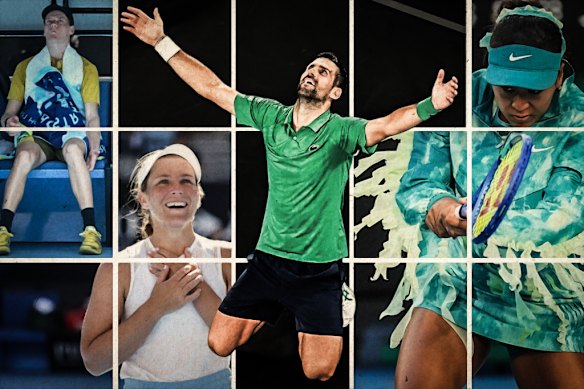
Jannik Sinner cramped, Maddy Inglis had a fairytale run, Novak Djokovic defied his age and Naomi Osaka dressed like a jellyfish.Credit: Artwork: Marija Ercegovac
B: Players from Novak Djokovic to Mirra Andreeva and Yulia Putintseva all copped boos during the tournament. Djokovic became agitated midway through his third-round clash after chair umpire John Blom “politely” asked fans to not distract the players. The former world No.1 marched towards Blom and said: “After two-and-a-half hours, you can’t be polite. You have to take a stand.” The crowd instantly and loudly booed Djokovic.
C: Cramping. Jannik Sinner had a lucky escape while besieged by heat-related stress when a timely break in play to close the roof enabled him to make it past American Eliot Spizzirri. But it was Alcaraz’s cramping episode in the semi-finals, particularly the loophole that enabled him to undergo a medical timeout, that enraged Alexander Zverev.
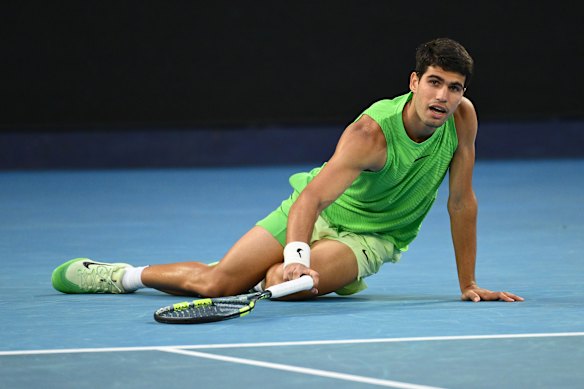
Alcaraz cramped, but prevailed.Credit: Getty Images
Alcaraz says he wasn’t initially certain he was suffering cramps, which resulted in the trainer assessing and massaging him, but it became obvious this was a classic case of cramps. Alcaraz, of course, rebounded to win in five sets, another pickle juice triumph.
D: The last Australian standing in the singles was again “Demon”, Alex de Minaur, who was in outstanding – perhaps, career-best – form on his way to booking back-to-back quarter-finals at his home slam. The problem was de Minaur ran into world No.1 Alcaraz, and that is where his run ended, but not before a captivating first set where he had his chances. He did us proud.
E: Elena Rybakina’s re-emergence, capped by her maiden Australian Open title on Saturday night after winning the WTA Tour finals in November, is great for the game. The Russian-born Kazakh recovered from 0-3 in the final set to exact revenge against Aryna Sabalenka for the 2023 final. Rybakina returns to No.3 in the world on Monday, and could be about to shake up the Sabalenka-Swiatek duopoly.
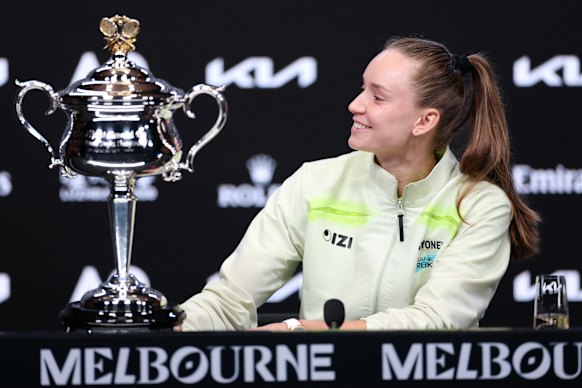
Rybakina with the Daphne Akhurst Trophy.Credit: Getty Images
F: There were a record 35 five-setters two years ago, and another 29 last year, but that number was only 22 entering men’s final day. In fact, no men’s matches went the distance on Rod Laver Arena until an epic men’s semi-final day, when two classic matches lasted a combined almost 10 hours before Alcaraz and Djokovic defeated over Zverev and Sinner, respectively. Neither clash will be forgotten anytime soon.
G: This is for Australia’s back-to-back mixed doubles champions, Olivia Gadecki and John Peers, who has long been one of the best doubles players going around. They had to do it the hard way in the final, pipping French pair Kristina Mladenovic and Manuel Guinard 4-6, 6-3, [10-8] in a match tiebreak to secure the title.
H: Melbourne’s weather was fickle as always, and the tournament ended on a cold note, but there were some seriously hot days throughout — none more so than the Tuesday of the second week, when the temperature in the city peaked at 42.7 degrees.
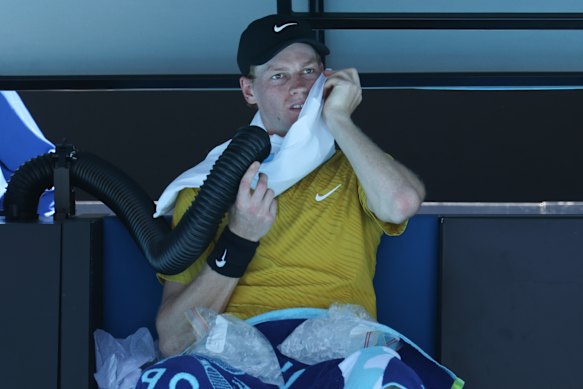
World No.2 Jannik Sinner struggled through the heat on Saturday, when temperatures in Melbourne approached 40 degrees.Credit: Getty Images
The AO’s five-level heat stress scale was enacted, meaning play on the outside courts was stopped for hours, and the roof was shut on courts that had one.
I: World No.168 Maddison Inglis was this year’s fairytale Australian story, surprising everyone – including herself – by storming from qualifying to the fourth round. She saved match points just to survive her first-round qualifying match, then won epic three-setters over close friend Kim Birrell and German veteran Laura Siegemund. Inglis was then the beneficiary of a Naomi Osaka walkover into the last 16, where Swiatek knocked her out. But that earned her a $480,000 payday. Inglis’ fiance, Jason Kubler, also reached the men’s doubles final with fellow Aussie Marc Polmans.
J: Stars are often born at the Australian Open, and this year’s event might be remembered as 18-year-old American Iva Jovic’s first major splash. Jovic enjoyed a terrific summer, making the Auckland semi-finals then the Hobart final before making it all the way to the quarters in Melbourne. The sky is the limit for this prodigy.
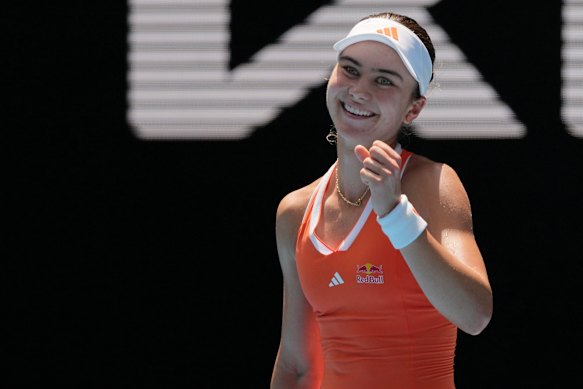
Iva Jovic is through to the Australian Open quarter-finals.Credit: AP
K: The Special Ks – Nick Kyrgios and Thanasi Kokkinakis – both opted not to play singles, and their doubles involvement ended in the first round to eventual finalists, Jason Kubler and Marc Polmans. The future is unclear for Kyrgios and Kokkinakis, who have struggled with various injuries that required surgeries, including the latter’s revolutionary pectoral cadaver graft.
L: American Learner Tien backed up his fourth-round run last year with a quarter-final showing, including eliminating Daniil Medvedev again – and this time, comfortably. Tien took a set from Zverev in the last eight, and good judges believe he is already one of the best baseliners on tour. The next generation looks promising, with former top juniors Rafael Jodar and Rei Sakamoto also illustrating that by qualifying then playing a marathon five-setter against each other in the first round.
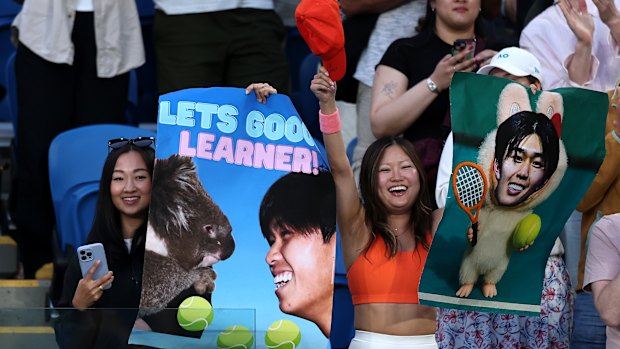
Lerner Tien is on the rise and has a cult following.Credit: Getty Images
M: Italian Lorenzo Musetti is the newest member of the top five, but had never made it past the third round at Melbourne Park in four previous visits. The 23-year-old improved that record drastically with an impressive run to the quarters, where he won the first two sets over Djokovic before retiring with what he believes is an adductor or hip flexor tear. It was brutal luck for one of the tour’s best talents.
N: Novak Djokovic somehow enhanced his extraordinary legacy with his mighty five-set semi-final boilover against two-time defending champion Sinner that ended close to 2am. It was an eventful fortnight for the 10-time champion. Musetti was two sets up on Djokovic before retiring hurt in their quarter-final. Should Tennis Australia erect a statue of Djokovic to recognise his unparalleled feats at Melbourne Park?
Loading
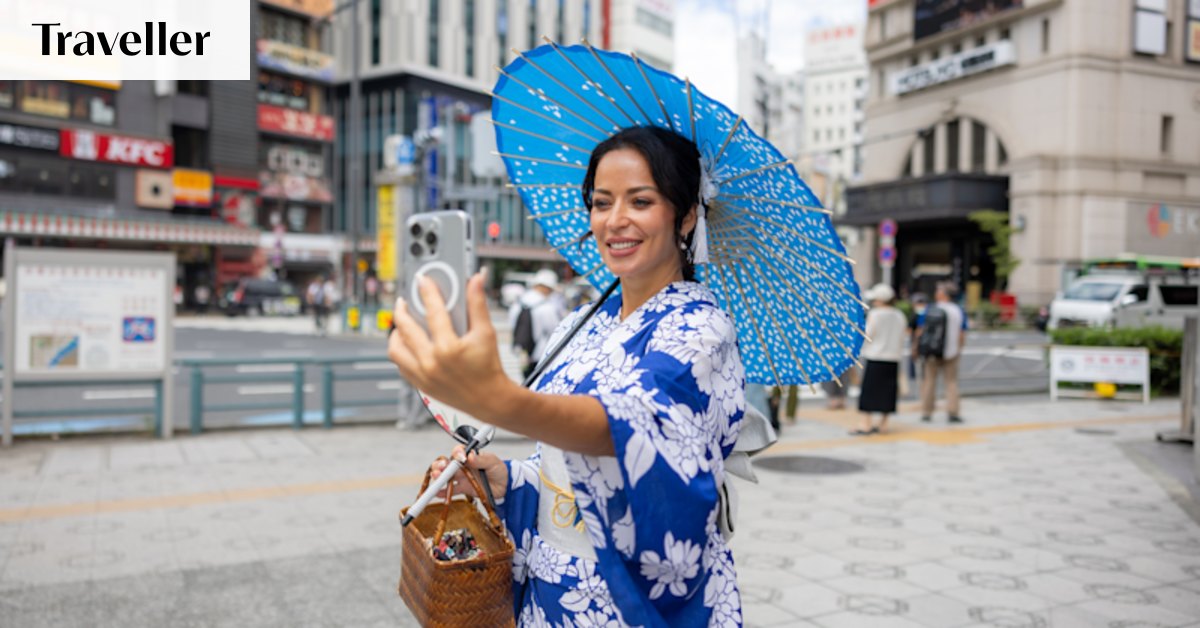
O: Dual women’s champion Naomi Osaka played only two matches at this year’s AO, but made as many headlines as anyone. It started with her bold entrance onto Rod Laver Arena in a jellyfish-inspired outfit, complete with white hat, veil and umbrella. Then she had a run-in with Sorana Cirstea a round later when the Romanian took exception to the Japanese superstar revving herself up between her opponent’s serves. Osaka withdrew before her third-round match against Inglis because of a persistent abdominal injury.
P: American Coco Gauff followed her error-strewn quarter-final exit at Elina Svitolina’s hands with a racquet-destroying rampage caught on camera in the bowels of Melbourne Park. Gauff was unimpressed when the moment went viral, questioning whether players had enough privacy.
Q: Epic queues marred the early rounds of the Open, with organisers underestimating Filipina Alexandra Eala’s cult-like following. Sale of ground passes was even temporarily paused, while tournament boss Craig Tiley opened a new entrance near Richmond station to help ease the gridlock. That sparked a debate about the event’s obsession with record crowd numbers and whether the fan experience was being compromised.
R: The Australian Open, which bills itself as more than just a tennis event, set another attendance record this year, with the cumulative three-week total already reaching 1,311,112 by Saturday night. That comfortably beats last year’s then-record of 1,218,831. Organisers might take aim at breaking the 1.5 million barrier next year..
Loading
S: Aryna Sabalenka has suffered back-to-back defeats in Australian Open finals after Saturday night’s loss to red-hot Elena Rybakina, and has now split her eight major finals. The world No.1 continues to reach the latter stages of slams, but won just one last year.
T: Is it 21 and out for tournament director Craig Tiley, who has served in the role since 2006? Tennis Australia’s chief executive has been linked to a move to the United States Tennis Association, but Tiley remains tight-lipped about the situation. He told this masthead on tournament eve: “I’ve read the speculation, I’ve seen the speculation, and I’m kind of not going to go there.” There should be clarity soon, but the jungle drums suggest he is off to the US after transforming the Melbourne major into a tennis-and-entertainment goliath.
U: Tennis has become synonymous with Russia’s invasion of, and ongoing war with, Ukraine. The skipped handshakes continue when Russian or Belarussian players face off with Ukrainians, to the extent that there was an announcement before the semi-final between Aryna Sabalenka and Elina Svitolina to inform the crowd there wouldn’t be one. Ukraine’s Oleksandra Oliynykova took aim at Sabalenka and co., saying they should be banned from competing.
V: The tournament needed a new villain after American Danielle Collins – who taunted Australian fans last year about her vast riches – announced she was skipping the 2026 event because of a back injury, and to complete her egg-freezing journey. Yulia Putintseva filled in admirably, dancing and holding a hand to her ear as jeers broke out in the pro-Turkey crowd after she beat Zeynep Sonmez.
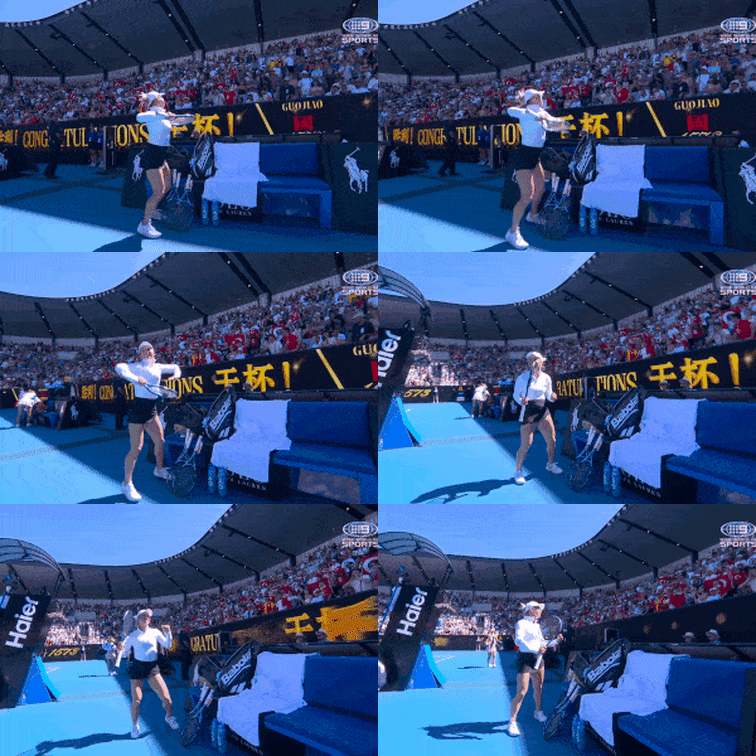
Yulia Putintseva dances after her win today.Credit: Nine
W: Who else but the “Stanimal”, Stan Wawrinka? Unlike fellow wildcard Venus Williams, whose involvement remains a bone of contention as a part-time player at best, retirement-bound Wawrinka, 40, earned his gift with a fantastic lead-up at the United Cup. The 2014 champion made it through to the round of 32, including winning a four-and-a-half-hour battle over Frenchman Arthur Gea, who is 19 years his junior. We’ll miss you, Stan.
X: China’s Wang Xinyu eliminated seeded rivals Jelena Ostapenko and Linda Noskova on her way to the last 16 of women’s singles, matching her career-best grand slam efforts at Wimbledon (2024) and the US Open (2023). She will be the No.2 Chinese woman when the rankings update.
Loading
Y: Nike did Sinner no favours with his mustard-coloured outfit – officially listed as olive flak – which was universally given a “yuck” rating. The running joke was this latest outfit completed Sinner’s Sauce Slam, based on the colours he wore at the majors across the years matching Heinz flavours.
Z: German Alexander Zverev leaves Melbourne unable to shake his tag as the best active player without a grand slam singles title. The world No.3 rallied from two sets down to be on the brink of semi-final victory over Carlos Alcaraz, only to collapse from 5-3 up in the final set. Zverev was surprisingly upbeat afterwards, but it must have hurt after battling for almost five-and-a-half hours.
Read more on the Australian Open
- Follow our live blog of the men’s final from 5pm
- Rybakina seals Australian Open redemption over Sabalenka in classic decider
- Why one smile makes Alcaraz the most dangerous man in tennis
Most Viewed in Sport
Loading